 Back
BackAlkynes: Structure, Properties, Nomenclature, and Reactions
Study Guide - Smart Notes
 Tailored notes based on your materials, expanded with key definitions, examples, and context.
Unit 9: Chapter 9 – Alkynes
9.1 Nomenclature of Alkynes
Alkynes are hydrocarbons containing at least one carbon–carbon triple bond. Their nomenclature follows IUPAC rules, similar to alkanes and alkenes, with specific modifications for the triple bond.
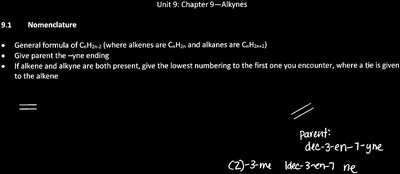
General Formula: $C_nH_{2n-2}$ (compare: alkenes $C_nH_{2n}$, alkanes $C_nH_{2n+2}$)
Parent Name: Use the longest carbon chain containing the triple bond and add the -yne suffix.
Numbering: Number the chain to give the triple bond the lowest possible number. If both double and triple bonds are present, the lowest number goes to the first multiple bond encountered; in a tie, the double bond takes priority.
Multiple Bonds: Indicate the position of the triple bond with a number.
Substituents: Name and number substituents as usual.
Examples: (E)-5-methyldec-5-en-2-yne

Physical Properties of Alkynes
Alkynes share several physical properties with alkanes and alkenes, but their triple bond imparts unique characteristics.
Low Density: Alkynes are less dense than water.
Low Water Solubility: Like other hydrocarbons, alkynes are generally insoluble in water due to their nonpolar nature.
1.9 Structure and Bonding in Alkynes: sp Hybridization
The carbon atoms in a triple bond are sp-hybridized, resulting in a linear geometry and unique bond properties.
Bond Angles: Alkynes have a linear shape with 180° bond angles.
Bond Strength and Length: The triple bond is shorter and stronger than a double bond (alkene).
9.7 Acidity of Acetylene and Terminal Alkynes
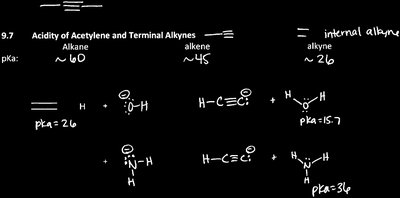
Terminal alkynes are significantly more acidic than alkanes and alkenes due to the high s-character of the sp-hybridized carbon.
pKa Values:
Alkane: ~60
Alkene: ~45
Alkyne: ~26
Terminal Alkynes: The hydrogen attached to the terminal carbon is relatively acidic and can be deprotonated by strong bases (e.g., NaNH2).
Internal Alkynes: Less acidic than terminal alkynes.
9.8 Preparation of Alkynes by Alkylation of Acetylene and Terminal Alkynes
Alkynes can be synthesized by alkylation, which involves the formation of new carbon–carbon bonds using acetylide anions.
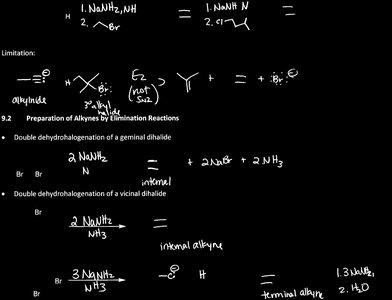
Alkylation Reaction: Terminal alkynes are deprotonated with a strong base (e.g., NaNH2) to form an acetylide ion, which then undergoes SN2 substitution with a primary alkyl halide.
Reagents: NaNH2 in liquid NH3

9.2 Preparation of Alkynes by Elimination Reactions
Alkynes can also be prepared by double dehydrohalogenation of dihalides (geminal or vicinal).
Geminal Dihalide: Both halogens on the same carbon.
Vicinal Dihalide: Halogens on adjacent carbons.
Reagents: Excess NaNH2 in NH3 removes two equivalents of HX, forming the alkyne.
9.5 Hydrogenation of Alkynes
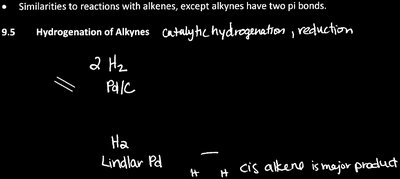
Alkynes can be reduced to alkanes or alkenes by catalytic hydrogenation. The choice of catalyst determines the product stereochemistry.
Complete Hydrogenation: Using Pd/C and H2 yields alkanes.
Partial Hydrogenation: Lindlar's catalyst (Pd/CaCO3 poisoned with Pb(OAc)2 and quinoline) produces cis-alkenes.
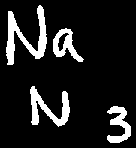
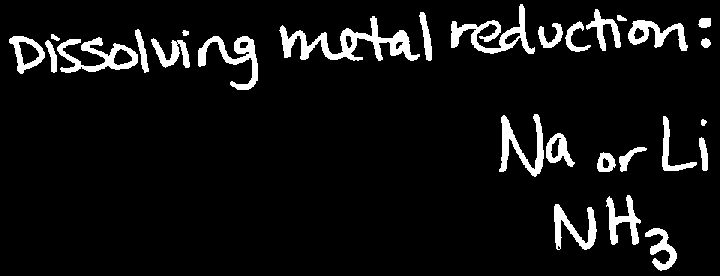
Dissolving Metal Reduction: Na or Li in liquid NH3 yields trans-alkenes.

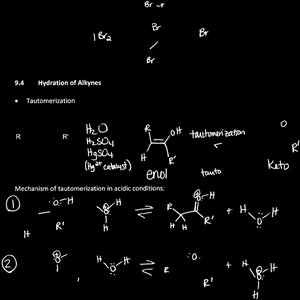
9.4 Hydration of Alkynes
Hydration of alkynes leads to the formation of enols, which rapidly tautomerize to ketones or aldehydes.
Reagents: H2O, H2SO4, HgSO4 (for terminal alkynes)
Mechanism: Acid-catalyzed addition of water forms an enol intermediate, which tautomerizes to a carbonyl compound (keto form).
Tautomerization: The process by which the enol and keto forms interconvert.

Reactions of Alkynes with Halogens and Hydrogen Halides
Alkynes react with halogens and hydrogen halides in a manner similar to alkenes, but with two equivalents possible due to the presence of two π bonds.
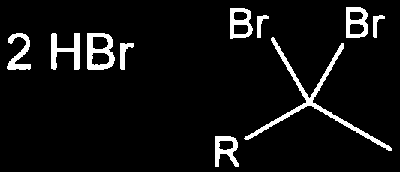
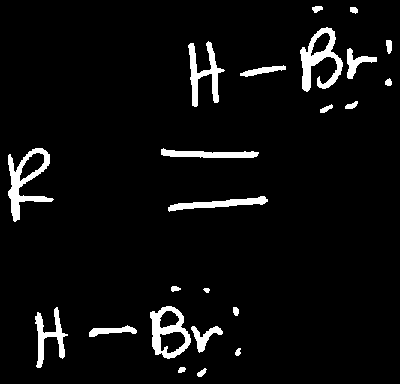
Addition of HX: Terminal alkynes react with two equivalents of HX to give geminal dihalides.
Addition of X2: Alkynes react with halogens to form tetrahalides.
Regioselectivity: Markovnikov's rule applies for unsymmetrical alkynes.

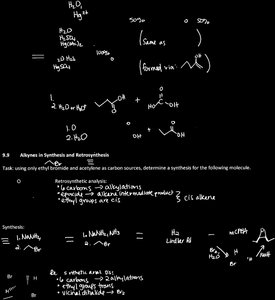
9.3 Alkynes in Synthesis and Retrosynthesis
Alkynes are valuable intermediates in organic synthesis, allowing for the construction of complex molecules through carbon–carbon bond formation and functional group transformations.
Retrosynthetic Analysis: Identify possible disconnections to form alkynes from simpler precursors (e.g., alkylation of acetylide anions, elimination from dihalides).
Synthetic Strategies: Use alkynes as intermediates for further functionalization, such as hydrogenation, hydration, or halogenation.
Summary Table: Acidity Comparison
Compound Type | pKa |
|---|---|
Alkane | ~60 |
Alkene | ~45 |
Alkyne (terminal) | ~26 |
Key Takeaways
Alkynes are hydrocarbons with a carbon–carbon triple bond and unique reactivity due to sp hybridization.
Terminal alkynes are more acidic than alkenes and alkanes, enabling unique synthetic transformations.
Preparation methods include alkylation of acetylide anions and elimination from dihalides.
Alkynes undergo addition, hydrogenation, and hydration reactions, with product outcomes dependent on reagents and conditions.
