 Back
BackAlkynes: Structure, Reactivity, and Synthetic Transformations
Study Guide - Smart Notes
 Tailored notes based on your materials, expanded with key definitions, examples, and context.
Alkynes
Nomenclature
Alkynes are hydrocarbons containing a carbon-carbon triple bond (C≡C). Their nomenclature follows IUPAC rules, with the suffix -yne indicating the presence of a triple bond. The parent chain must include the triple bond, and numbering is done to give the triple bond the lowest possible locant. The locant is assigned to the first carbon of the triple bond.
Terminal alkyne: The triple bond is at the end of the chain.
Internal alkyne: The triple bond is within the chain, not at the terminus.
Structural Features
Alkynes can be classified as terminal or internal based on the position of the triple bond. Terminal alkynes have a hydrogen atom attached to the triple-bonded carbon, while internal alkynes do not.
Terminal alkyne: R–C≡C–H
Internal alkyne: R–C≡C–R'
Alkyne Acidity
Acidic Properties of Terminal Alkynes
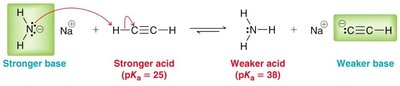
Terminal alkynes possess an acidic proton (pKa ≈ 25), which can be deprotonated by a strong base. The conjugate base formed is an alkynide ion. Only bases with conjugate acid pKa values greater than 25 (e.g., NH2⁻, pKa ≈ 38; RC⁻, pKa ≈ 50) are suitable for deprotonation.
Acidic proton: Present in terminal alkynes.
Strong base required: Water is not suitable as a solvent.
Preparation of Alkynes
Elimination Reactions
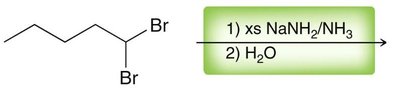
Alkynes can be synthesized by elimination reactions from dihalides. Geminal dihalides (two halides on the same carbon) and vicinal dihalides (halides on adjacent carbons) undergo E2 elimination with strong base to yield alkynes.
Internal alkynes: Elimination of geminal or vicinal dihalides.
Terminal alkynes: Requires a hydrogen on the geminal carbon; strong base deprotonates the terminal alkyne, and a weak proton source is used to protonate the alkynide ion.
Alkylation of Terminal Alkynes
Alkylation Mechanism
Terminal alkynes can be alkylated by first deprotonating with a strong base to form an alkynide ion, which then undergoes SN2 reaction with a methyl or primary alkyl halide. Secondary or tertiary alkyl halides typically lead to elimination rather than substitution.
Step 1: Deprotonation with strong base (e.g., NaNH2).
Step 2: SN2 reaction with alkyl halide.

Reduction of Alkynes
Hydrogenation
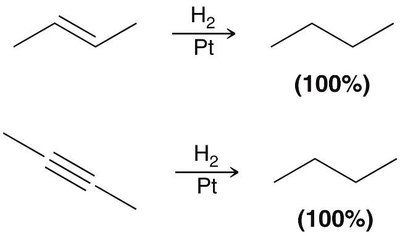
Alkynes can be reduced to alkenes or alkanes by hydrogenation. Complete hydrogenation with platinum (Pt) yields alkanes, while partial hydrogenation with a poisoned catalyst (e.g., Lindlar's catalyst) produces cis-alkenes.
Complete hydrogenation: Two equivalents of H2 convert alkyne to alkane.
Partial hydrogenation: Produces cis-alkene intermediate.

Lindlar's Catalyst
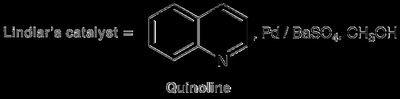
Lindlar's catalyst is a poisoned palladium catalyst used for selective hydrogenation of alkynes to cis-alkenes. It consists of Pd/BaSO4 and quinoline.
Dissolving Metal Reduction
Dissolving metal reduction (e.g., Na/NH3) converts alkynes to trans-alkenes via anti-addition. This method is useful for synthesizing trans-alkenes from alkynes.

Hydrohalogenation of Alkynes
Markovnikov and Anti-Markovnikov Addition
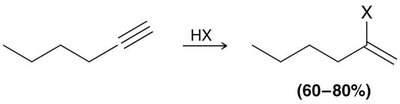
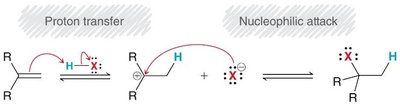
Alkynes react with hydrogen halides (HX) to form vinyl halides (1 equiv) or geminal dihalides (2 equiv). Markovnikov addition occurs in the absence of peroxides, while anti-Markovnikov addition is promoted by peroxides (ROOR).
Markovnikov addition: Halide adds to the more substituted carbon.
Anti-Markovnikov addition: Halide adds to the less substituted carbon.

Hydration of Alkynes
Acid-Catalyzed Hydration
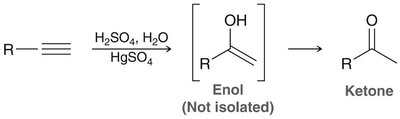
Alkynes undergo hydration to form enol intermediates, which tautomerize to ketones. Acid-catalyzed hydration (using HgSO4 or Hg(OAc)2) follows Markovnikov regiochemistry.
Enol intermediate: Not isolated; rapidly tautomerizes to ketone.
Regiochemistry: Markovnikov addition.
Hydroboration-Oxidation
Hydroboration-oxidation of alkynes gives anti-Markovnikov hydration products. The enol intermediate tautomerizes to a ketone (internal alkyne) or an aldehyde (terminal alkyne). Bulky borane reagents prevent multiple additions.
Reagents: BH3, THF; H2O2, NaOH; disiamylborane; 9-BBN.
Product: Ketone or aldehyde, depending on alkyne type.

Oxidative Cleavage of Alkynes
Ozonolysis and Permanganate Oxidation
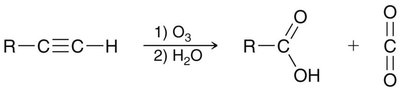
Oxidative cleavage of alkynes breaks the triple bond to yield carboxylic acids. Internal alkynes produce two carboxylic acids, while terminal alkynes yield one carboxylic acid and carbon dioxide. Ozonolysis (O3, H2O) and permanganate oxidation (KMnO4, NaOH, heat, H3O+) give similar products.
Internal alkyne: Two carboxylic acids.
Terminal alkyne: One carboxylic acid and CO2.

Synthesis and Retrosynthesis
Multi-Step Synthesis
Alkyne chemistry is central to organic synthesis, allowing for the construction of complex molecules via multi-step reactions. Key considerations include changes in the carbon skeleton and functional group transformations.
Carbon skeleton: Gain or loss of carbon atoms.
Functional group: Conversion and positional changes.
Example: Synthesis of 3-heptyne from acetylene involves alkylation and elimination steps.
Additional info: Alkynes are versatile intermediates in organic synthesis, enabling the formation of a wide range of functional groups and carbon frameworks.
