 Back
BackAllylic and Benzylic Reactivity: Carbocations, Radicals, Anions, and SN2 Reactions
Study Guide - Smart Notes
 Tailored notes based on your materials, expanded with key definitions, examples, and context.
Allylic and Benzylic Reactivity
Introduction
Allylic and benzylic positions in organic molecules are characterized by their proximity to double bonds (allylic) or aromatic rings (benzylic). These positions exhibit unique reactivity due to resonance stabilization, which influences the behavior of carbocations, radicals, anions, and the rates of substitution and elimination reactions.
Allylic and Benzylic Positions
Definitions and Structural Features
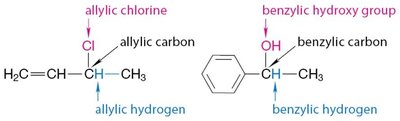
Allylic group: A group attached to a carbon atom adjacent to a carbon-carbon double bond.
Benzylic group: A group attached to a carbon atom adjacent to a benzene ring or substituted benzene ring.
These positions are unusually reactive, and certain reactions occur preferentially or exclusively at these sites.
Reactions Involving Allylic and Benzylic Carbocations
Resonance Stabilization of Carbocations
Carbocations at allylic and benzylic positions are stabilized by resonance, which delocalizes the positive charge over multiple atoms, lowering the energy of the intermediate and increasing reactivity.
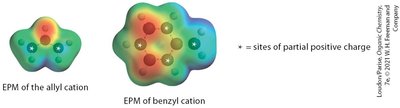
Allylic carbocation: The positive charge is delocalized over two terminal carbons.
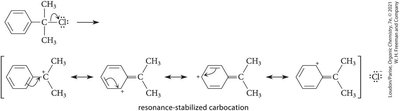
Benzylic carbocation: The positive charge is delocalized over the aromatic ring, resulting in several resonance structures.


MO Theory and Charge Distribution
Molecular orbital (MO) theory and electrostatic potential maps (EPM) confirm the delocalization of positive charge in allylic and benzylic carbocations, as predicted by resonance structures.
Comparison of Solvolysis Rates
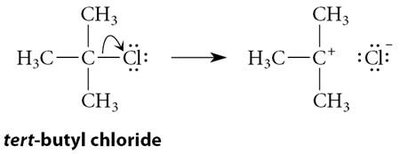
The enhanced stability of allylic and benzylic carbocations leads to much faster SN1 solvolysis rates for allylic and benzylic alkyl halides compared to non-allylic/non-benzylic analogs. This is due to the lower activation energy required to form the stabilized carbocation intermediate.
Alkyl Chloride | Relative Rate (SN1) |
|---|---|
tert-butyl chloride | 1.0 |
tert-cumyl chloride | 620 |
benzhydryl chloride | 200* |
trityl chloride | >600,000 |
*In 80% aqueous ethanol.
Effect of Electron-Donating Substituents
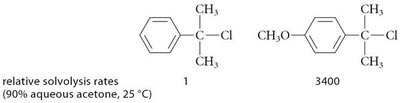
Electron-donating groups (EDGs), especially in the ortho or para positions on the aromatic ring, further stabilize benzylic carbocations and enhance reaction rates. For example, a para-methoxy group increases the solvolysis rate dramatically.
Delocalization Involving Heteroatoms
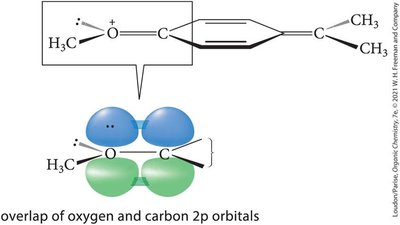
Delocalization of lone pairs from heteroatoms (such as oxygen) into the carbocation center further stabilizes the intermediate. This occurs via overlap of the oxygen 2p orbital with the carbon 2p orbitals of the carbocation.
Regioisomer Formation
For allylic carbocations, the positive charge is shared between two terminal carbons, allowing for the formation of regioisomeric products after reactions such as hydration.
For benzylic carbocations, regioisomer formation does not occur because only aromatic products are stable; non-aromatic products are not favored.
Reactions Involving Allylic and Benzylic Radicals
Resonance Stabilization of Radicals
Allylic and benzylic radicals are stabilized by resonance, similar to carbocations. The unpaired electron is delocalized over the π system, making these radicals more stable and easier to generate than non-allylic/non-benzylic radicals.


Bond Dissociation Energies
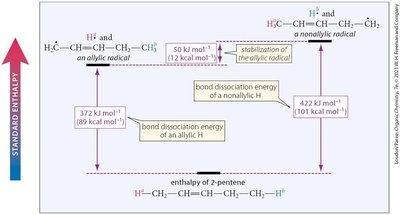
The bond dissociation energy (BDE) for removing an allylic or benzylic hydrogen is significantly lower than for non-allylic/non-benzylic hydrogens, reflecting the increased stability of the resulting radicals.
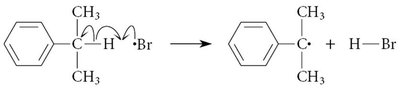
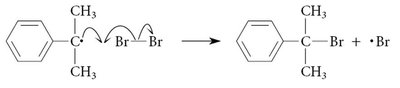
Generation of Benzylic and Allylic Radicals
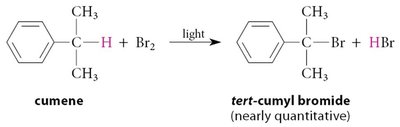
Benzylic hydrogens are readily abstracted during radical halogenation reactions, such as bromination with Br2 under light.
Allylic Halogenation and Competing Reactions
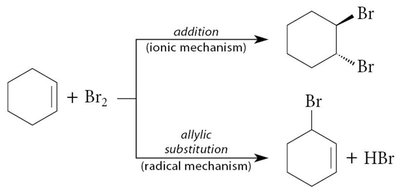
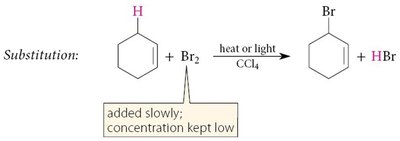
Allylic halogenation can occur via radical substitution, but addition to the double bond is a competing reaction. Careful control of reaction conditions is required to favor substitution over addition.

N-Bromosuccinimide (NBS) in Allylic and Benzylic Bromination
NBS is a reagent that allows for controlled, low-concentration bromination at allylic and benzylic positions, minimizing unwanted addition reactions.
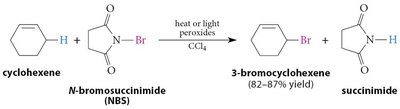
Mechanism of NBS Bromination
Initiation: Homolytic cleavage of the N–Br bond generates a bromine atom.
Propagation: (1) Bromine atom abstracts an allylic hydrogen, (2) HBr reacts with NBS to produce Br2, (3) Allylic radical reacts with Br2 to form the brominated product.


Reactions Involving Allylic and Benzylic Anions
Resonance Stabilization of Anions
Allylic and benzylic anions are stabilized by resonance, which delocalizes the negative charge over the π system. This stabilization is reflected in their lower pKa values compared to non-allylic/non-benzylic analogs.
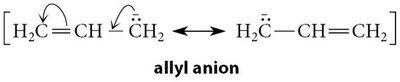

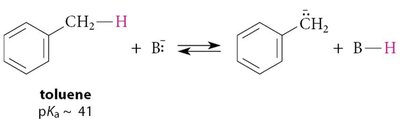
pKa Values and Acidity
The enhanced stability of allylic and benzylic anions is reflected in their pKa values. For example, the pKa of propene is ~43, and that of toluene is ~41, both much lower than ordinary alkanes (pKa ~55).

Allylic Grignard Reagents and Rearrangement
Grignard reagents formed from allylic halides exhibit rapid equilibration, with the MgBr group moving between two partially negative carbons. This is an example of allylic rearrangement, where two distinct structures are in equilibrium (not resonance structures).
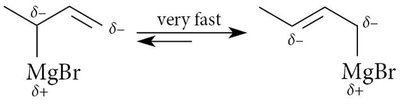
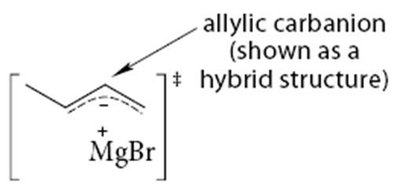
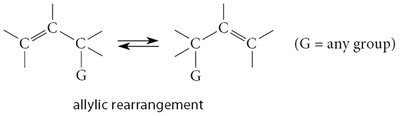
Formation of Grignard Reagents from Different Alkyl Halides
Different, but related, alkyl halides can produce the same Grignard reagent due to allylic rearrangement.
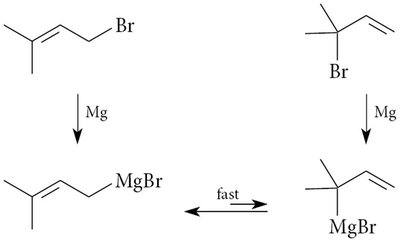
Product Mixtures from Unsymmetrical Allylic Grignard Reagents
Unsymmetrical allylic Grignard reagents produce a mixture of products, regardless of which alkyl halide is used to form the reagent.
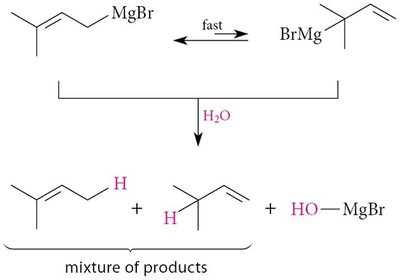
Elimination and Substitution at Allylic and Benzylic Positions
E2 Eliminations
E2 elimination reactions are favored over SN2 at allylic and benzylic positions due to the stabilization of the developing carbanion character in the transition state. Factors favoring elimination include branching at the α- or β-carbon and greater acidity of β-hydrogens.

Summary of Factors Favoring E2 over SN2
Branching at the α-carbon
Branching at the β-carbon
Greater acidity of β-hydrogens
SN2 Reactions at Allylic and Benzylic Positions
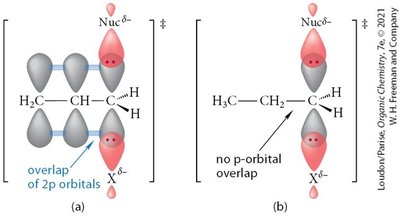
SN2 reactions are also enhanced at allylic and benzylic positions due to stabilization in the transition state, often attributed to overlap of 2p orbitals.



Transition State Stabilization in SN2 Reactions
The rate enhancement in SN2 reactions at allylic and benzylic positions is credited to stabilization in the transition state, where p-orbital overlap allows for delocalization of charge.
Additional info: This summary omits allylic and benzylic oxidation and biosynthesis of terpenes and steroids, as directed by the source material. All images included are directly relevant to the explanations provided and reinforce key mechanistic and structural concepts.
