 Back
BackAmino Acids, Peptide Synthesis, and Carbohydrate Mechanisms: Mini-Study Guide
Study Guide - Smart Notes
 Tailored notes based on your materials, expanded with key definitions, examples, and context.
Amino Acids and Peptide Synthesis
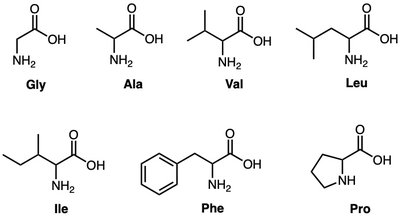
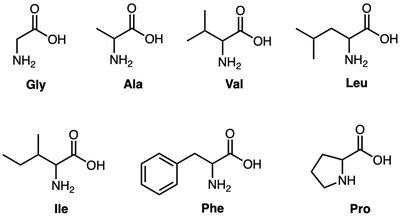
Structures and Properties of Common Amino Acids
Amino acids are the building blocks of proteins and peptides. Each amino acid contains an amino group (–NH2), a carboxylic acid group (–COOH), a hydrogen atom, and a unique side chain (R group) attached to a central (α) carbon.
Glycine (Gly): The simplest amino acid, with a hydrogen as its side chain.
Alanine (Ala): Has a methyl group as its side chain.
Valine (Val): Contains a branched isopropyl group.
Leucine (Leu): Has a larger, branched isobutyl side chain.
Isoleucine (Ile): Contains a sec-butyl side chain.
Phenylalanine (Phe): Contains a benzyl side chain (aromatic ring).
Proline (Pro): Unique due to its cyclic structure, where the side chain forms a ring with the amino group.
Peptide Bond Formation: Synthesis of Tripeptides
Peptides are formed by linking amino acids via peptide bonds (amide bonds). The synthesis of a tripeptide such as Ala-Gly-Val involves sequential condensation reactions between the carboxyl group of one amino acid and the amino group of another, releasing water.
Step 1: Protect the amino and carboxyl groups not involved in the bond formation to prevent side reactions.
Step 2: Couple the first two amino acids (e.g., Ala and Gly) using a coupling reagent (such as DCC or EDC) to form a dipeptide.
Step 3: Deprotect the terminal group and couple the third amino acid (Val) to form the tripeptide.
General Reaction:
Example: Synthesis of Ala-Gly-Val from the individual amino acids using protecting groups and coupling reagents.
Carbohydrate Structure and Mechanisms
Fischer and Haworth Projections
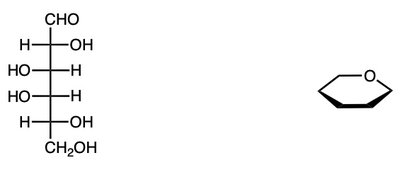
Carbohydrates can be represented in two main ways: Fischer projections (linear form) and Haworth projections (cyclic form). These representations help visualize stereochemistry and ring formation in sugars.
Fischer Projection: A two-dimensional representation showing the configuration of each chiral center in the sugar.
Haworth Projection: A cyclic representation, commonly used for five- and six-membered rings (furanoses and pyranoses).
Example: Glucose can cyclize to form a six-membered ring (pyranose) via hemiacetal formation between the aldehyde and a hydroxyl group.
Hemiacetal and Acetal Mechanisms in Carbohydrates
Carbohydrates can interconvert between linear and cyclic forms through hemiacetal (or hemiketal) formation. The mechanism involves nucleophilic attack of a hydroxyl group on the carbonyl carbon, forming a new ring structure.
Hemiacetal Formation: Aldehyde + Alcohol → Hemiacetal
Acetal Formation: Hemiacetal + Alcohol → Acetal (requires acid catalyst)
Ring-Chain Equilibrium: In aqueous solution, monosaccharides exist in equilibrium between their linear and cyclic forms.
Example: Glucose forms a cyclic hemiacetal (pyranose) in solution.
Epimerization Mechanism
Epimerization is the process by which one stereocenter in a sugar is inverted, converting one epimer to another. This can occur enzymatically or under basic conditions via enolate intermediates.
Epimers: Stereoisomers differing at only one chiral center (e.g., glucose and mannose).
Mechanism: Involves deprotonation to form an enolate, followed by reprotonation from the opposite face.
Oxidation and Reduction of Carbohydrates
Carbohydrates can undergo oxidation (to form acids) and reduction (to form sugar alcohols). These reactions are important in metabolism and analytical chemistry.
Oxidation: Aldoses can be oxidized to aldonic acids (e.g., glucose to gluconic acid).
Reduction: Carbonyl groups can be reduced to alcohols (e.g., glucose to sorbitol).
Additional Notes
When drawing mechanisms, always consider the equilibrium between ring and linear forms for carbohydrates.
In amino acid synthesis and peptide coupling, protecting groups are essential to control selectivity.
Watch out for acetals in carbohydrate chemistry, as they are key intermediates in glycoside formation.
