 Back
BackAmino Acids, Peptide Synthesis, and Carbohydrate Mechanisms: Mini-Textbook Study Notes
Study Guide - Smart Notes
 Tailored notes based on your materials, expanded with key definitions, examples, and context.
Amino Acids and Peptide Synthesis
Structures and Properties of Common Amino Acids
Amino acids are the building blocks of proteins, each containing an amino group, a carboxylic acid group, and a unique side chain (R group). The structure and properties of amino acids determine the characteristics of peptides and proteins.
Glycine (Gly): The simplest amino acid with a hydrogen side chain.
Alanine (Ala): Contains a methyl side chain.
Valine (Val): Has a branched isopropyl side chain.
Leucine (Leu): Features a larger, branched isobutyl side chain.
Isoleucine (Ile): Contains a sec-butyl side chain.
Phenylalanine (Phe): Has a benzyl aromatic side chain.
Proline (Pro): Unique cyclic structure, side chain forms a ring with the amino group.
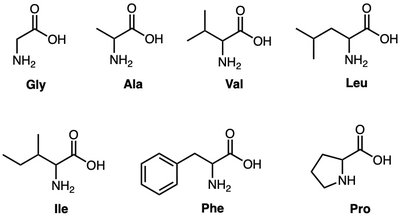
Example: The structures above show the backbone and side chains of several common amino acids, which are essential for peptide synthesis and protein structure.
Peptide Synthesis: Ala-Gly-Val
Peptides are formed by linking amino acids via peptide bonds (amide bonds) between the carboxyl group of one amino acid and the amino group of another. The synthesis of a tripeptide such as Ala-Gly-Val involves sequential coupling of the amino acids in the correct order.
Step 1: Protect the amino and carboxyl groups not involved in the bond formation to prevent side reactions.
Step 2: Activate the carboxyl group of the first amino acid (e.g., Ala) for nucleophilic attack by the amino group of the second amino acid (Gly).
Step 3: Couple the resulting dipeptide (Ala-Gly) with the third amino acid (Val) using similar protection and activation strategies.
Equation:
Example: The synthesis of Ala-Gly-Val from the individual amino acids requires careful protection and deprotection steps to ensure correct sequence formation.
Carbohydrate Structure and Mechanisms
Fischer and Haworth Projections
Carbohydrates can be represented in two main ways: Fischer projections (linear form) and Haworth projections (cyclic form). These representations help visualize stereochemistry and ring formation in sugars.
Fischer Projection: A two-dimensional representation showing the configuration of each chiral center in the sugar.
Haworth Projection: A cyclic representation, commonly used for five- and six-membered ring forms of sugars.
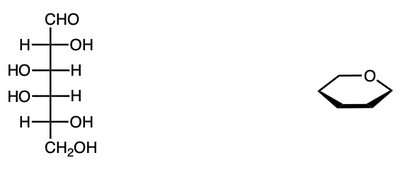
Example: The image above shows a Fischer projection of a hexose sugar (left) and a Haworth projection of a six-membered pyranose ring (right).
Carbohydrate Mechanisms: Hemiacetal/Acetal Formation, Epimerization, and Redox Reactions
Carbohydrates undergo several important reactions, including ring formation (hemiacetal/acetal), epimerization, and oxidation/reduction.
Hemiacetal/Acetal Formation: The linear form of an aldose or ketose can cyclize to form a hemiacetal (or hemiketal), which can further react to form an acetal (glycosidic bond in disaccharides).
Epimerization: The process by which one stereocenter in a sugar is inverted, converting one epimer to another (e.g., glucose to mannose).
Oxidation/Reduction: Aldoses can be oxidized to aldonic acids or reduced to alditols. These reactions are important in carbohydrate metabolism and analysis.
Ring-Chain Equilibrium: Carbohydrates exist in equilibrium between their linear and cyclic forms in solution.
Acetals: Formation of acetals is important in the structure of disaccharides and polysaccharides.
Example: The conversion of glucose from its linear Fischer projection to a cyclic Haworth projection involves the formation of a hemiacetal at the anomeric carbon.
Additional Mechanistic Examples
Deuterium-Labeled Compounds and Stereochemistry
Organic molecules can be labeled with isotopes such as deuterium (D) to study reaction mechanisms and stereochemistry. The configuration of chiral centers and the position of substituents (e.g., Br, D) are important for understanding reaction outcomes.
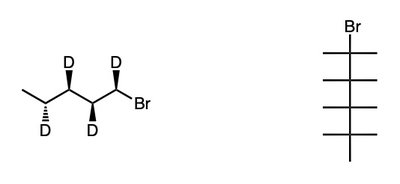
Example: The image above shows a deuterium-labeled compound with multiple stereocenters and a bromine substituent, useful for mechanistic studies in organic chemistry.
Summary Table: Key Reactions and Representations
Topic | Main Concept | Example/Application |
|---|---|---|
Amino Acid Structure | Side chain variation determines properties | Glycine (H), Alanine (CH3), Valine (isopropyl) |
Peptide Synthesis | Sequential coupling with protection/deprotection | Ala-Gly-Val tripeptide |
Carbohydrate Projections | Fischer (linear) vs. Haworth (cyclic) | Glucose Fischer and Haworth forms |
Hemiacetal/Acetal Formation | Ring formation in sugars | Glucose cyclization |
Epimerization | Inversion at one stereocenter | Glucose to mannose |
Oxidation/Reduction | Redox reactions of sugars | Aldose to aldonic acid |
