 Back
BackAnalyzing Reaction Stability and Spontaneity Using Energy Diagrams
Study Guide - Smart Notes
 Tailored notes based on your materials, expanded with key definitions, examples, and context.
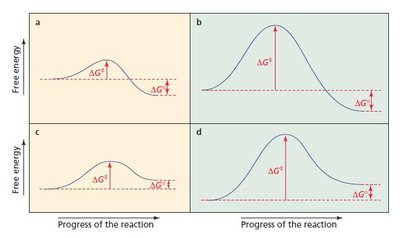
Q3. Which of the following reactions:
A) The most kinetically stable? Explain.
B) Thermodynamically and kinetically unstable? Explain.
C) Thermodynamically stable and kinetically unstable? Explain.
D) Thermodynamically and kinetically stable? Explain.
E) Spontaneous? Explain.
F) Not spontaneous? Explain.
G) Can occur at low temperatures? Explain.
H) Can only occur at high temperatures? Explain.
Background
Topic: Reaction Thermodynamics and Kinetics
This question is testing your understanding of the difference between kinetic and thermodynamic stability, as well as the concepts of spontaneity and temperature dependence in chemical reactions. You are expected to interpret reaction coordinate diagrams and relate them to reaction properties.
Key Terms and Formulas
Kinetic Stability: Refers to how slow a reaction is (high activation energy, ).
Thermodynamic Stability: Refers to how favorable the products are compared to reactants (negative ).
Spontaneity: A reaction is spontaneous if .
Activation Energy (): The energy barrier that must be overcome for the reaction to proceed.
Reaction Free Energy (): The difference in free energy between products and reactants.
Step-by-Step Guidance
Examine each reaction coordinate diagram (a, b, c, d) and identify the values of (activation energy) and (overall free energy change).
Recall that a high means the reaction is kinetically stable (slow to react), while a low $\Delta G^{\ddagger}$ means it is kinetically unstable (reacts quickly).
Recall that a negative means the reaction is thermodynamically favorable (products are more stable than reactants), while a positive $\Delta G^\circ$ means it is thermodynamically unfavorable.
For each part (A–H), match the description to the appropriate diagram by considering both and values. For example, the most kinetically stable reaction will have the highest $\Delta G^{\ddagger}$, and the most thermodynamically stable will have the most negative $\Delta G^\circ$.
For temperature dependence, remember that reactions with high activation energies may require higher temperatures to proceed at a reasonable rate.
Try solving on your own before revealing the answer!
