 Back
BackAromatic Compounds and Aromaticity: Structure, Nomenclature, and Properties
Study Guide - Smart Notes
 Tailored notes based on your materials, expanded with key definitions, examples, and context.
Chapter 17: Aromatic Compounds and Aromaticity
Introduction to Aromatic Compounds
Aromatic compounds are a class of cyclic, planar molecules characterized by a high degree of stability due to electron delocalization. Benzene is the prototypical aromatic compound, and its unique properties have led to the development of specific rules and models to explain aromaticity.
Benzene: Structure and Models
Kekulé Structure of Benzene
The first structure for benzene was proposed by August Kekulé in 1872, depicting alternating single and double bonds in a six-membered ring. However, this model did not account for benzene's unusual chemical reactivity and equal bond lengths.
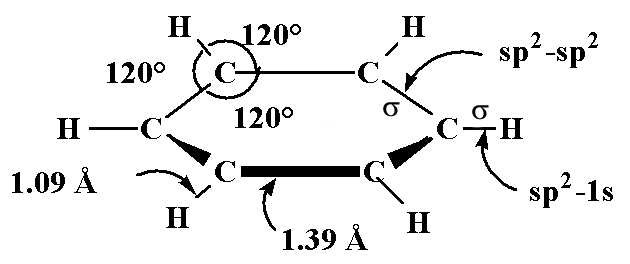
Planar hexagon: All carbon atoms are sp2 hybridized, forming a planar ring with 120° bond angles.
Bond lengths: All C–C bonds are equal (about 1.39 Å), intermediate between single and double bonds.
Reactivity: Benzene does not react like typical alkenes (e.g., does not decolorize Br2 without a catalyst).
Molecular Orbital (MO) Model of Benzene
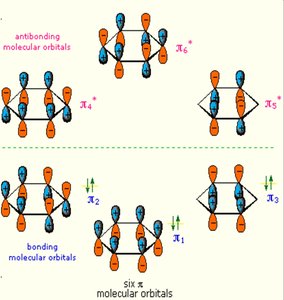
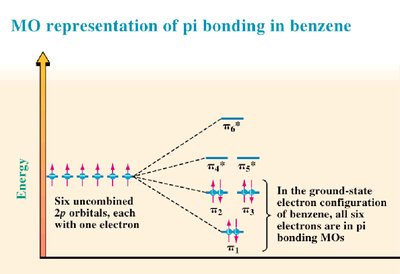
The MO model explains benzene's stability by the delocalization of six π electrons over six carbon atoms, forming a conjugated π system.
Six 2p orbitals combine to form six molecular orbitals: three bonding and three antibonding.
All six π electrons occupy the three bonding MOs, resulting in a stable, delocalized electron cloud above and below the ring.
Resonance Model of Benzene
Benzene is best represented as a resonance hybrid of two equivalent Kekulé structures, with delocalized electrons resulting in bond lengths and strengths intermediate between single and double bonds.
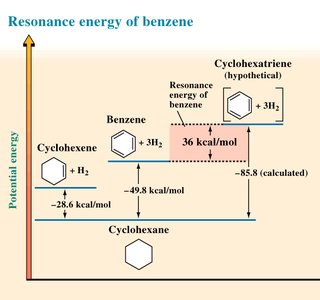
Resonance energy: The extra stability of benzene compared to hypothetical localized structures is called resonance energy (about 36 kcal/mol).
Heats of hydrogenation: Used to estimate resonance energy by comparing benzene to cyclohexene.
Concept of Aromaticity
Hückel's Rule and Criteria for Aromaticity
Hückel's rule provides the criteria for aromaticity based on molecular orbital theory:
Cyclic: The molecule must be cyclic.
Planar: The molecule must be planar or nearly planar.
Conjugated: There must be a continuous overlap of p orbitals (fully conjugated π system).
Electron count: The molecule must have a closed loop of (4n + 2) π electrons, where n is a non-negative integer (Hückel's rule).
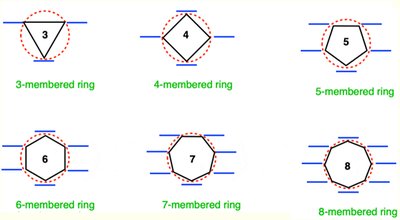
Frost Circles
The Frost circle method is a mnemonic for predicting the relative energies of π molecular orbitals in cyclic conjugated systems. Vertices below the center represent bonding orbitals, those above are antibonding, and those on the center are non-bonding.
Nomenclature of Aromatic Compounds
Monosubstituted Benzenes
Monosubstituted benzenes are named as derivatives of benzene. Some common names are retained (e.g., toluene, phenol, aniline).
Phenyl group (C6H5–): Benzene ring as a substituent.
Benzyl group (C6H5CH2–): Benzene ring attached via a methylene group.
Disubstituted and Polysubstituted Benzenes
For two or more substituents, use locants (numbers) or the prefixes ortho- (1,2-), meta- (1,3-), and para- (1,4-). If no group imparts a special name, list substituents alphabetically and assign the lowest possible numbers.
Polycyclic Aromatic Hydrocarbons (PAHs)
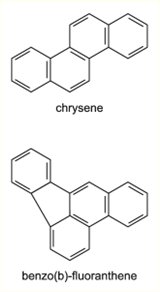
PAHs contain multiple fused benzene rings, such as naphthalene, anthracene, and phenanthrene. Their nomenclature follows specific conventions based on ring fusion and substituent positions.
Annulenes and Aromaticity
Annulenes
Annulenes are monocyclic hydrocarbons with alternating single and double bonds. Their aromaticity depends on planarity and the number of π electrons.
[10]Annulene: Has 10 π electrons (fits Hückel's rule), but is not planar due to steric hindrance, so it is not aromatic.
[14]Annulene and [18]Annulene: Both are planar and aromatic, satisfying Hückel's rule.
![[10]Annulene structure](https://static.studychannel.pearsonprd.tech/study_guide_files/organic-chemistry/sub_images/3b6cf9f8_image_17.png)
![[14]Annulene structure](https://static.studychannel.pearsonprd.tech/study_guide_files/organic-chemistry/sub_images/3b6cf9f8_image_18.png)
![[18]Annulene structure](https://static.studychannel.pearsonprd.tech/study_guide_files/organic-chemistry/sub_images/3b6cf9f8_image_20.png)
Antiaromatic and Nonaromatic Compounds
Antiaromaticity
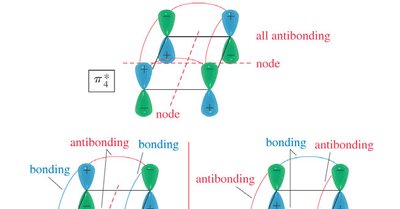
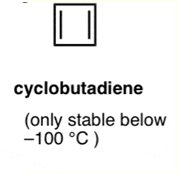
Antiaromatic compounds are cyclic, planar, fully conjugated systems with 4n π electrons. They are unusually unstable compared to open-chain analogs.
Cyclobutadiene: 4 π electrons, planar, antiaromatic, highly unstable.
Cyclooctatetraene: 8 π electrons, but adopts a non-planar (tub) conformation, so it is nonaromatic.
Heterocyclic Aromatic Compounds
Definition and Examples
Heterocyclic aromatic compounds contain at least one atom other than carbon in the ring. Common examples include pyridine, pyrrole, furan, and thiophene.
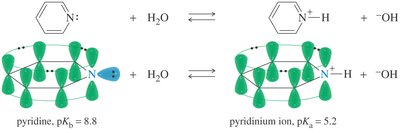
Pyridine: Nitrogen atom contributes one π electron; lone pair is in an sp2 orbital perpendicular to the π system.
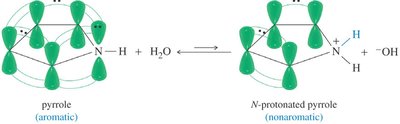
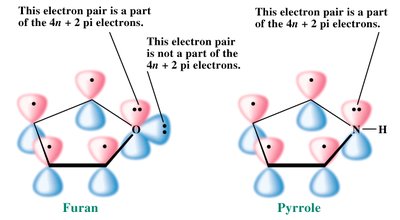
Pyrrole: Nitrogen's lone pair is part of the aromatic π system, making it a much weaker base than pyridine.
Furan: One lone pair on oxygen is part of the aromatic system; the other is not.
Aromatic Hydrocarbon Ions
Carbocation and Carbanion Aromaticity
Certain ions derived from cyclic hydrocarbons can be aromatic if they satisfy Hückel's rule and are planar and fully conjugated.
Cyclopropenyl cation: Aromatic (2 π electrons, n=0).
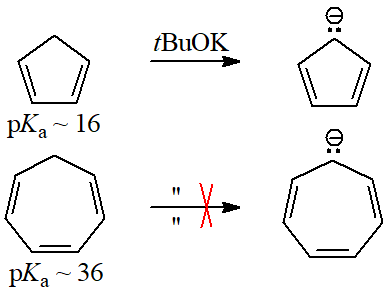
Cyclopentadienyl anion: Aromatic (6 π electrons, n=1).
Cycloheptatrienyl cation (tropylium ion): Aromatic (6 π electrons, n=1).
Spectroscopic Properties of Aromatic Compounds
NMR Spectroscopy
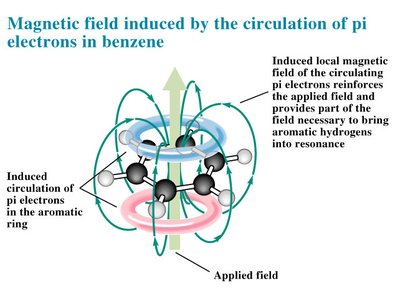
Hydrogens attached to aromatic rings appear in the region δ 6.5–8.5 in 1H NMR spectra, due to the ring current effect. 13C NMR signals for aromatic carbons appear at δ 120–150.
Ring current: Circulation of π electrons induces a magnetic field, shifting aromatic hydrogens downfield.
IR Spectroscopy
Aromatic compounds show characteristic absorptions in IR spectroscopy:
C=C stretch: Around 1600 cm−1.
sp2 C–H stretch: Just above 3000 cm−1.
