 Back
BackAromatic Compounds: Electrophilic Substitution and Reactivity (Chapter 15 Study Guide)
Study Guide - Smart Notes
 Tailored notes based on your materials, expanded with key definitions, examples, and context.
Reactions of Aromatic Compounds
Overview of Aromatic Electrophilic Substitution
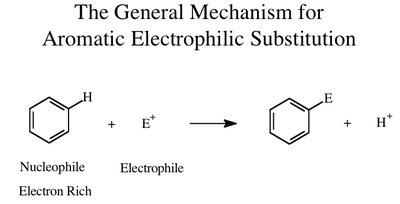
Aromatic compounds, such as benzene, undergo electrophilic substitution reactions where an electrophile replaces a hydrogen atom on the aromatic ring. The mechanism involves the generation of a reactive electrophile, which attacks the electron-rich aromatic ring, forming a resonance-stabilized intermediate.
Electrophilic substitution is the most common reaction for aromatic compounds.
Five basic reactions: Halogenation, Nitration, Sulfonation, Friedel-Crafts Alkylation, Friedel-Crafts Acylation.
Each reaction involves the formation of a specific electrophile.
General Mechanism and Energy Profile
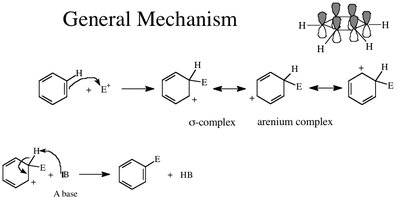
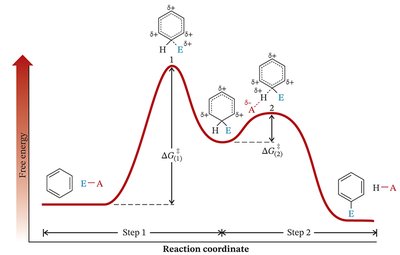
The general mechanism for aromatic electrophilic substitution consists of two main steps: formation of the arenium ion (σ-complex) and restoration of aromaticity by loss of a proton. The energy profile shows two transition states, with the formation of the arenium ion being the rate-determining step.
Step 1: Electrophile attacks the aromatic ring, forming a σ-complex.
Step 2: Loss of a proton restores aromaticity.
The intermediate is stabilized by resonance.
Types of Aromatic Electrophilic Substitution Reactions
Halogenation of Benzene
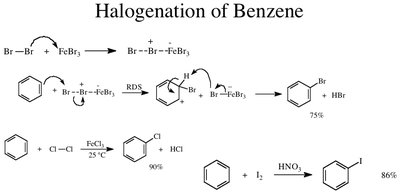
Halogenation introduces a halogen atom onto the aromatic ring. The reaction requires a Lewis acid catalyst (e.g., FeBr3 or FeCl3) to generate the halogen electrophile.
Electrophile: Br+ or Cl+
Mechanism: Formation of halogen cation, attack on benzene, loss of proton.
Products: Bromobenzene, chlorobenzene, etc.
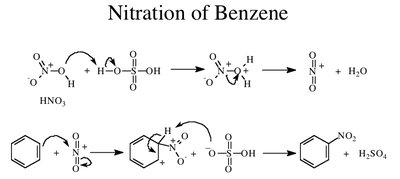
Nitration of Benzene
Nitration introduces a nitro group (-NO2) onto the aromatic ring. The reaction uses a mixture of concentrated nitric acid and sulfuric acid to generate the nitronium ion (NO2+).
Electrophile: NO2+ (nitronium ion)
Mechanism: Generation of NO2+, attack on benzene, loss of proton.
Product: Nitrobenzene
Sulfonation of Benzene
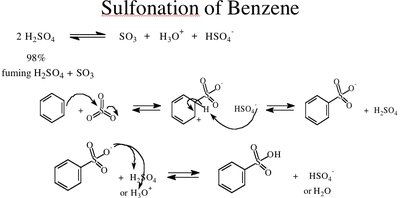
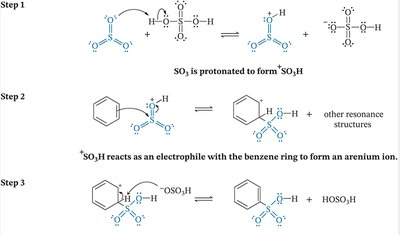
Sulfonation introduces a sulfonic acid group (-SO3H) onto the aromatic ring. The reaction uses fuming sulfuric acid (SO3 in H2SO4) to generate the electrophile.
Electrophile: SO3 or protonated SO3 (SO3H+)
Mechanism: Protonation of SO3, attack on benzene, loss of proton.
Product: Benzenesulfonic acid
Friedel-Crafts Alkylation
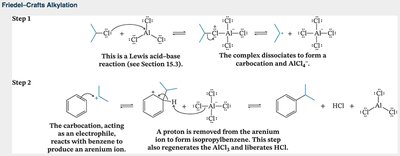
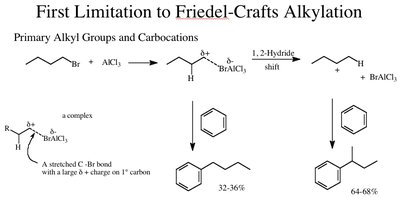
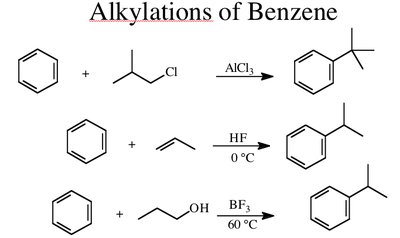
Friedel-Crafts alkylation introduces an alkyl group onto the aromatic ring using an alkyl halide and a Lewis acid catalyst (AlCl3). The reaction proceeds via carbocation formation.
Electrophile: Alkyl carbocation
Mechanism: Formation of carbocation, attack on benzene, loss of proton.
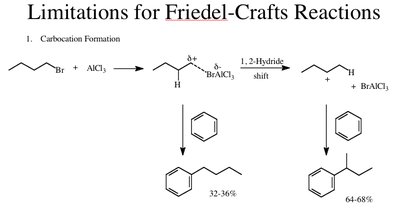
Limitations: Carbocation rearrangements, polyalkylation, unreactive organohalides.
Friedel-Crafts Acylation
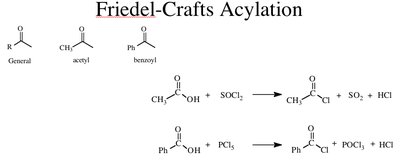
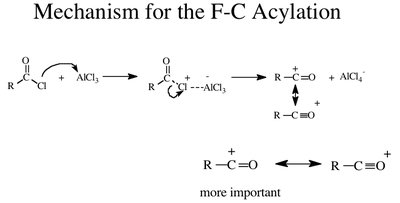
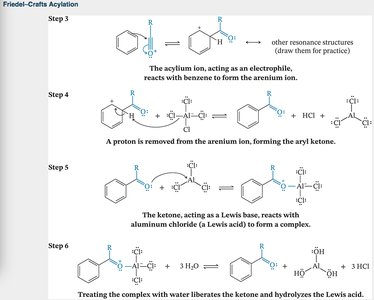
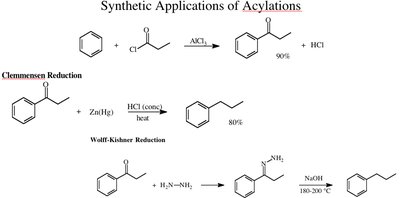
Friedel-Crafts acylation introduces an acyl group onto the aromatic ring using an acyl chloride and AlCl3. The reaction forms an acylium ion as the electrophile.
Electrophile: Acylium ion (R-C≡O+)
Mechanism: Formation of acylium ion, attack on benzene, loss of proton.
Advantages: No polyacylation, no carbocation rearrangement.
Limitations and Synthetic Applications
Limitations of Friedel-Crafts Reactions
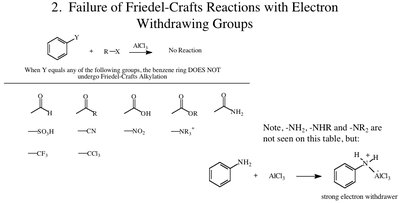
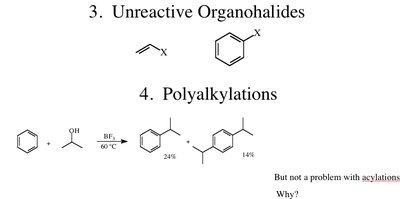
Friedel-Crafts reactions are limited by carbocation rearrangements, failure with electron-withdrawing groups, unreactive organohalides, and polyalkylation.
Carbocation rearrangement: Primary alkyl halides may rearrange to more stable carbocations.
Electron-withdrawing groups: Benzene rings with strong electron-withdrawing substituents do not react.
Unreactive organohalides: Vinyl and aryl halides are unreactive.
Polyalkylation: Multiple alkylations can occur, but not a problem with acylations.

Synthetic Applications: Reduction of Aryl Acyl Compounds
Acylated aromatic compounds can be reduced to alkylbenzenes using Clemmensen or Wolff-Kishner reductions.
Clemmensen reduction: Zn(Hg) and HCl (heat) reduce aryl ketones to alkanes.
Wolff-Kishner reduction: Hydrazine and base (NaOH, heat) reduce aryl ketones to alkanes.
Substituent Effects: Reactivity and Orientation
Activators and Deactivators
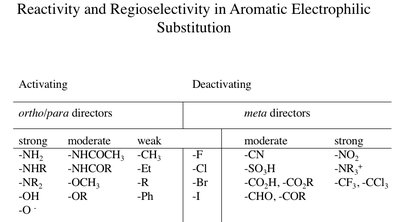
Substituents on the aromatic ring affect both the rate and orientation of electrophilic substitution. Activators increase reactivity and direct substitution to ortho/para positions, while deactivators decrease reactivity and direct substitution to the meta position.
Activators: Electron-donating groups (e.g., -OH, -OCH3, -NH2)
Deactivators: Electron-withdrawing groups (e.g., -NO2, -COOH, -SO3H)
Halogens: Deactivate but are ortho/para directors due to resonance.
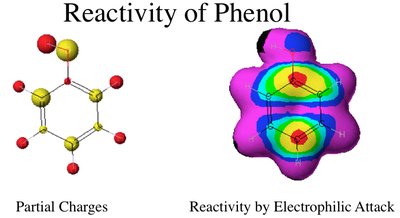
Reactivity of Phenol and Nitrobenzene
Phenol is highly reactive due to electron donation from the hydroxyl group, while nitrobenzene is much less reactive due to electron withdrawal by the nitro group.
Phenol: Activates the ring, increases rate of substitution.
Nitrobenzene: Deactivates the ring, decreases rate of substitution.
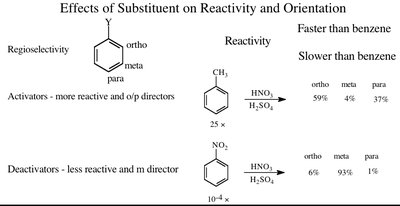
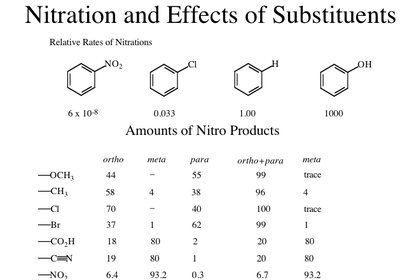
Nitration and Effects of Substituents
The rate and orientation of nitration are strongly influenced by substituents. Activators favor ortho/para products, while deactivators favor meta products.
Relative rates: Phenol >> benzene >> chlorobenzene >> nitrobenzene.
Product distribution: See table below for ortho/meta/para ratios.
Substituent | Ortho | Meta | Para | Ortho+Para | Meta |
|---|---|---|---|---|---|
OCH3 | 44 | 4 | 55 | 99 | trace |
CH3 | 58 | 4 | 38 | 96 | 4 |
Cl | 70 | - | 40 | 100 | trace |
Br | 37 | 1 | 62 | 99 | 1 |
CO2H | 18 | 80 | 2 | 20 | 80 |
CN | 18 | 80 | 2 | 20 | 80 |
NO2 | 6.4 | 93.2 | 0.3 | 6.7 | 93.2 |
Inductive and Resonance Effects
Inductive Effects
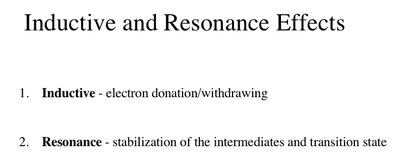
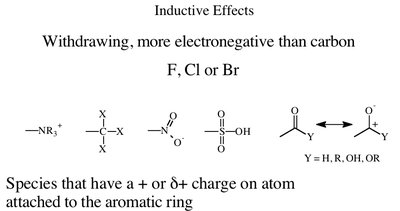
Inductive effects arise from electron donation or withdrawal through sigma bonds. Electronegative atoms (e.g., F, Cl, Br) withdraw electron density from the ring, decreasing reactivity.
Electron-withdrawing: F, Cl, Br, -NR3+, -COOH, -SO3H
Electron-donating: Alkyl groups, -OH, -OR
Resonance Effects
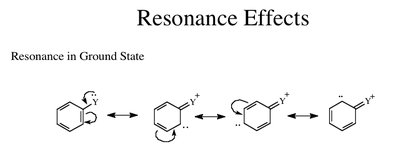
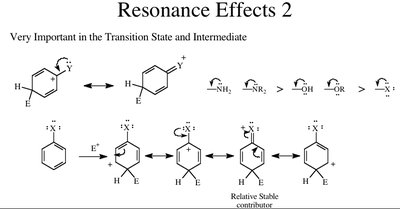
Resonance effects involve delocalization of electrons, stabilizing intermediates and transition states. Groups with lone pairs or π bonds can donate or withdraw electrons via resonance.
Electron-donating: -NH2, -OH, -OR
Electron-withdrawing: -NO2, -COOH
Activation and Deactivation
Activation/Deactivation of Aromatic Rings
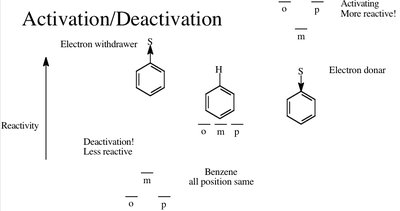
Substituents can activate or deactivate the aromatic ring, affecting both reactivity and orientation. Activators increase the rate of substitution and favor ortho/para positions, while deactivators decrease the rate and favor meta positions.
Activators: Electron donors (e.g., -OH, -NH2)
Deactivators: Electron withdrawers (e.g., -NO2, -COOH)
Reactivity of Halogens
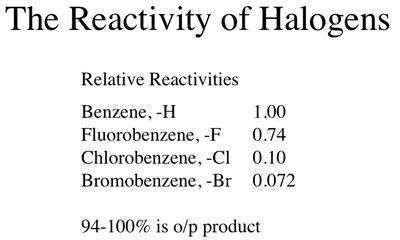
Halogens are unique: they deactivate the ring by induction but direct substitution to ortho/para positions by resonance.
Relative reactivity: Benzene > fluorobenzene > chlorobenzene > bromobenzene
94-100% of products are ortho/para.
Relative Rates of Aromatic Electrophilic Substitution
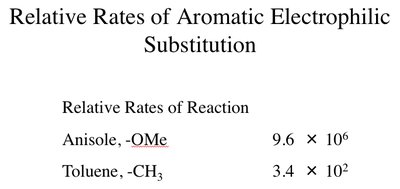
The rate of substitution varies widely depending on the substituent. Electron-donating groups greatly increase the rate, while electron-withdrawing groups decrease it.
Anisole (-OMe):
Toluene (-CH3):
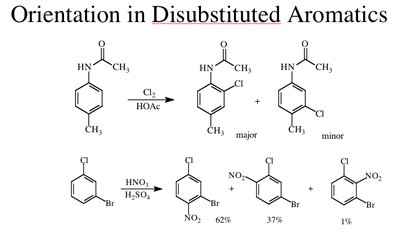
Orientation in Disubstituted Aromatics
Orientation Rules
When two substituents are present, their combined effects determine the orientation of further substitution. The more activating group usually dominates.
Major product: Substitution occurs at positions favored by the strongest activator.
Minor product: Substitution at less favored positions.
Reactivity at the Benzylic Position
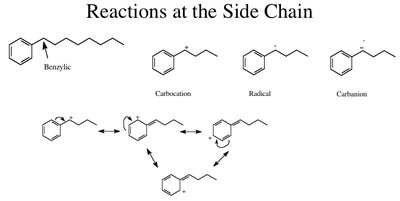
Benzylic Radicals and Carbocations
The benzylic position (adjacent to the aromatic ring) is highly reactive due to resonance stabilization. Benzylic radicals and carbocations are important intermediates in side-chain reactions.
Benzylic carbocation: Stabilized by resonance with the aromatic ring.
Benzylic radical: Also stabilized by resonance.
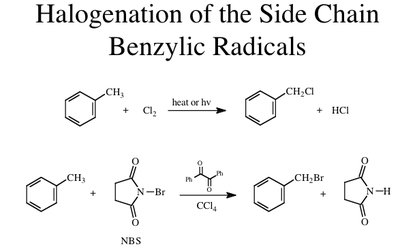
Halogenation of the Benzylic Position
Halogenation at the benzylic position can be achieved using Cl2 (heat or light) or NBS (N-bromosuccinimide) in CCl4. The reaction proceeds via radical intermediates.
Benzylic halogenation: Produces benzyl halides.
Conditions: Cl2 (heat/light), NBS (CCl4).
Stability of Benzylic Radicals
Benzylic radicals are more stable than alkyl radicals due to resonance stabilization. The bond dissociation energy (BDE) reflects this increased stability.
BDE (kcal/mol): Allylic (86), benzylic (88), tertiary (93), secondary (96), primary (100), methyl (105)
BDE (kJ/mol): Allylic (360), benzylic (368), tertiary (398), secondary (402), primary (418), methyl (439)
Additional info:
Inductive and resonance effects are critical for understanding substituent influence on aromatic reactivity.
Friedel-Crafts acylation avoids polyacylation due to the deactivating effect of the acyl group.
Clemmensen and Wolff-Kishner reductions are important for converting aryl ketones to alkanes.
