 Back
BackAromatic Electrophilic Substitution and Reactivity of Aromatic Compounds
Study Guide - Smart Notes
 Tailored notes based on your materials, expanded with key definitions, examples, and context.
Chapter 15: Reactions of Aromatic Compounds
Overview of Aromatic Electrophilic Substitution
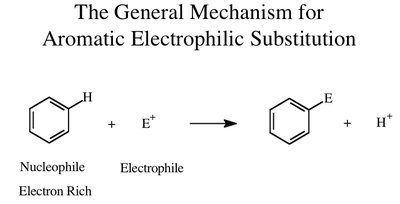
Aromatic compounds, such as benzene, undergo electrophilic substitution reactions, where an electrophile replaces a hydrogen atom on the aromatic ring. This process is fundamental in organic chemistry, enabling the functionalization of aromatic systems.
Electrophilic Substitution: The aromatic ring acts as a nucleophile, reacting with an electrophile (E+).
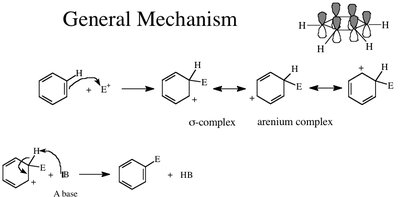
General Mechanism: Formation of a σ-complex (arenium ion), followed by deprotonation to restore aromaticity.
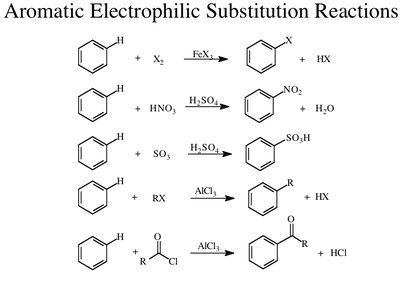
Key Reactions: Halogenation, Nitration, Sulfonation, Friedel-Crafts Alkylation, Friedel-Crafts Acylation.
Mechanistic Details
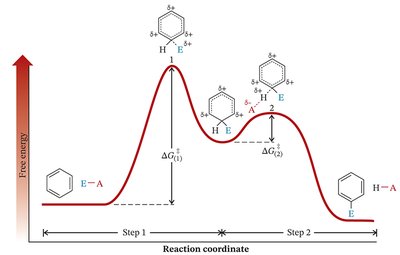
The mechanism involves two main steps: formation of the arenium ion and subsequent loss of a proton. The reaction profile shows two transition states, with the first step (formation of the σ-complex) being rate-determining.
Step 1: Electrophile attacks the aromatic ring, forming a σ-complex.
Step 2: Deprotonation restores aromaticity.
Energy Profile: The first transition state is higher in energy, corresponding to the formation of the arenium ion.
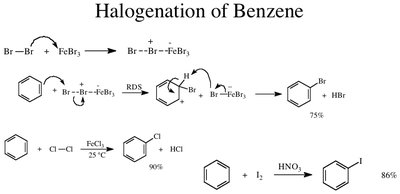
Halogenation of Benzene
Halogenation introduces a halogen atom onto the aromatic ring. The reaction requires a Lewis acid catalyst (e.g., FeBr3 or AlCl3) to generate the electrophilic halogen species.
Mechanism: Formation of Br+ or Cl+ via interaction with FeBr3 or AlCl3.
Products: Bromobenzene, chlorobenzene, or iodinated benzene.
Regioselectivity: Halogens are ortho/para directors but are deactivating.
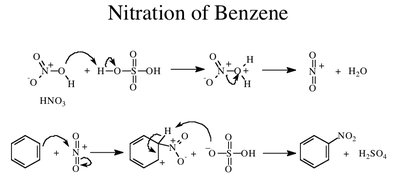
Nitration of Benzene
Nitration introduces a nitro group (NO2) onto the aromatic ring. The reaction uses a mixture of concentrated HNO3 and H2SO4 to generate the nitronium ion (NO2+).
Mechanism: Generation of NO2+ and its attack on benzene.
Product: Nitrobenzene.
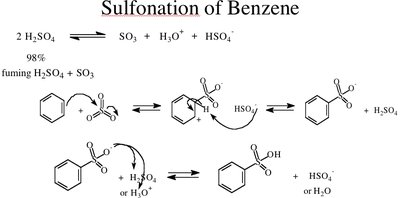
Sulfonation of Benzene
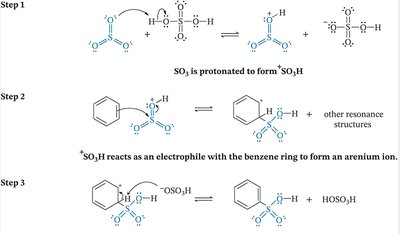
Sulfonation introduces a sulfonic acid group (SO3H) onto the aromatic ring. The reaction uses fuming sulfuric acid (H2SO4 + SO3).
Mechanism: Protonation of SO3 to form the electrophile, followed by attack on benzene.
Product: Benzenesulfonic acid.
Friedel-Crafts Alkylation
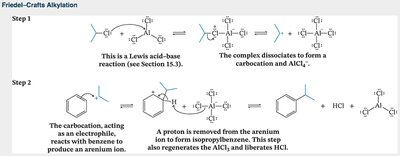
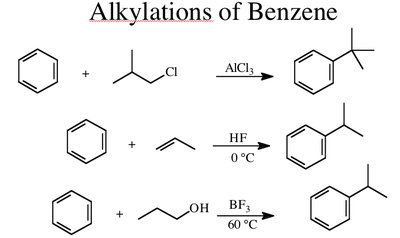
Friedel-Crafts alkylation introduces an alkyl group onto the aromatic ring using an alkyl halide and a Lewis acid catalyst (AlCl3). The reaction proceeds via carbocation formation.
Mechanism: Formation of carbocation, attack by benzene, and deprotonation.
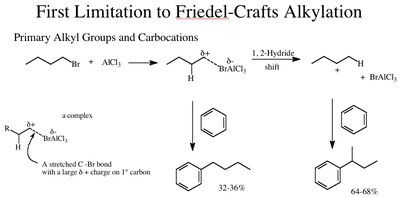
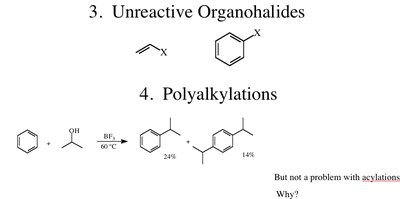
Limitations: Rearrangement of carbocations, polyalkylation, and failure with deactivated rings.
Friedel-Crafts Acylation
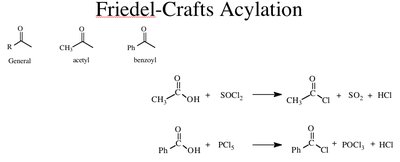
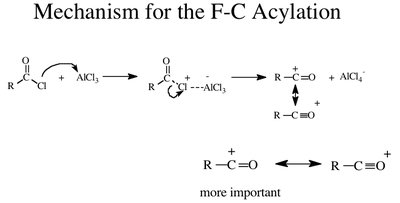
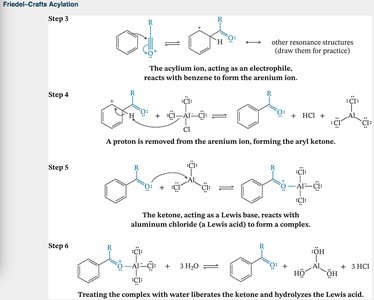
Friedel-Crafts acylation introduces an acyl group onto the aromatic ring using an acyl chloride and AlCl3. The reaction forms an acylium ion, which is stabilized by resonance.
Mechanism: Formation of acylium ion, attack by benzene, and deprotonation.
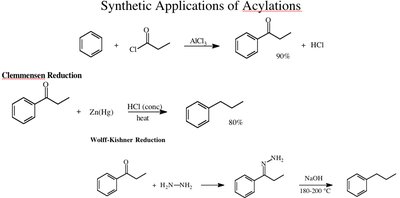
Advantages: No rearrangement, avoids polyacylation.
Limitations of Friedel-Crafts Reactions
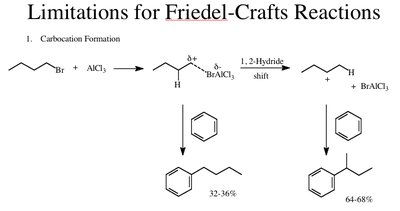
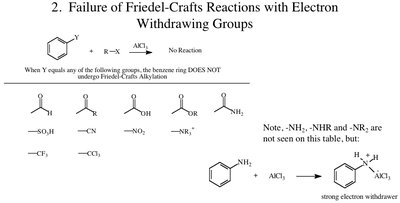
Several limitations affect Friedel-Crafts reactions, including carbocation rearrangement, failure with electron-withdrawing groups, unreactive organohalides, and polyalkylation.
Carbocation Rearrangement: Primary alkyl halides may rearrange to more stable carbocations.
Electron-Withdrawing Groups: Deactivated rings do not react.
Polyalkylation: Multiple alkylations can occur, but acylation avoids this issue.

Synthetic Applications: Reduction of Aryl Acyl Compounds
Acylated aromatic compounds can be reduced to alkylbenzenes using Clemmensen or Wolff-Kishner reductions.
Clemmensen Reduction: Zn(Hg) and HCl reduce aryl ketones to alkanes.
Wolff-Kishner Reduction: Hydrazine and base reduce aryl ketones to alkanes.
Effects of Substituents on Reactivity and Orientation
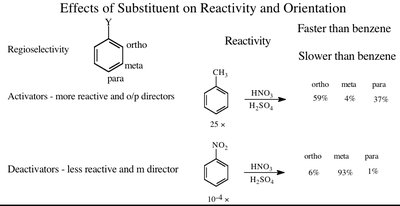
Substituents on the aromatic ring influence both the rate and regioselectivity of electrophilic substitution. Activators increase reactivity and direct substitution to ortho/para positions, while deactivators decrease reactivity and direct to meta positions.
Activators: Electron-donating groups (e.g., -OH, -NH2, -OCH3).
Deactivators: Electron-withdrawing groups (e.g., -NO2, -COOH, -SO3H).
Halogens: Special case; deactivating but ortho/para directing.
Reactivity of Phenol and Nitrobenzene
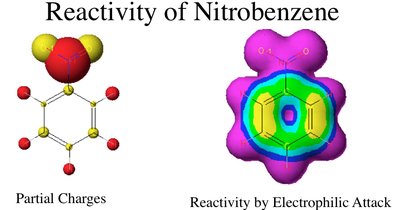
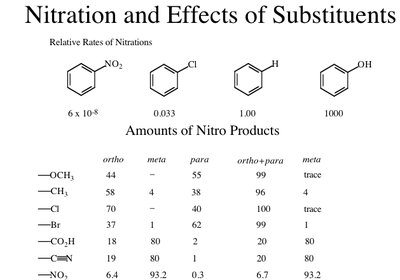
Phenol is highly reactive due to electron donation from the hydroxyl group, while nitrobenzene is much less reactive due to strong electron withdrawal by the nitro group.
Phenol: Activates the ring, increases electrophilic attack.
Nitrobenzene: Deactivates the ring, reduces electrophilic attack.
Nitration and Effects of Substituents
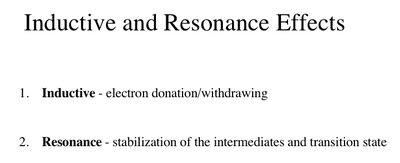
The rate and regioselectivity of nitration are strongly affected by substituents. Activators favor ortho/para products, while deactivators favor meta products.
Relative Rates: Substituents can increase or decrease the rate by several orders of magnitude.
Product Distribution: Quantitative data shows the influence of substituents on ortho, meta, and para product formation.
Inductive and Resonance Effects
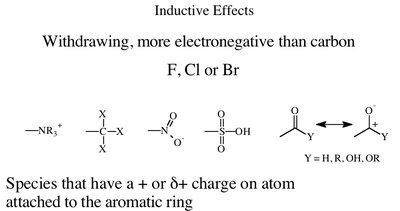
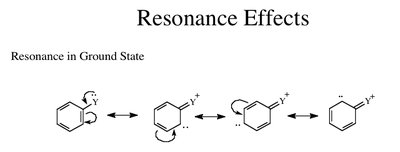
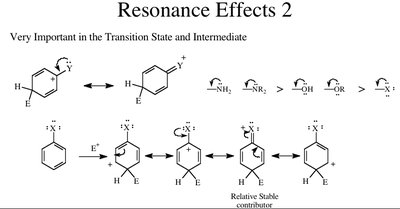
Substituent effects are explained by inductive and resonance contributions. Inductive effects involve electron donation or withdrawal through sigma bonds, while resonance effects involve delocalization of electrons.
Inductive: Electron-withdrawing groups (e.g., F, Cl, Br) decrease reactivity.
Resonance: Electron-donating groups stabilize intermediates and transition states.
Activation and Deactivation
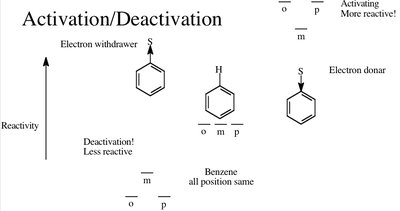
Activation increases the reactivity of the aromatic ring, while deactivation decreases it. The position of substitution (ortho, meta, para) is determined by the nature of the substituent.
Activating Groups: Direct to ortho/para positions.
Deactivating Groups: Direct to meta positions.
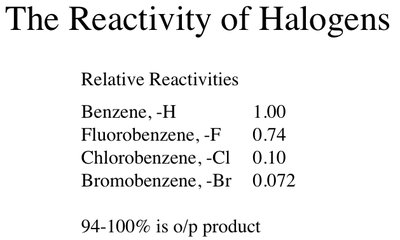
Reactivity of Halogens
Halogens are unique in aromatic substitution. They are deactivating due to their electronegativity but direct substitution to ortho/para positions.
Relative Reactivity: Fluorobenzene > Chlorobenzene > Bromobenzene.
Product Distribution: 94-100% ortho/para products.
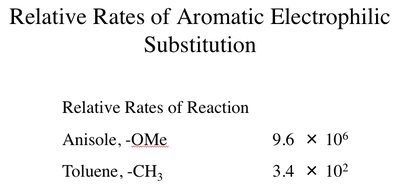
Relative Rates of Aromatic Electrophilic Substitution
The rate of substitution varies widely depending on the substituent. Anisole (methoxybenzene) reacts much faster than toluene (methylbenzene).
Anisole: 9.6 × 10⁶ times faster than benzene.
Toluene: 3.4 × 10² times faster than benzene.
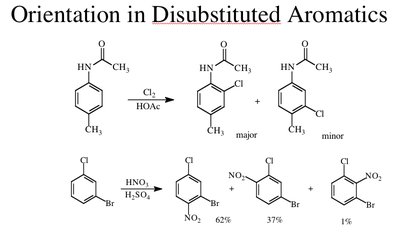
Orientation in Disubstituted Aromatics
When two substituents are present, their combined effects determine the orientation of further substitution. The more activating group usually dominates.
Major vs. Minor Products: Substitution occurs at positions favored by the strongest director.
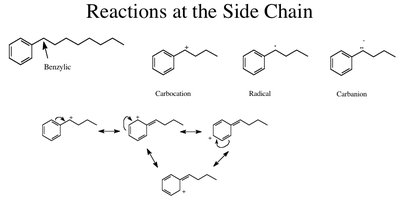
Reactions at the Benzylic Position
The benzylic position (adjacent to the aromatic ring) is highly reactive, especially towards radical and carbocation formation. This reactivity is exploited in various synthetic transformations.
Benzylic Radicals: Formed by halogenation or oxidation.
Benzylic Carbocations: Stabilized by resonance with the aromatic ring.
Halogenation of the Benzylic Position
Halogenation at the benzylic position is achieved using Cl2 or NBS (N-bromosuccinimide) under radical conditions. The reaction is highly selective for the benzylic hydrogen.
Conditions: Heat or light for Cl2; NBS in CCl4 for Br.
Products: Benzylic halides.
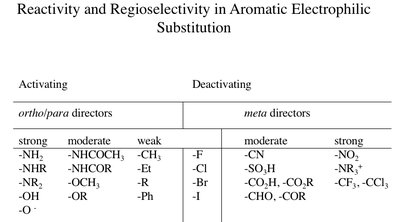
Summary Table: Reactivity and Regioselectivity in Aromatic Electrophilic Substitution
Activating (ortho/para directors) | Deactivating (meta directors) |
|---|---|
Strong: -NH2, -NHR, -NR2, -OH, -O- | Strong: -NO2, -NR3+, -CF3, -CCl3 |
Moderate: -NHCOCH3, -NHCOOR, -OCH3, -OR | Moderate: -CN, -SO3H, -COH, -COR |
Weak: -CH3, -Et, -R, -Ph, -I | Weak: -F, -Cl, -Br |
Additional info: These notes cover the fundamental concepts, mechanisms, and synthetic applications of aromatic electrophilic substitution, including the effects of substituents, limitations of Friedel-Crafts reactions, and reactivity at the benzylic position. The included images directly illustrate key mechanisms, reaction types, and tables for exam preparation.
