 Back
BackAromaticity and Reaction Mechanisms in Organic Chemistry
Study Guide - Smart Notes
 Tailored notes based on your materials, expanded with key definitions, examples, and context.
Q10. Label the structures below as aromatic (A), non-aromatic (NA), or antiaromatic (AA)
Background
Topic: Aromaticity, Non-aromaticity, and Antiaromaticity
This question tests your understanding of the rules that define aromatic, non-aromatic, and antiaromatic compounds. Recognizing these properties is crucial for predicting reactivity and stability in organic molecules.
Key Terms and Concepts:
Aromatic: A molecule is aromatic if it is cyclic, planar, fully conjugated (every atom in the ring has a p orbital), and follows Hückel's rule (4n+2 π electrons, where n is an integer).
Antiaromatic: A molecule is antiaromatic if it is cyclic, planar, fully conjugated, but has 4n π electrons (where n is an integer), making it especially unstable.
Non-aromatic: A molecule is non-aromatic if it does not meet the criteria for aromaticity or antiaromaticity (e.g., not fully conjugated, not planar, or not cyclic).
Hückel's Rule: π electrons = aromatic; π electrons = antiaromatic.
Step-by-Step Guidance
Examine each structure to determine if it is cyclic and planar. Only cyclic, planar molecules can be aromatic or antiaromatic.
Check if the molecule is fully conjugated (every atom in the ring has a p orbital or can participate in resonance).
Count the number of π electrons in the ring system. Remember to include lone pairs if they are delocalized into the ring.
Apply Hückel's rule: If the molecule has π electrons, it is aromatic. If it has π electrons, it is antiaromatic. If it does not fit either, it is non-aromatic.
For ions, consider the charge and how it affects the π electron count (e.g., a positive charge may remove electrons from the π system).
Try solving on your own before revealing the answer!
Final Answers:
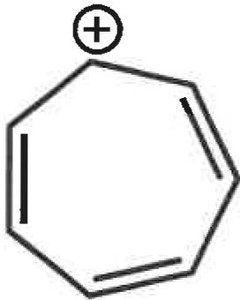
Cycloheptatrienyl cation (tropylium ion): Aromatic (A) – It is planar, fully conjugated, and has 6 π electrons ( in Hückel's rule).
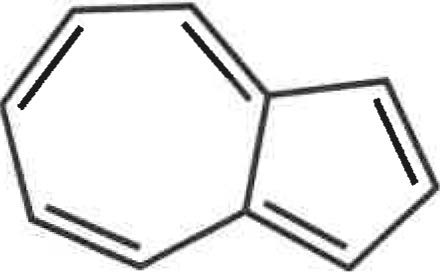
Indole structure: Aromatic (A) – Both rings together contribute to a conjugated system with 10 π electrons ( in Hückel's rule).
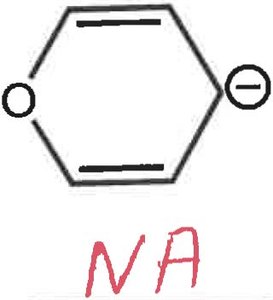
1,4-dihydroxybenzene dianion: Non-aromatic (NA) – The negative charges disrupt conjugation, so it is not aromatic.
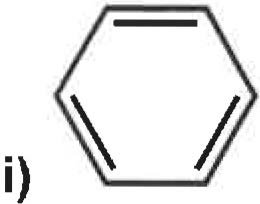
Benzene ring: Aromatic (A) – Classic example of an aromatic compound with 6 π electrons.
Each structure was analyzed for planarity, conjugation, and π electron count to determine its classification.
