 Back
BackAromaticity: Structure, Properties, and Reactivity
Study Guide - Smart Notes
 Tailored notes based on your materials, expanded with key definitions, examples, and context.
Aromaticity
Definition and Criteria
Aromaticity is a fundamental concept in organic chemistry describing the unique stability and reactivity of certain cyclic, planar molecules with delocalized π-electrons. Aromatic compounds must satisfy specific criteria known as Huckel's rule.
Huckel's Rule: A molecule is aromatic if it is cyclic, planar, fully conjugated, and contains 4n+2 π-electrons (where n is a non-negative integer).
Antiaromaticity: Compounds that are cyclic, planar, fully conjugated, but contain 4n π-electrons are antiaromatic and are destabilized.
Non-aromatic: Compounds that do not meet the above criteria (e.g., not planar or not fully conjugated) are non-aromatic.
Energy and Stability of Aromatic Compounds
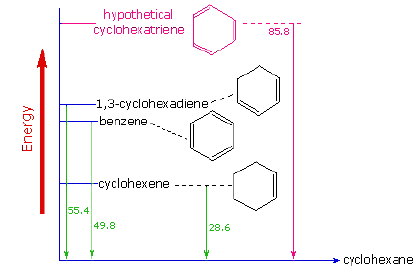
Aromatic compounds exhibit enhanced thermodynamic stability compared to non-aromatic analogs. This stability is reflected in their lower heats of hydrogenation and resistance to addition reactions.
Energy Diagram: Benzene is significantly more stable than hypothetical cyclohexatriene and other unsaturated cyclic compounds.
Heats of Hydrogenation: The heat released upon hydrogenation of benzene is much less than expected for a typical triene, indicating aromatic stabilization.
Molecular Orbital Theory of Aromaticity
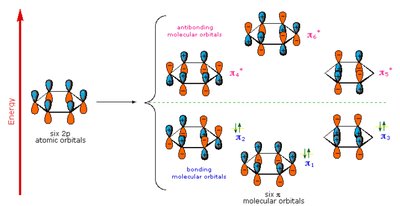
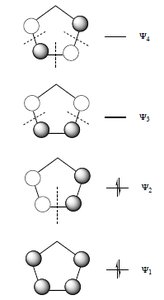
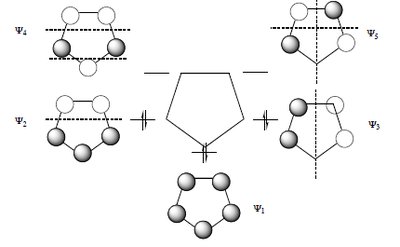
The stability of aromatic compounds is explained by molecular orbital theory. In benzene, six 2p atomic orbitals combine to form six π molecular orbitals, with the lowest energy orbitals fully occupied by electrons.
Bonding and Antibonding Orbitals: The bonding orbitals are filled, while the antibonding orbitals remain empty, resulting in a stable electronic configuration.
Delocalization: The π-electrons are delocalized over the entire ring, contributing to aromatic stability.
Polycyclic Aromatic Hydrocarbons
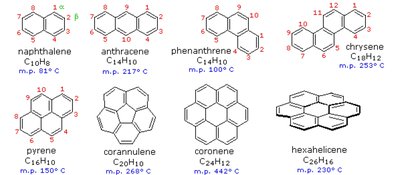
Polycyclic aromatic hydrocarbons (PAHs) are compounds containing multiple fused benzene rings. Their aromaticity and melting points vary depending on the number and arrangement of rings.
Examples: Naphthalene, anthracene, phenanthrene, chrysene, pyrene, corannulene, coronene, and hexahelicene.
Properties: PAHs exhibit high melting points and unique electronic properties due to extended conjugation.
Reactivity of Aromatic Compounds
Electrophilic Aromatic Substitution
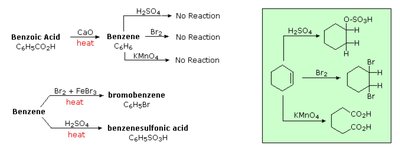
Aromatic compounds typically undergo substitution reactions rather than addition, preserving their aromaticity.
Bromination: Benzene reacts with Br2 in the presence of FeBr3 to form bromobenzene.
Sulfonation: Benzene reacts with H2SO4 to form benzenesulfonic acid.
Oxidation: Benzoic acid and benzene do not react with KMnO4 under certain conditions, highlighting their stability.
Comparison of Aromatic and Non-aromatic Compounds
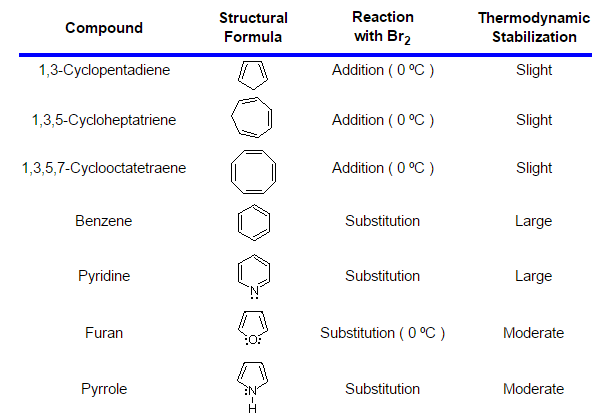
The reactivity and thermodynamic stabilization of aromatic compounds differ significantly from non-aromatic analogs.
Substitution vs. Addition: Aromatic compounds undergo substitution, while non-aromatic compounds undergo addition reactions with Br2.
Stabilization: Benzene and pyridine are highly stabilized, while cyclopentadiene and cycloheptatriene are only slightly stabilized.
Compound | Structural Formula | Reaction with Br2 | Thermodynamic Stabilization |
|---|---|---|---|
1,3-Cyclopentadiene | Five-membered ring with two double bonds | Addition (0°C) | Slight |
1,3,5-Cycloheptatriene | Seven-membered ring with three double bonds | Addition (0°C) | Slight |
1,3,5,7-Cyclooctatetraene | Eight-membered ring with four double bonds | Addition (0°C) | Slight |
Benzene | Six-membered ring with three double bonds | Substitution | Large |
Pyridine | Six-membered ring with one nitrogen | Substitution | Large |
Furan | Five-membered ring with one oxygen | Substitution (0°C) | Moderate |
Pyrrole | Five-membered ring with one nitrogen | Substitution | Moderate |
Annulenes and Aromaticity
Annulenes: Structure and Stability
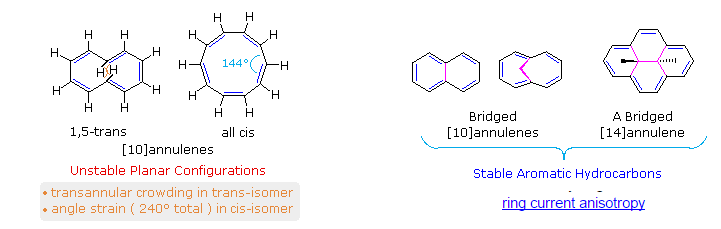
Annulenes are monocyclic hydrocarbons with alternating double and single bonds. Their aromaticity depends on planarity and the number of π-electrons.
[10]Annulene: Unstable due to transannular crowding and angle strain.
Bridged Annulenes: Bridged [10] and [14] annulenes are stable aromatic hydrocarbons due to enforced planarity and ring current anisotropy.
Non-planar and Planar Annulenes
Cyclooctatetraene: Adopts a tub conformation, is non-planar, and behaves like an alkene.
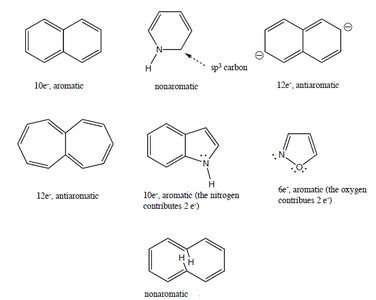
Pentalene and Heptalene: Planar, but very unstable due to antiaromaticity (8 or 12 π-electrons).
Heterocyclic Aromatic Compounds
Examples and Electron Counting
Heterocyclic aromatic compounds contain atoms other than carbon in the ring, such as nitrogen or oxygen. Their aromaticity is determined by electron counting and the contribution of lone pairs.
Pyridine: Aromatic, nitrogen does not contribute lone pair electrons to the π-system.
Pyrrole: Aromatic, nitrogen contributes two electrons from its lone pair.
Furan: Aromatic, oxygen contributes two electrons from its lone pair.
Annulene Derivatives: Electron counting and planarity determine aromaticity or antiaromaticity.
Aromaticity and Basicity
Effect of Aromaticity on Basicity
Aromaticity can influence the basicity of compounds, particularly in heterocycles. Resonance stabilization of the protonated form affects the relative basicity.
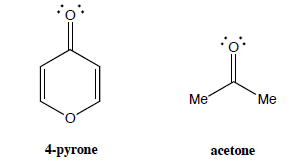
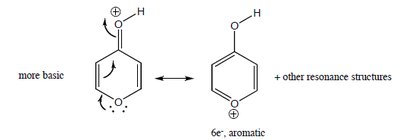
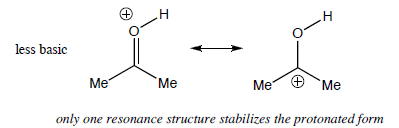
4-Pyrone vs. Acetone: 4-Pyrone is more basic due to resonance stabilization in the aromatic form.
Resonance Structures: Multiple resonance structures stabilize the protonated form in aromatic compounds, while only one stabilizes acetone.
Molecular Dipole in Aromatic Compounds
Some aromatic compounds, such as azulene, exhibit large molecular dipoles due to the distribution of electron density and resonance structures.
Azulene: The molecule has a large dipole because resonance structures separate positive and negative charges across the rings.
Summary Table: Aromaticity Classification
Classification of Aromatic, Antiaromatic, and Non-aromatic Compounds
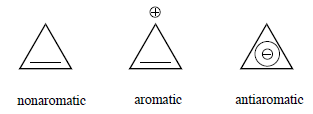
Non-aromatic: Not planar or not fully conjugated.
Aromatic: Planar, fully conjugated, 4n+2 π-electrons.
Antiaromatic: Planar, fully conjugated, 4n π-electrons.
Additional info:
Polycyclic aromatic hydrocarbons are important in environmental chemistry and materials science.
Heterocyclic aromatics are key in pharmaceuticals and biological systems.
Annulenes illustrate the importance of planarity and electron count in aromaticity.
