 Back
BackBenzene and Aromatic Compounds: Structure, Stability, and Nomenclature
Study Guide - Smart Notes
 Tailored notes based on your materials, expanded with key definitions, examples, and context.
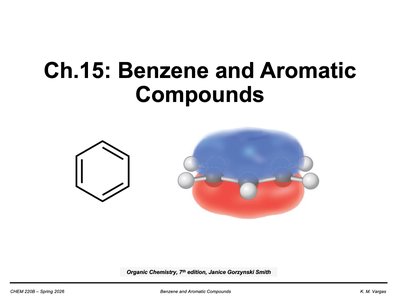
Ch. 15: Benzene and Aromatic Compounds
Introduction to Benzene and Aromatic Compounds
Benzene is the prototypical aromatic compound, characterized by a planar, cyclic structure with delocalized π electrons. Aromatic compounds exhibit unique stability and reactivity due to this electron delocalization, a property known as aromaticity.
History and Discovery of Benzene
Early Observations and Structure Proposals
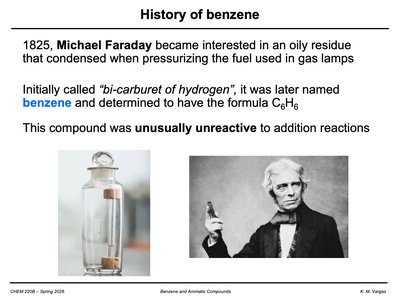
1825, Michael Faraday: Discovered benzene in an oily residue from gas lamps, initially called "bi-carburet of hydrogen" and later named benzene (C6H6).
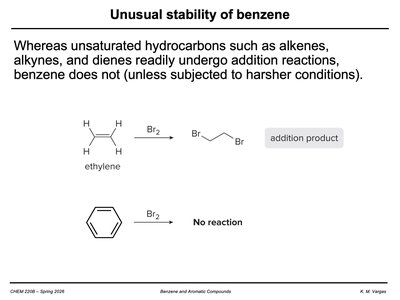
Benzene was noted for being unusually unreactive to addition reactions, unlike typical unsaturated hydrocarbons.
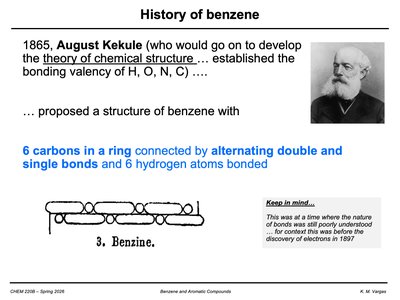
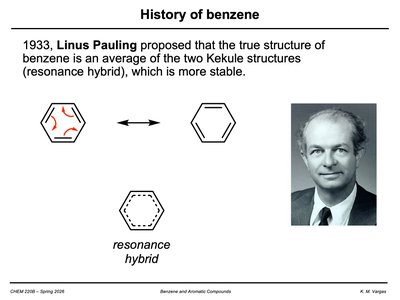
1865, August Kekulé: Proposed benzene as a six-carbon ring with alternating single and double bonds, each carbon bonded to one hydrogen.
This was before the electron was discovered, so the nature of bonding was not fully understood.
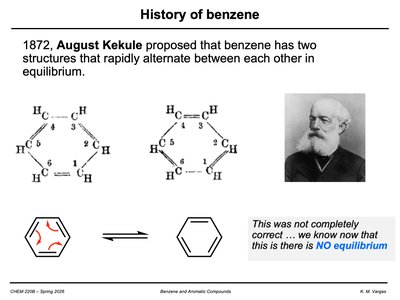
1872, Kekulé: Suggested benzene rapidly alternates between two equivalent structures (now known as resonance forms). However, modern understanding shows there is no equilibrium—the true structure is a resonance hybrid.
1933, Linus Pauling: Proposed that benzene's true structure is a resonance hybrid, averaging the two Kekulé forms, resulting in greater stability.
Benzene: Structure and Aromaticity
Electronic Structure and Aromatic Stabilization
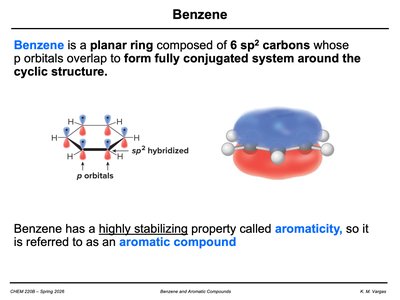
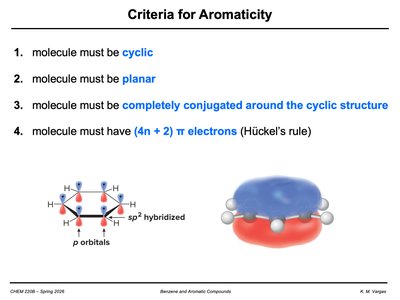
Benzene is a planar ring of six sp2 hybridized carbons. Each carbon has a p orbital, and these overlap to form a fully conjugated π system around the ring. This delocalization of electrons leads to a highly stabilizing property called aromaticity.
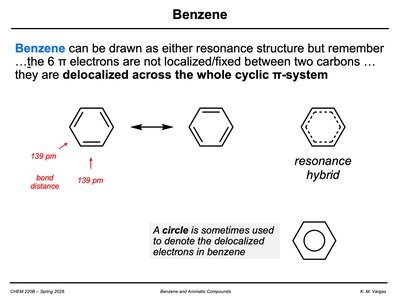
The six π electrons in benzene are delocalized across the entire ring, not fixed between any two carbons. This is often represented by a circle inside the hexagonal ring.
Unusual Stability of Benzene
Unlike alkenes and alkynes, benzene does not readily undergo addition reactions (e.g., with Br2), highlighting its exceptional stability due to aromaticity.
Nomenclature of Benzene Derivatives
Mono-Substituted Benzenes
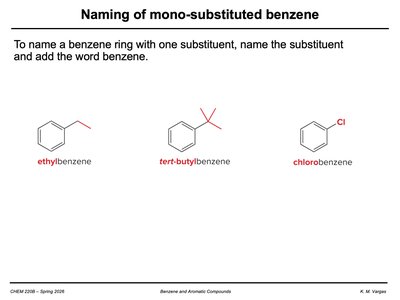
To name a benzene ring with one substituent, name the substituent and add the word "benzene." Some common names must be memorized.
Examples: ethylbenzene, tert-butylbenzene, chlorobenzene
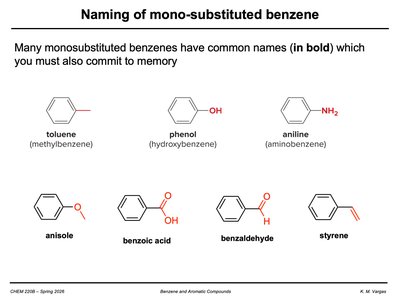
Common names: toluene (methylbenzene), phenol (hydroxybenzene), aniline (aminobenzene), anisole, benzoic acid, benzaldehyde, styrene
Di-Substituted Benzenes
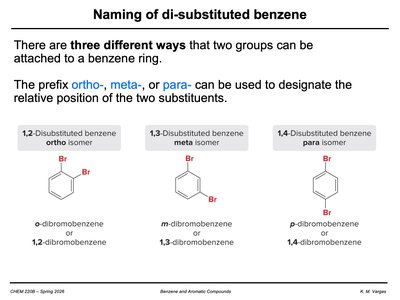
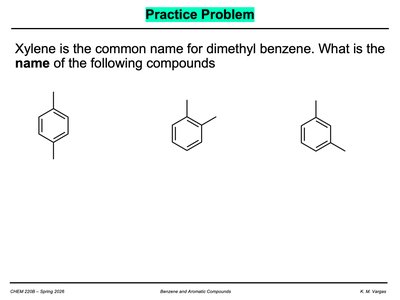
When two groups are attached, use the prefixes ortho- (1,2-), meta- (1,3-), and para- (1,4-) to indicate their relative positions.
Polysubstituted Benzenes
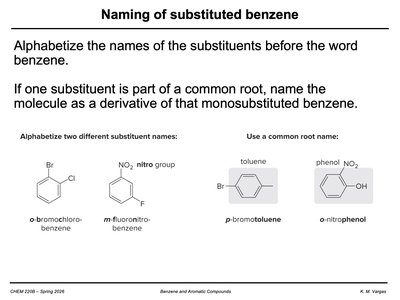
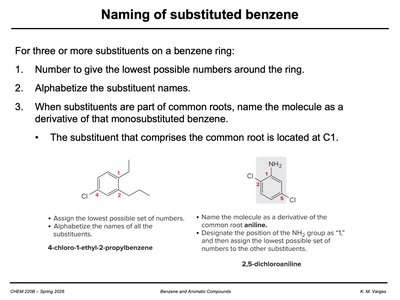
Alphabetize substituent names before "benzene."
If one substituent is part of a common root, name as a derivative of that root (e.g., p-bromotoluene, o-nitrophenol).
For three or more substituents: Number to give the lowest possible numbers, alphabetize, and use common roots when appropriate. The common root is always at C1.
Benzene as a Substituent
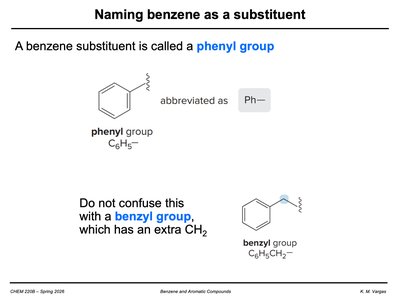
A benzene ring as a substituent is called a phenyl group (Ph–). A benzyl group (Bn–) contains an extra CH2 group.
Practice Problems: Structure and Naming
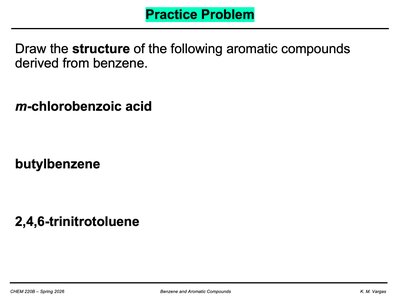
Draw the structure of: m-chlorobenzoic acid, butylbenzene, 2,4,6-trinitrotoluene.
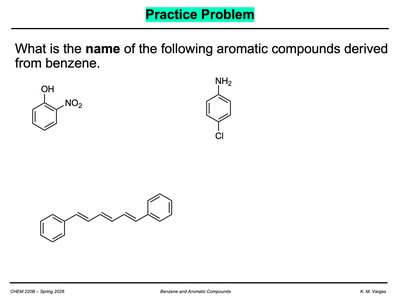
Name the following aromatic compounds (structures provided):
Identify the names of xylene isomers (dimethylbenzenes).
Applications: Benzene Rings in Pharmaceuticals
Benzene rings are prevalent in many pharmaceuticals, including top-selling drugs such as Eliquis, Revlimid, Imbruvica, Zoloft, Plavix, and Nexium. The aromatic ring often contributes to the molecule's stability and biological activity.

Stability of Benzene: Thermodynamic Evidence
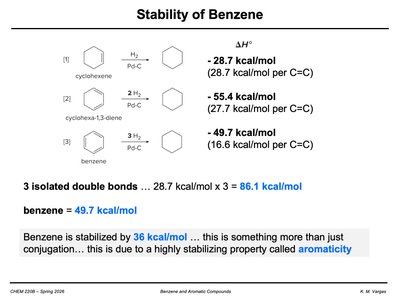
Benzene is much more stable than expected for a compound with three isolated double bonds. The heat of hydrogenation for benzene is significantly less than the sum for three double bonds, indicating an extra stabilization of about 36 kcal/mol due to aromaticity.
Heat of hydrogenation for cyclohexene: -28.7 kcal/mol
For benzene: -49.7 kcal/mol (vs. -86.1 kcal/mol expected for three isolated double bonds)
Criteria for Aromaticity
For a molecule to be aromatic, it must satisfy the following:
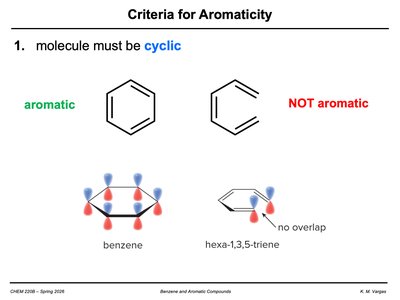
Cyclic: The molecule must form a ring.
Planar: All atoms in the ring must be in the same plane.
Completely conjugated: Every atom in the ring must have a p orbital, allowing for continuous overlap.
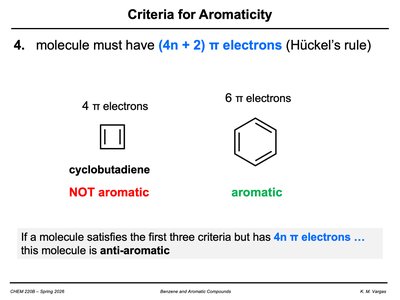
(4n + 2) π electrons: The ring must contain a specific number of π electrons (Hückel's rule), where n is a non-negative integer.
Examples and Non-Examples
Cyclic: Benzene is aromatic; hexa-1,3,5-triene is not (not cyclic).
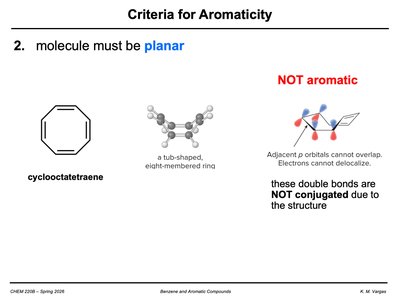
Planar: Cyclooctatetraene is not aromatic due to its non-planar structure.
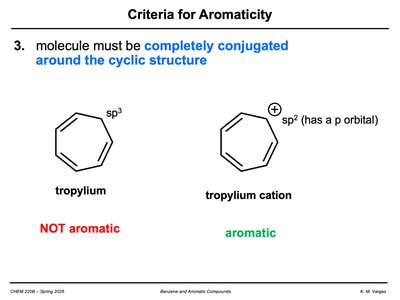
Completely conjugated: Tropyllium cation is aromatic; tropyllium (neutral) is not.
(4n + 2) π electrons: Benzene (6 π electrons) is aromatic; cyclobutadiene (4 π electrons) is antiaromatic.
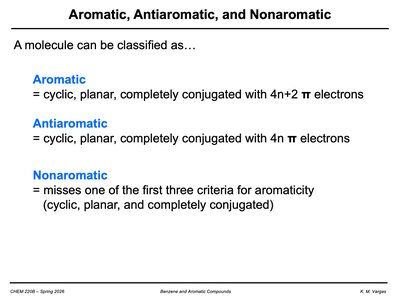
Classification: Aromatic, Antiaromatic, Nonaromatic
Aromatic: Cyclic, planar, fully conjugated, and (4n + 2) π electrons.
Antiaromatic: Cyclic, planar, fully conjugated, but 4n π electrons.
Nonaromatic: Fails one or more of the first three criteria.
Practice Problems: Aromaticity Classification
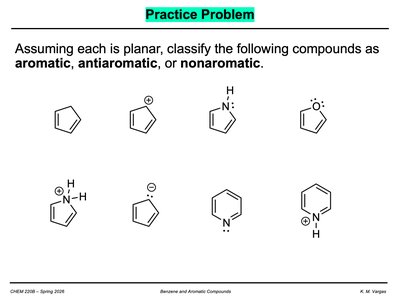
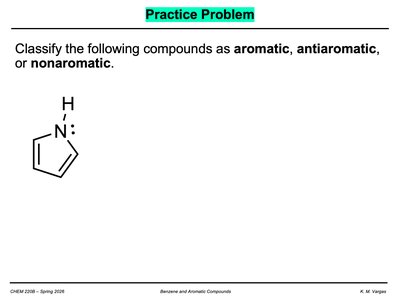
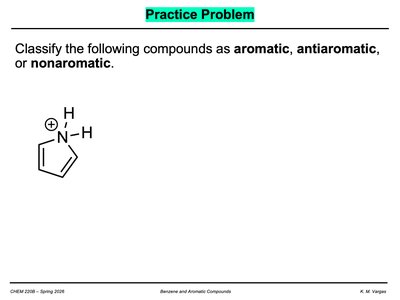
Classify various heterocyclic and carbocyclic compounds as aromatic, antiaromatic, or nonaromatic, assuming planarity.
Detailed Example: Aromaticity in Pyrrole
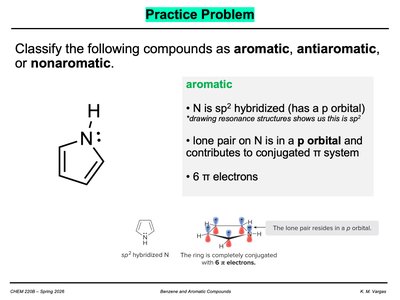
Nitrogen is sp2 hybridized (has a p orbital).
Lone pair on N is in a p orbital and contributes to the conjugated π system.
Total of 6 π electrons: aromatic.
Additional info: The above notes provide a comprehensive overview of the structure, stability, nomenclature, and aromaticity criteria for benzene and related compounds, suitable for exam preparation in a college-level organic chemistry course.
