 Back
BackBiopolymers: Structure, Synthesis, and Properties
Study Guide - Smart Notes
 Tailored notes based on your materials, expanded with key definitions, examples, and context.
Introduction to Biopolymers
What is a Biopolymer?
Biopolymers are naturally occurring macromolecules composed of repeating monomeric units. They are fundamental to life and include proteins, nucleic acids, and polysaccharides. Unlike synthetic polymers, biopolymers are typically composed of a diverse set of monomers arranged in a specific sequence, which determines their structure and function.
Polynucleotides: DNA and RNA
Polypeptides: Proteins
Polysaccharides/Glycans: Complex carbohydrates




General Structure of Biopolymers
Biopolymers are formed by the polymerization of monomers:
Proteins/Peptides: Built from amino acids
DNA/RNA: Built from nucleotides
Sugars/Glycans: Built from monosaccharides
Most biopolymers are made from chiral monomers. Chirality is described using R/S (CIP rules) or D/L (biochemical convention) descriptors, with D/L assigned by analogy to glyceraldehyde.
Biopolymer Nomenclature
Biopolymers are classified by the number of monomer units:
Oligomers: Short chains (e.g., oligonucleotide, oligopeptide)
Polymers: Longer chains (e.g., polynucleotide, polypeptide)
Examples: Dipeptide (2 amino acids), Trinucleotide (3 nucleotides), Hexasaccharide (6 sugars).
Comparison: Biopolymers vs. Synthetic Polymers
Key Differences
Monomer Diversity: Biopolymers have many different monomers; synthetic polymers often have few.
Sequence Specificity: Biopolymers have a defined sequence, critical for function; synthetic polymers often have random or repeating sequences.
Directed Synthesis: Biopolymer synthesis must be stepwise and controlled to ensure correct sequence.
For example, the amino acid sequence of a protein determines its 3D structure and function. A single change can cause diseases (e.g., cancer).
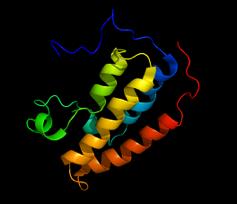
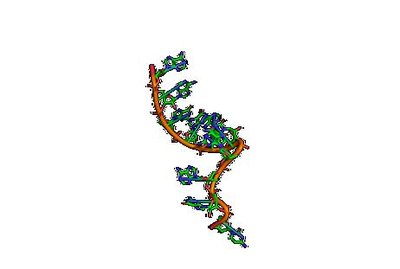
Biopolymer Synthesis
Why Synthesize Biopolymers?
Synthetic access to biopolymers enables drug discovery, biotechnology, and research. Natural biosynthesis is limited by scale, cost, and the inability to produce unnatural variants.
Examples: Peptide drugs (e.g., semaglutide), oligonucleotide drugs, synthetic biology (CRISPR, DNA sequencing).
Condensation Reactions in Biopolymer Formation
All major biopolymers are formed by condensation reactions (loss of water):
Peptide bond: Between amino acids
Glycosidic bond: Between monosaccharides
Phosphodiester bond: Between nucleotides
Directed Linear Synthesis
Each monomer must be added in a defined order. Synthesis is stepwise, and high yield per step is critical. The overall yield is the product of the yields of each step:
Where n is the number of coupling steps.
Requirements for Efficient Synthesis
High-yielding reactions
High excess of reagents
Cheap building blocks
Fast reactions
Minimal work-up and purification
Solid-phase synthesis is commonly used to meet these requirements.
Solid Phase Synthesis
Principles and Advantages
Developed by Bruce Merrifield (Nobel Prize, 1984), solid-phase synthesis immobilizes the growing polymer on an inert resin. This allows for easy washing and automation, with purification only required at the end.

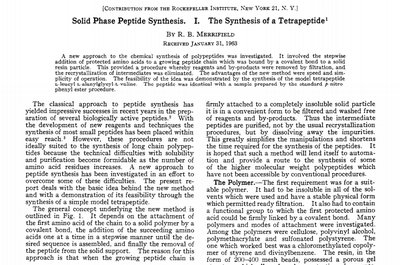
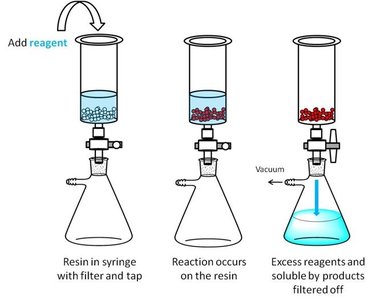
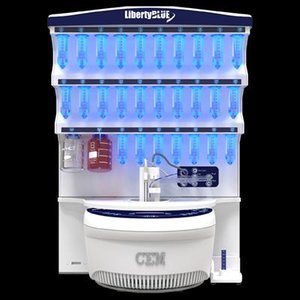
Resin beads (e.g., polystyrene) are functionalized with reactive handles for monomer attachment.
Reactions occur on the resin; excess reagents and byproducts are washed away.
After synthesis, the product is cleaved from the resin and purified (often by HPLC).
Characterization is typically by high-resolution mass spectrometry, not NMR.
Amino Acids and Peptides
Structure and Properties of Amino Acids
Amino acids are the building blocks of peptides and proteins. They have a central (alpha) carbon bonded to an amino group, a carboxylic acid, a hydrogen, and a variable side chain (R group).
At physiological pH (~7), amino acids are zwitterionic (both + and - charges).
Natural amino acids are L-configuration and alpha-amino acids (except glycine, which is achiral).
Side chains determine properties: hydrophobic, hydrophilic, acidic, basic, aromatic.
Nomenclature
Full name (e.g., Lysine)
Three-letter code (e.g., Lys)
One-letter code (e.g., K)
Peptides and Proteins
Peptides are short chains of amino acids linked by amide (peptide) bonds. Proteins are long polypeptides (typically >50 residues). Sequence is always written from the N-terminus (amino end) to the C-terminus (carboxyl end).
Peptide bonds are usually in the trans configuration (except for proline).
Peptide charge at neutral pH is determined by the termini and side chains.
Naming Peptides
Give the N-terminus, then each amino acid, then the C-terminus.
Example: H-Ser-Ile-Gly-OH (SIG)
Summary Table: Amino Acid Properties
Type | Examples | Charge at pH 7 |
|---|---|---|
Hydrophobic | Isoleucine, Leucine, Valine | 0 |
Acidic | Aspartic acid, Glutamic acid | -1 |
Basic | Lysine, Arginine, Histidine | +1 |
Aromatic | Phenylalanine, Tyrosine, Tryptophan | 0 |
Key Concepts and Mechanisms
Chirality: Most biopolymer monomers are chiral, affecting structure and function.
pKa: Determines ionization state of amino acids and peptides.
Polymer Chemistry: Biopolymers are sequence-defined, unlike many synthetic polymers.
Solid Phase Synthesis: Enables efficient, automated synthesis of complex biopolymers.
Practice Questions (True/False)
Biopolymer synthesis usually involves multiple coupling steps. True
Biopolymer synthesis is usually performed in solution. False (commonly solid phase)
Peptides are made up of nucleotide monomers. False (amino acids)
Biopolymers usually contain chiral monomers. True
