 Back
Bonding Theories, Hybridization, and Alkanes/Cycloalkanes: Structured Study Notes
Study Guide - Smart Notes
 Tailored notes based on your materials, expanded with key definitions, examples, and context.
I. Bonding Theories
Valence Bond Theory
Valence Bond Theory (VBT) explains the formation of chemical bonds as the overlap of atomic orbitals from two atoms, resulting in a shared pair of electrons. This theory is particularly useful for describing the localized bonding in simple molecules.
Bond Formation: Bonds are formed when atomic orbitals overlap and electrons are shared between atoms.
Types of Bonds: Sigma (σ) bonds are formed by head-on overlap, while pi (π) bonds are formed by side-on overlap of p orbitals.
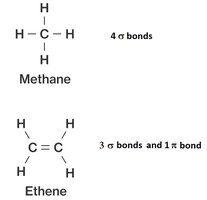
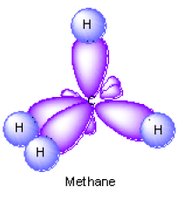
Example: In methane (CH4), four sigma bonds are formed between carbon and hydrogen atoms.
Molecular Orbital Theory
Molecular Orbital Theory (MOT) describes electrons in molecules as occupying molecular orbitals that are spread over the entire molecule, rather than being localized between two atoms. This theory is essential for understanding delocalized bonding and electronic structure in more complex molecules.
Bonding and Antibonding Orbitals: Atomic orbitals combine to form bonding and antibonding molecular orbitals.
Electron Delocalization: Electrons are not confined to individual bonds but are distributed over the molecule.
Application: Useful for explaining phenomena such as resonance and aromaticity.
II. Hybridization
sp3 Hybridization
sp3 hybridization occurs when one s and three p orbitals mix to form four equivalent sp3 hybrid orbitals. This is typical for tetrahedral molecules such as methane (CH4).
Geometry: Tetrahedral, with bond angles of approximately 109.5°.
Bonding: Each sp3 orbital forms a sigma bond with hydrogen in methane.
Example: Methane (CH4) and ethane (C2H6).
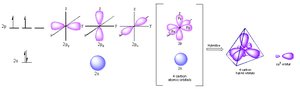
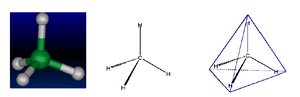
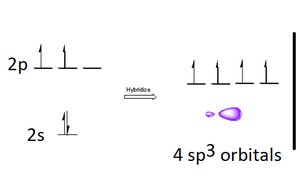
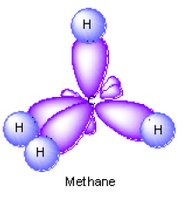
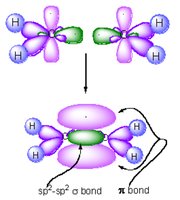
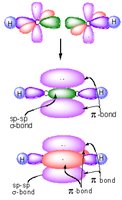
Bonding in Methane: Four sigma bonds are formed, each using an sp3 orbital from carbon and a 1s orbital from hydrogen.
sp2 Hybridization
sp2 hybridization involves the mixing of one s and two p orbitals to form three sp2 hybrid orbitals and one unhybridized p orbital. This is characteristic of trigonal planar molecules such as ethene (C2H4).
Geometry: Trigonal planar, with bond angles of approximately 120°.
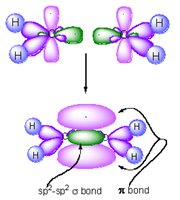
Bonding: Each carbon forms three sigma bonds using sp2 orbitals, and the unhybridized p orbitals form a pi bond.
Example: Ethene (C2H4).
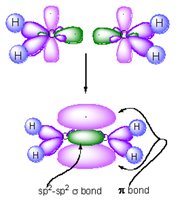
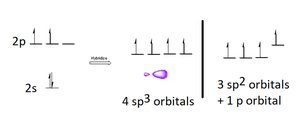
Bonding in Ethene: Three sigma bonds and one pi bond are present between the two carbons and hydrogens.
sp Hybridization
sp hybridization occurs when one s and one p orbital mix to form two sp hybrid orbitals, leaving two unhybridized p orbitals. This is typical for linear molecules such as ethyne (acetylene, C2H2).
Geometry: Linear, with bond angles of 180°.
Bonding: Each carbon forms two sigma bonds using sp orbitals, and two pi bonds are formed from the unhybridized p orbitals.
Example: Ethyne (C2H2).
Bonding in Ethyne: Two sigma bonds and two pi bonds are present between the two carbons and hydrogens.

Summary Table: Hybridization, Geometry, and Bonding
Hybridization | Geometry | Bond Angles | Example |
|---|---|---|---|
sp3 | Tetrahedral | 109.5° | Methane (CH4) |
sp2 | Trigonal planar | 120° | Ethene (C2H4) |
sp | Linear | 180° | Ethyne (C2H2) |
III. Classes of Hydrocarbons
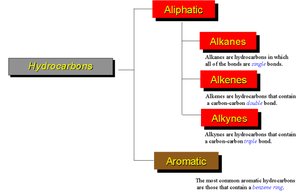
Classification of Hydrocarbons
Hydrocarbons are organic compounds composed entirely of carbon and hydrogen. They are classified based on the types of bonds between carbon atoms and the presence of rings.
Alkanes: Saturated hydrocarbons with only single bonds (C–C).
Alkenes: Unsaturated hydrocarbons with at least one double bond (C=C).
Alkynes: Unsaturated hydrocarbons with at least one triple bond (C≡C).
Aromatic hydrocarbons: Contain conjugated pi systems, typically benzene rings.
IV. Alkanes and Cycloalkanes
Structure and Isomerism
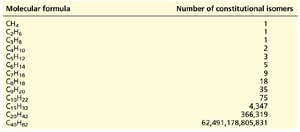
Alkanes are saturated hydrocarbons with the general formula CnH2n+2. Cycloalkanes are ring-shaped alkanes with the formula CnH2n. Isomerism is common in alkanes with four or more carbons.
n-Alkanes: Unbranched, straight-chain alkanes.
Branched Alkanes: Contain one or more branches off the main chain.
Constitutional Isomers: Compounds with the same molecular formula but different connectivity.
Examples of Alkanes
Methane (CH4): The simplest alkane, major component of natural gas.
Ethane (C2H6): Second most abundant in natural gas.
Propane (C3H8): Used as fuel, also found in natural gas.
Butane (C4H10): Exists as n-butane (unbranched) and isobutane (branched).
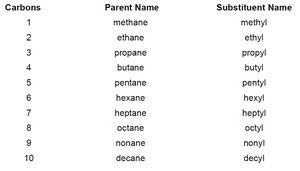
V. Naming Alkanes and Cycloalkanes (IUPAC Nomenclature)
Rules for Naming Alkanes
The IUPAC system provides a systematic method for naming alkanes and their derivatives. The main steps are:
Find the parent hydrocarbon: Identify the longest continuous carbon chain.
Number the chain: Begin at the end nearest a branch point.
Identify and number substituents: Assign numbers to each substituent based on its attachment point.
Write the name: Combine substituent names and numbers, using hyphens and commas as needed. List substituents alphabetically.
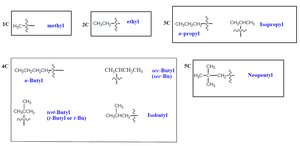
Complex substituents: Name and number as if they are separate compounds, using parentheses.
Rules for Naming Cycloalkanes
Cycloalkanes are named similarly to alkanes, with additional rules for rings:
Parent name: Use the ring as the parent if it has more carbons than any substituent.
Numbering: Start at the point of attachment and number to give the lowest set of locants to substituents.
Alphabetical order: When multiple substituents are present, use alphabetical priority for numbering.
Halogens: Treated as alkyl groups for naming purposes.
Primary, Secondary, Tertiary, and Quaternary Carbons
Carbons are classified based on the number of other carbons to which they are attached:
Primary (1°): Attached to one other carbon.
Secondary (2°): Attached to two other carbons.
Tertiary (3°): Attached to three other carbons.
Quaternary (4°): Attached to four other carbons.
VI. Oxidation-Reduction in Organic Chemistry
Oxidation State of Carbon
The oxidation state of carbon in organic molecules is determined by the electronegativity of the atoms bonded to it:
Formula:
Oxidation: Occurs when a bond to a less electronegative atom is replaced by a bond to a more electronegative atom (e.g., C–H replaced by C–O).
Reduction: The reverse process, where a bond to a more electronegative atom is replaced by a bond to a less electronegative atom.
Additional info: This concept is crucial for understanding organic redox reactions, such as those involving alcohols, aldehydes, ketones, and carboxylic acids.
