 Back
BackCarbohydrate Chain Modification, Amino Acid Synthesis, and Peptide Bond Formation
Study Guide - Smart Notes
 Tailored notes based on your materials, expanded with key definitions, examples, and context.
Carbohydrate Chain Lengthening and Shortening
Kiliani-Fischer Synthesis (Chain Lengthening)
The Kiliani-Fischer synthesis is a classic method for lengthening the carbon chain of an aldose (a carbohydrate with an aldehyde group) by one carbon atom. This process is important for the structural modification of sugars and for the synthesis of rare sugars from common ones.
Step 1: Cyanohydrin Formation – The aldose reacts with hydrogen cyanide (HCN) to form a cyanohydrin intermediate.
Step 2: Hydrolysis – The cyanohydrin is hydrolyzed to an aldonic acid.
Step 3: Reduction – The aldonic acid is reduced to the corresponding aldose, which is one carbon longer than the starting material.
Epimer Formation – This process produces a mixture of two epimers at the new stereocenter created during chain extension.
Reagents – Typical reagents include HCN, H2, and BaSO4 for reduction.
Limitation – Only works on aldoses (not ketoses).
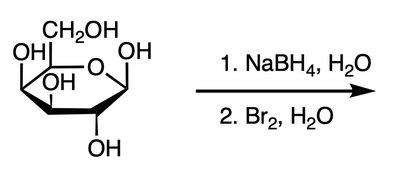
Wohl Degradation (Chain Shortening)
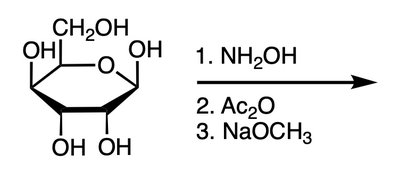
The Wohl degradation is a method for shortening the carbon chain of an aldose by one carbon atom. This is the reverse of the Kiliani-Fischer synthesis and is useful for structural elucidation and synthesis of simpler sugars.
Step 1: Oxime Formation – The aldose reacts with hydroxylamine (NH2OH) to form an oxime.
Step 2: Acetylation – The oxime is acetylated with acetic anhydride (Ac2O).
Step 3: Base-Induced Elimination – Treatment with sodium methoxide (NaOCH3) eliminates the terminal carbon as HCN, yielding an aldose with one fewer carbon atom.
Limitation – Only works on aldoses.
Amino Acids: Structure, Properties, and Synthesis
Structure and Acid-Base Properties of Amino Acids
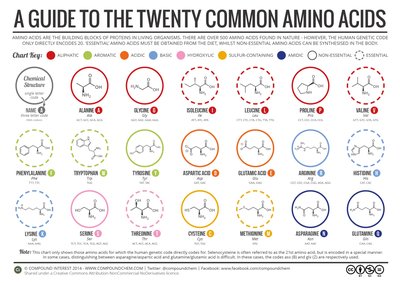
Amino acids are the building blocks of proteins, containing both an amino group (–NH2) and a carboxylic acid group (–COOH) attached to the same carbon (the α-carbon). Their structure and charge state depend on the pH of the environment:
At low pH (acidic): Both groups are protonated (–NH3+, –COOH).
At neutral pH (physiological, ~7.4): Amino acids exist as zwitterions (–NH3+, –COO–).
At high pH (basic): Both groups are deprotonated (–NH2, –COO–).
Synthesis of Amino Acids
Several methods exist for the laboratory synthesis of amino acids. The three most important are:
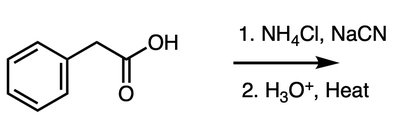
1. Strecker Synthesis
Step 1: An aldehyde reacts with ammonium chloride (NH4Cl) and sodium cyanide (NaCN) to form an α-aminonitrile.
Step 2: Acidic hydrolysis of the α-aminonitrile yields an α-amino acid.
General Reaction:
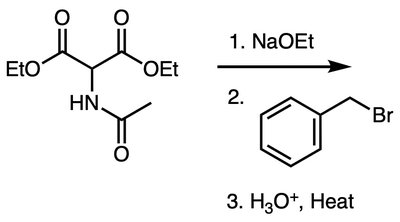
2. Amidomalonate Synthesis
Step 1: Diethyl acetamidomalonate is alkylated with an alkyl halide in the presence of base (NaOEt).
Step 2: Acidic hydrolysis and decarboxylation yield the amino acid.
General Reaction:
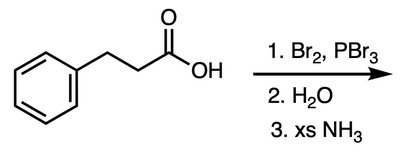
3. Hell-Volhard-Zelinsky (HVZ) Reaction
Step 1: Carboxylic acid is brominated at the α-position using Br2 and PBr3.
Step 2: The α-bromo acid is treated with excess ammonia (NH3) to substitute bromine with an amino group, forming the amino acid.
General Reaction:
Peptide Bond Formation
What is a Peptide Bond?
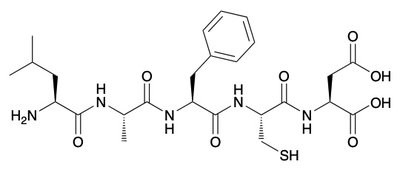
A peptide bond is an amide linkage formed between the carboxyl group of one amino acid and the amino group of another. This bond is the fundamental linkage in proteins and peptides.
Structure: –CO–NH– linkage between amino acids.
Formation: Condensation reaction (loss of water).
Directionality: Peptides have an N-terminus (free –NH2) and a C-terminus (free –COOH).

Peptide Synthesis Using DCC
Dicyclohexylcarbodiimide (DCC) is a common reagent used to promote peptide bond formation in laboratory synthesis. DCC activates the carboxyl group, making it more susceptible to nucleophilic attack by the amino group of another amino acid.
Step 1: DCC reacts with the carboxyl group to form an O-acylisourea intermediate.
Step 2: The amino group attacks the activated carbonyl, forming the peptide bond and releasing dicyclohexylurea as a byproduct.
Importance: DCC allows peptide synthesis under mild conditions, preventing racemization.
Protecting Groups in Peptide Synthesis
During peptide synthesis, protecting groups are used to prevent unwanted reactions at functional groups not involved in the desired bond formation. The Boc group (tert-butyloxycarbonyl) is a common protecting group for amines.
Boc Protection: Temporarily masks the amino group, allowing selective reactions at the carboxyl group.
Deprotection: Boc group can be removed under acidic conditions to regenerate the free amine.
Summary Table: Amino Acid Synthesis Methods
Method | Key Reagents | Intermediate | Product |
|---|---|---|---|
Strecker Synthesis | NH4Cl, NaCN, H3O+ | α-Aminonitrile | α-Amino acid |
Amidomalonate Synthesis | NaOEt, Alkyl halide, H3O+ | Alkylated malonate | α-Amino acid |
HVZ Reaction | Br2, PBr3, NH3 | α-Bromo acid | α-Amino acid |
