 Back
BackCarboxylic Acids and Their Derivatives: Structure, Properties, and Reactions
Study Guide - Smart Notes
 Tailored notes based on your materials, expanded with key definitions, examples, and context.
Carboxylic Acids and Their Derivatives
Overview
Carboxylic acids and their derivatives are a central class of organic compounds, characterized by the presence of the carboxyl group (-COOH). Their derivatives include esters, amides, anhydrides, acid chlorides, and nitriles. These compounds are widely found in nature and are essential in both biological and industrial chemistry.
Nomenclature of Carboxylic Acids and Derivatives
Carboxylic Acids
IUPAC Naming: The parent chain is the longest chain containing the carboxyl group. The suffix -oic acid is used (e.g., ethanoic acid for acetic acid).
Common Names: Many carboxylic acids have common names, often derived from their natural sources (e.g., formic acid, acetic acid, benzoic acid).
Greek Letters: Common names use Greek letters (α, β, γ, etc.) to indicate the position of substituents, starting from the carbon adjacent to the carboxyl group.
Dicarboxylic Acids
IUPAC: Named as "alkanedioic acids" (e.g., butanedioic acid for succinic acid).
Common Names: Some common names are retained (e.g., oxalic acid, malonic acid, succinic acid).
Esters
Named as alkyl alkanoates, where the alkyl group comes from the alcohol and the alkanoate from the acid (e.g., methyl acetate).
Amides
Named by replacing the "-oic acid" or "-ic acid" ending with "-amide" (e.g., butanamide from butanoic acid).
Substituents on nitrogen are indicated with "N-" (e.g., N,N-dimethylacetamide).
Nitriles
Named by adding "-nitrile" to the parent hydrocarbon (e.g., butanenitrile).
Acid Chlorides
Named by replacing "-ic acid" with "-yl chloride" (e.g., acetyl chloride).
Anhydrides
Named by replacing "acid" with "anhydride" (e.g., acetic anhydride).
Physical Properties
Polarity and Hydrogen Bonding
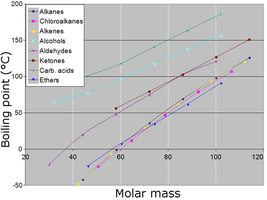
Carboxylic acids are highly polar due to the presence of both a carbonyl and a hydroxyl group. They form strong hydrogen bonds, often existing as dimers in the liquid and solid states, which leads to high boiling points.
Esters: Polar, but cannot hydrogen bond with themselves, resulting in lower boiling points than acids or alcohols.
Amides: Very strong dipoles and hydrogen bonding (especially primary and secondary amides), leading to high boiling points and good water solubility for small amides.
Nitriles: Polar, with boiling points similar to alcohols, but due to dipole-dipole interactions rather than hydrogen bonding.
Acid Chlorides and Anhydrides: Polar, but react with water; boiling points are similar to ketones.
Boiling Points Comparison
The boiling points of organic compounds are influenced by intermolecular forces. The order from lowest to highest is: alkanes < ethers < esters < ketones < alcohols < carboxylic acids < amides.
Solubility
Carboxylic acids and small amides are soluble in water due to hydrogen bonding.
Esters and nitriles are moderately soluble; solubility decreases with increasing chain length.
Long-chain carboxylates form micelles in water above the critical micelle concentration (CMC).
Acidity and Resonance
Acidity of Carboxylic Acids
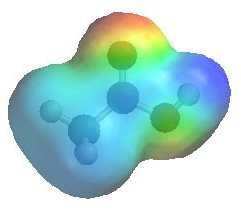
Carboxylic acids are weak acids, partially ionized in water. Their acidity is due to resonance stabilization of the carboxylate anion and the electronegativity of the carbonyl carbon.
pKa values: Typically range from 3 to 5 for simple carboxylic acids.
Resonance: The negative charge is delocalized over two oxygen atoms, stabilizing the anion.
Effect of Substituents
Electron-withdrawing groups (e.g., halogens) increase acidity (lower pKa).
Electron-donating groups decrease acidity (raise pKa).
Acidity of Dicarboxylic Acids
Dicarboxylic acids have two pKa values due to stepwise deprotonation; the second deprotonation is less favorable due to charge repulsion.
Separation and Extraction Techniques
Acid-Base Extraction
Differences in acidity and solubility are used to separate carboxylic acids, phenols, and other organic compounds in laboratory extractions. Carboxylic acids are soluble in aqueous NaOH and NaHCO3, while phenols are only soluble in NaOH.
Reactivity and Mechanisms
General Mechanism Patterns
The carbonyl carbon in carboxylic acids and derivatives is electrophilic and reacts with nucleophiles. The mechanisms for acid and base catalysis differ, but all involve nucleophilic acyl substitution.
Preparation of Carboxylic Acids
Oxidation of primary alcohols or aldehydes using strong oxidizing agents (e.g., KMnO4, K2Cr2O7).
Formation of Acid Chlorides
Carboxylic acid reacts with thionyl chloride (SOCl2) to form acid chloride, SO2, and HCl.
Equation:
Formation of Esters
From acid chlorides or anhydrides with alcohols (often with a base like TEA or pyridine).
Fischer esterification: Carboxylic acid reacts with alcohol in acid, equilibrium driven by excess alcohol or removal of water.
Hydrolysis of Esters
Acidic hydrolysis is reversible and driven by excess water.
Base hydrolysis (saponification) is irreversible, forming a carboxylate salt.
Formation and Hydrolysis of Amides
Amides are formed from acid chlorides or anhydrides with amines (often with TEA).
Hydrolysis of amides requires strong acid or base and heat.
Nitrile Formation and Hydrolysis
Nitriles can be formed from alkyl halides via cyanide substitution or from dehydration of amides.
Hydrolysis of nitriles yields carboxylic acids.
Special Topics
Polyamides and Polyesters
Polyamides (e.g., nylon, Kevlar) and polyesters (e.g., PET) are important polymers formed from the condensation of diamines with dicarboxylic acids or diols with dicarboxylic acids, respectively.
β-Lactams
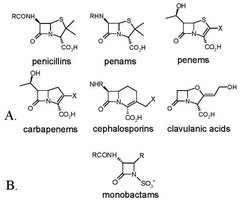
β-Lactams are cyclic amides that mimic peptide bonds in bacterial cell wall synthesis, acting as antibiotics (e.g., penicillins, cephalosporins).
Soap and Surfactants
Soaps are sodium or potassium salts of long-chain carboxylic acids. They act as surfactants, forming micelles above the critical micelle concentration (CMC).
Soap Surfactant | CMC (25°C) |
|---|---|
Sodium Oleate | 7.3 × 10⁻⁴ M |
Sodium Linoleate | 1.8 × 10⁻³ M |
Sodium Stearate | 1.9 × 10⁻⁴ M |
Sodium Iso-Stearate | 4 × 10⁻⁴ M |
Sodium Myristate | 4.3 × 10⁻³ M |
Sodium Laurate | 2 × 10⁻² M |
Merrifield Peptide Synthesis
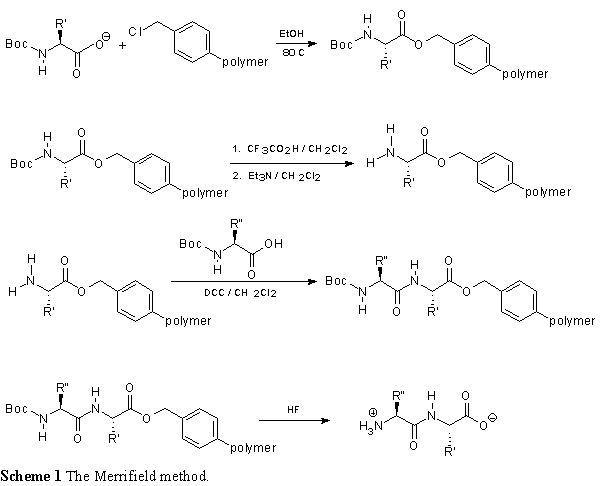
The Merrifield method is a solid-phase synthesis technique for peptides, using a polymer support and stepwise addition of protected amino acids. Carbodiimide reagents (e.g., DCC) are commonly used for coupling.
Summary Table: Boiling Points and Intermolecular Forces
Compound Type | Major Intermolecular Force | Boiling Point Trend |
|---|---|---|
Alkanes, Alkenes, Ethers | London Dispersion | Lowest |
Esters | Dipole-Dipole | Higher than ethers |
Ketones, Aldehydes | Dipole-Dipole | Higher than esters |
Alcohols | Hydrogen Bonding | Much higher |
Carboxylic Acids | Strong Hydrogen Bonding | Very high |
Amides | Very strong dipoles & H-bonding | Highest |
Additional info: This guide covers the nomenclature, properties, and reactivity of carboxylic acids and their derivatives, including their role in polymer and peptide synthesis, and their importance in biological and industrial contexts.
