 Back
BackCarboxylic Acids: Properties, Acid Strength, and Reactions
Study Guide - Smart Notes
 Tailored notes based on your materials, expanded with key definitions, examples, and context.
Carboxylic Acids
Acidity and pKa of Carboxylic Acids
Carboxylic acids are a fundamental class of organic acids, characterized by the presence of a carboxyl group (-COOH). Their acidity is quantified by the pKa value, which is typically around 5 for most carboxylic acids. This makes them less acidic than strong inorganic acids (such as HBr or HCl), but more acidic than alcohols, water, ammonia, or alkanes.
pKa Definition: The pKa is the negative logarithm of the acid dissociation constant (Ka), and lower pKa values indicate stronger acids.
Acid Strength Comparison: Carboxylic acids are stronger acids than alcohols and water, but weaker than HBr and HCl.
Role in Reactions: Carboxylic acids typically act as acids in organic reactions, donating a proton to form their conjugate base.
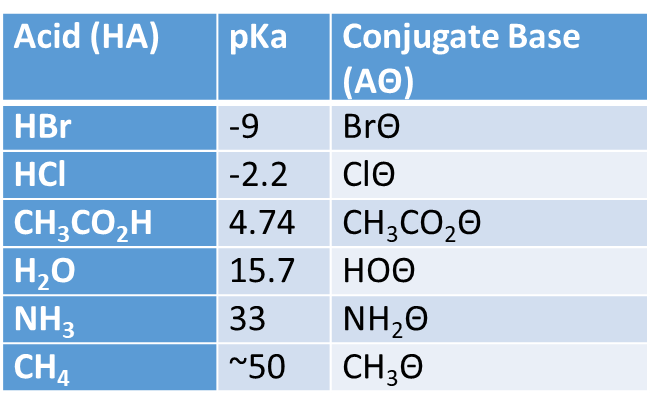
Example Table: The following table compares the pKa values and conjugate bases of several acids:
Acid (HA) | pKa | Conjugate Base (AΘ) |
|---|---|---|
HBr | -9 | BrΘ |
HCl | -2.2 | ClΘ |
CH3CO2H | 4.74 | CH3CO2Θ |
H2O | 15.7 | HOΘ |
NH3 | 33 | NH2Θ |
CH4 | ~50 | CH3Θ |
Predicting Acid Strength Without pKa Values
When pKa values are unavailable, acid strength can be predicted by analyzing the stability of the conjugate base. The more stable the conjugate base, the stronger the acid. The SFERI mnemonic is used to assess conjugate base stability:
Size
Formal charge
Electronegativity
Resonance
Induction
For example, the conjugate base of a carboxylic acid is resonance stabilized, making it more stable than the conjugate base of an alcohol, which lacks resonance stabilization. Thus, carboxylic acids are stronger acids than alcohols.
Ranking Acid Strength: Example Problem
To rank acids by strength:
Draw the conjugate base for each compound.
Identify similarities and differences.
Determine which SFERI effects are relevant.
Rank acid strength based on conjugate base stability.

Example Solution: Oxygen is more electronegative than nitrogen, so the conjugate base with oxygen is more stable. Resonance and induction effects further stabilize certain conjugate bases. Acids are ranked from most acidic to least acidic based on these factors.
Reactions of Carboxylic Acids
Carboxylic acids undergo several important organic reactions:
Alkylation: Conversion of acid to ketone by adding an alkyl group.
Esterification: Formation of esters by reaction with alcohols.
Decarboxylation: Loss of CO2, decreasing the carbon count by one.
Reduction: Conversion to primary alcohols (strong reducing agent) or aldehydes (weak reducing agent).
Decarboxylation: Example Problem
To determine which compound can be used to prepare cyclohexanone via decarboxylation:
Draw cyclohexanone.
Check for the required functional groups for decarboxylation.
Number the functional groups to ensure correct relationship.
Verify that the compound will yield cyclohexanone after decarboxylation.

Example Solution: Decarboxylation requires a carboxylic acid and another carbonyl at the 3-position. Only the compound with the correct functional group arrangement will yield cyclohexanone.
Retrosynthesis and Synthesis Planning: Example Problem
To convert benzaldehyde to a specific ketone product:
Identify differences between starting reagent and product.
Consider possible methods for ketone synthesis.
Draw a retrosynthetic plan.
Consider regioselectivity and order of reactions.

Example Solution: The aldehyde is converted to a ketone (addition of 1C), and a Br group is added to the ring in the meta position. Ketones are meta directors in electrophilic aromatic substitution (EAS). The aldehyde should be converted to a ketone before bromination to avoid side reactions.
Summary Table: SFERI Factors for Conjugate Base Stability
Factor | Description |
|---|---|
Size | Atomic radius of the atom bearing the charge |
Formal charge | Charge distribution on the conjugate base |
Electronegativity | Ability of atom to stabilize negative charge |
Resonance | Delocalization of charge through resonance structures |
Induction | Stabilization by electron-withdrawing groups |
Additional info: SFERI is a useful mnemonic for predicting acid strength in organic chemistry, especially when pKa values are not available.
