 Back
BackChapter 15: Dienes and Aromaticity – Structure, Stability, and Reactions
Study Guide - Smart Notes
 Tailored notes based on your materials, expanded with key definitions, examples, and context.
Chapter 15: Dienes and Aromaticity
Overview
This chapter explores the structure, stability, and reactivity of dienes, the fundamentals of aromaticity, and the unique chemistry associated with conjugated systems. Key topics include the classification of dienes, molecular orbital theory, UV-Vis spectroscopy, the Diels-Alder reaction, addition reactions, diene polymers, resonance, and the criteria for aromaticity.
Structure and Stability of Dienes
Classification of Dienes
Dienes are hydrocarbons containing two double bonds. They are classified based on the arrangement of these double bonds:
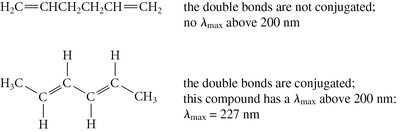
Conjugated Dienes: Double bonds separated by one single bond (e.g., 1,3-butadiene).
Cumulated Dienes (Cumulenes): Double bonds share a common carbon atom (e.g., allene).
Non-conjugated (Isolated) Dienes: Double bonds separated by two or more single bonds (e.g., 1,6-heptadiene).
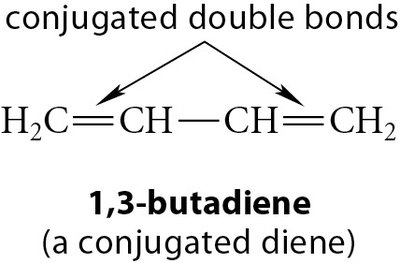
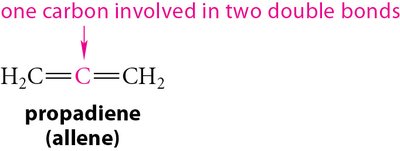
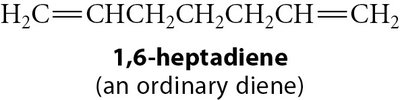
Heats of Formation and Stability
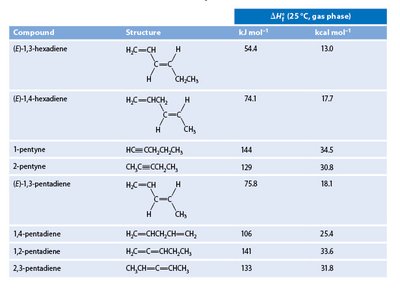
Conjugated dienes are more stable than isolated or cumulated dienes due to electron delocalization. This is reflected in their lower heats of formation.
Compound | Structure | ΔHf (kJ/mol) | ΔHf (kcal/mol) |
|---|---|---|---|
(E)-1,3-hexadiene | H2C=CHCH=CHCH2CH3 | 54.4 | 13.0 |
(E)-1,4-hexadiene | H2C=CHCH2CH2CH=CH2 | 74.1 | 17.7 |
Molecular Orbital (MO) Picture of 1,3-Butadiene
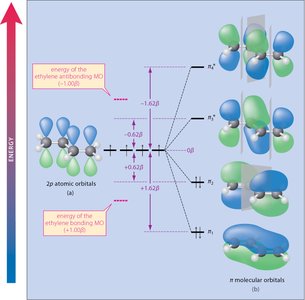
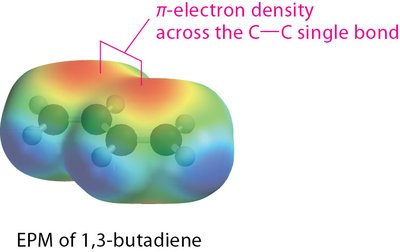
The stability of conjugated dienes arises from the delocalization of π electrons across the entire π system. The MO diagram shows four π molecular orbitals, with the lowest energy orbital (π1) delocalized over all four carbons.
Bond Lengths in Conjugated Dienes
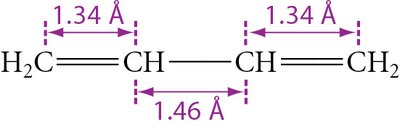
Conjugation shortens the single bond between the two double bonds (C2–C3 in 1,3-butadiene) compared to a typical C–C single bond due to partial double bond character.
sp2–sp2 bond (C2–C3): 1.46 Å
sp3–sp3 bond: 1.54 Å
sp2–sp3 bond: 1.50 Å
Conformations of Dienes
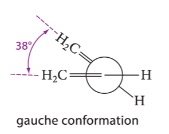
The most stable conformation of a conjugated diene is the s-trans (anti) conformation. The s-cis conformation is less stable due to steric repulsion between hydrogens.
Cumulated Dienes (Allenes)
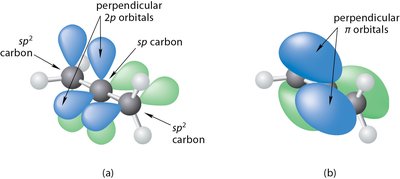
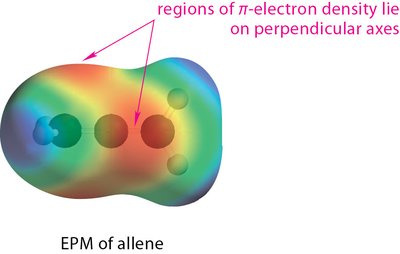
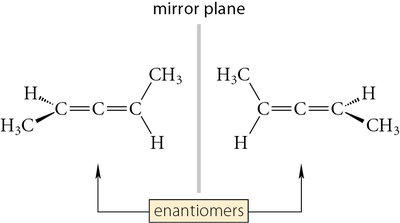
In allenes, the central carbon is sp-hybridized, resulting in two perpendicular π bonds. Some allenes are chiral even without an asymmetric carbon.
Ultraviolet-Visible (UV-Vis) Spectroscopy and Conjugation
Principles of UV-Vis Spectroscopy
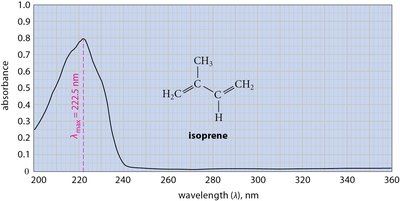
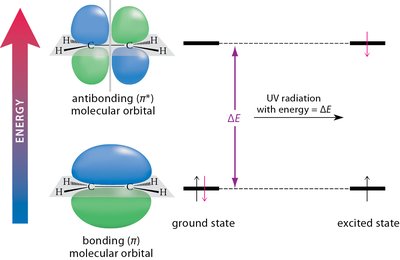
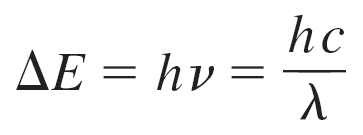
UV-Vis spectroscopy measures the absorption of ultraviolet or visible light by molecules, which promotes π electrons from the highest occupied molecular orbital (HOMO) to the lowest unoccupied molecular orbital (LUMO). The energy difference (ΔE) corresponds to the wavelength (λ) of absorbed light:
Chromophore: The part of a molecule responsible for its color and UV-Vis absorption.
Effect of Conjugation on λmax
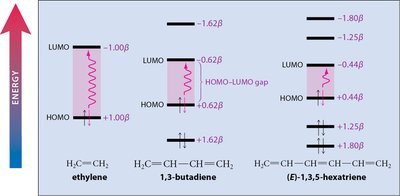
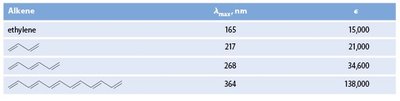
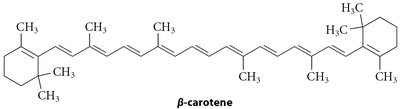
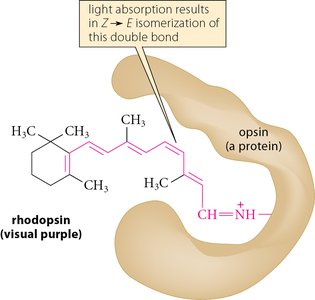
As the number of conjugated double bonds increases, the HOMO-LUMO gap decreases, resulting in absorption at longer wavelengths (higher λmax). Each additional conjugated double bond increases λmax by 30–50 nm. Highly conjugated systems can absorb in the visible region, making them colored.
Alkene | λmax (nm) | ε |
|---|---|---|
Ethylene | 165 | 15,000 |
1,3-Butadiene | 217 | 21,000 |
1,3,5-Hexatriene | 268 | 34,600 |
β-Carotene | 364 | 138,000 |
Estimating λmax: Conformational and Substituent Effects
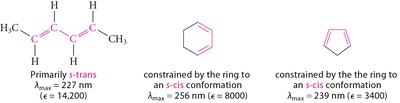
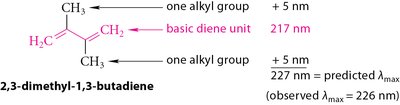
Dienes locked in s-cis conformation have higher λmax than s-trans.
Each alkyl substituent adds ~5 nm to λmax.
The Diels-Alder Reaction
Mechanism and Features
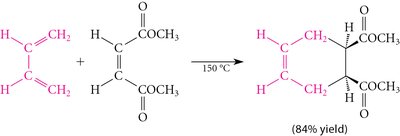
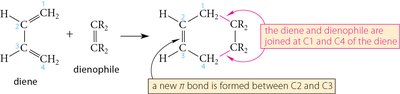
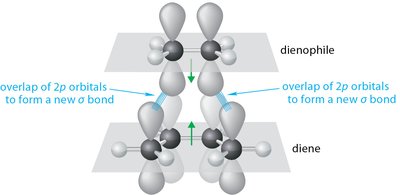
The Diels-Alder reaction is a [4+2] cycloaddition between a conjugated diene and a dienophile (alkene or alkyne), forming a six-membered ring. It is a concerted, pericyclic reaction involving cyclic electron flow.
Diene: Must be in the s-cis conformation to react.
Dienophile: Electron-deficient alkenes (with -CO2R, -CN, etc.) react faster.
Effect of Diene Conformation
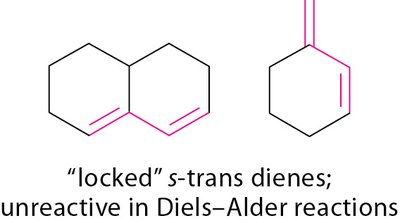
Dienes locked in the s-trans conformation are unreactive in Diels-Alder reactions, while those locked in s-cis are highly reactive.
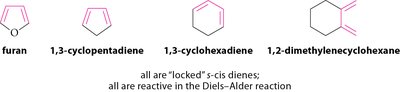
Stereochemistry of the Diels-Alder Reaction
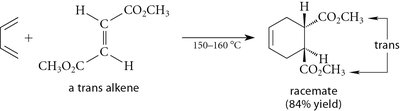
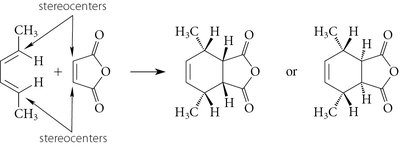
The reaction is stereospecific: substituents on the diene and dienophile retain their relative positions (syn addition). The endo product (substituents cis to the outer diene substituents) is generally favored over the exo product.
Addition of Hydrogen Halides to Conjugated Dienes
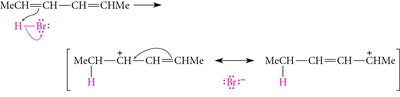
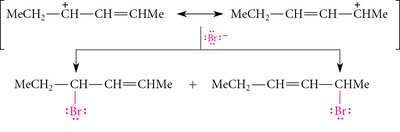
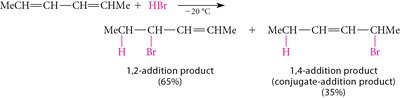
1,2- and 1,4-Addition
Conjugated dienes react with hydrogen halides (H-X) to give two types of products:
1,2-Addition: Addition occurs at adjacent carbons.
1,4-Addition: Addition occurs at carbons separated by one double bond.
Kinetic vs. Thermodynamic Control
Kinetic Control: At low temperature, the product that forms fastest (usually 1,2-addition) predominates.
Thermodynamic Control: At higher temperature, the more stable product (often 1,4-addition) predominates.
Diene Polymers
1,3-Butadiene can be polymerized to form polybutadiene, a key material in synthetic rubber. Copolymers (e.g., with styrene) and natural rubber (polyisoprene) are also important diene polymers. Vulcanization with sulfur increases strength and rigidity by forming crosslinks.
Resonance and Stability
Resonance structures describe electron delocalization in molecules where a single Lewis structure is inadequate. Resonance increases molecular stability, especially in conjugated systems and aromatic compounds.
More resonance structures generally mean greater stability.
Resonance structures with complete octets and appropriate charge placement are most important.
Introduction to Aromatic Compounds
Criteria for Aromaticity (Hückel’s Rule)
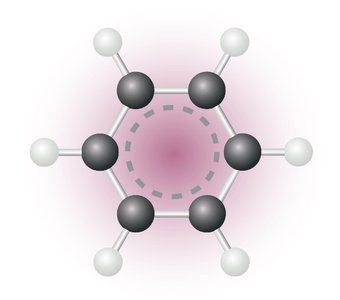
Aromatic compounds are cyclic, planar, fully conjugated molecules with (4n + 2) π electrons (n = 0, 1, 2, ...). Benzene is the prototypical aromatic compound.
All atoms in the ring must be sp2 hybridized.
The molecule must be planar for effective π overlap.
Examples: Benzene, aromatic ions, and heterocycles.
Aromatic, Antiaromatic, and Nonaromatic Compounds
Aromatic: Meets all Hückel criteria; highly stable.
Antiaromatic: Planar, cyclic, conjugated, but with 4n π electrons; highly unstable.
Nonaromatic: Does not meet criteria for aromaticity or antiaromaticity.
Noncovalent Interactions of Aromatic Rings
Aromatic rings can interact via offset stacking (π-π interactions), edge-to-face interactions, and π-cation interactions. These noncovalent forces are crucial in biological systems, stabilizing protein structures and complexes.
Additional info: This summary integrates and expands upon the provided lecture slides, including definitions, examples, and academic context for clarity and completeness.
