 Back
BackChapter 8: Alkenes I – Properties and Electrophilic Additions
Study Guide - Smart Notes
 Tailored notes based on your materials, expanded with key definitions, examples, and context.
Alkenes: Structure, Properties, and Nomenclature
Properties of Alkenes
Alkenes are hydrocarbons containing at least one carbon-carbon double bond. Their physical properties differ from those of alkanes due to the presence of the pi bond.
Boiling and Melting Points: Alkenes generally have lower boiling and melting points than their alkane counterparts. This is due to weaker van der Waals interactions, as the pi bond's p orbitals do not allow as close packing as sigma bonds.
Van der Waals Interactions: The presence of the pi bond reduces the effectiveness of intermolecular forces, leading to lower phase transition temperatures.

Degrees of Unsaturation (Index of Hydrogen Deficiency, IHD)
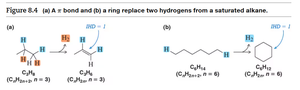
The degree of unsaturation (IHD) indicates how many pairs of hydrogen atoms are missing from a molecule compared to a saturated hydrocarbon. Each double bond or ring increases the IHD by one.
Calculation: The formula for IHD is:
Interpretation: Each ring or pi bond (double bond) increases the IHD by one. Triple bonds increase IHD by two.
Application: IHD helps deduce possible structures and isomers for a given molecular formula.
Molecular Orbitals and Rotation
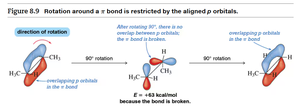
Alkenes have a sigma bond and a pi bond between the double-bonded carbons. The pi bond arises from the sideways overlap of p orbitals, which restricts rotation around the double bond.
Restricted Rotation: Rotation around the double bond would break the pi bond, requiring significant energy (~63 kcal/mol).
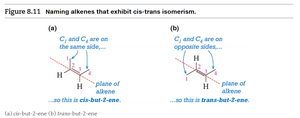
Consequence: This restriction leads to the possibility of cis/trans (geometric) isomerism.
Stereochemistry of Alkenes
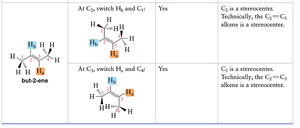
Alkenes with two different groups on each carbon of the double bond can exhibit stereoisomerism (cis/trans or E/Z isomerism). The lack of free rotation around the double bond is the basis for this phenomenon.
Stereocenter Formation: If each carbon of the double bond has two different substituents, the alkene can exist as two distinct isomers.
Example: But-2-ene has cis and trans forms, while propene does not have stereoisomers.
Nomenclature of Alkenes
Alkene nomenclature follows IUPAC rules, with specific conventions for straight-chain, branched, and cyclic alkenes.
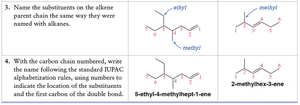
Straight-Chain Alkenes: The parent chain is the longest chain containing the double bond. The suffix is changed from -ane to -ene, and the position of the double bond is indicated by the lowest possible number.
Cycloalkenes: The double bond is always between carbons 1 and 2; numbering proceeds to give substituents the lowest possible numbers.
Substituents: Named and numbered as in alkanes, with the double bond taking priority for the lowest numbering.
Cis/Trans and E/Z Isomerism
Alkenes can exhibit geometric isomerism:
Cis (Z): The two highest-priority groups are on the same side of the double bond.
Trans (E): The two highest-priority groups are on opposite sides.
Priority: Determined by the Cahn-Ingold-Prelog rules based on atomic number.
Reactivity and Mechanisms of Alkenes
Alkenes as Nucleophiles
The pi bond in alkenes is electron-rich, making alkenes nucleophilic (Lewis bases). They typically react with electrophiles (Lewis acids) in addition reactions.
Electrophilic Addition: The pi electrons attack an electrophile, leading to the formation of a carbocation intermediate, which is then attacked by a nucleophile.
Electrophilic Addition of HBr
When HBr is added to an alkene, the pi bond attacks the hydrogen, forming a carbocation. The bromide ion then attacks the carbocation, resulting in a bromoalkane.
Regioselectivity: In unsymmetrical alkenes, the more stable carbocation intermediate is favored (Markovnikov's rule).
Stereochemistry: Attack can occur from either side, leading to racemic mixtures if a new stereocenter is formed.
Carbocation Stability and Rearrangement
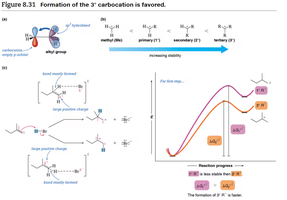
Carbocation intermediates can rearrange to form more stable carbocations via hydride or alkyl shifts. Tertiary carbocations are more stable than secondary or primary due to hyperconjugation and inductive effects.
Hyperconjugation: Stabilization of the carbocation by adjacent sigma bonds.
Rearrangement: 1,2-hydride or alkyl shifts can occur if a more stable carbocation can be formed.
Markovnikov and Anti-Markovnikov Addition
Markovnikov's rule states that in the addition of HX to an alkene, the hydrogen attaches to the carbon with more hydrogens (less substituted), and the halide attaches to the more substituted carbon. In the presence of peroxides, anti-Markovnikov addition can occur, especially with HBr, due to a radical mechanism.
Hydration of Alkenes
Alkenes can be hydrated to form alcohols via acid-catalyzed addition of water. The reaction proceeds via a carbocation intermediate and follows Markovnikov's rule. Rearrangement can occur if a more stable carbocation is possible.
Oxymercuration-Reduction
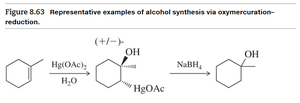
Oxymercuration-reduction is a two-step process that hydrates alkenes without carbocation rearrangement. The reaction proceeds via a mercurinium ion intermediate, which is attacked by water, followed by reduction with sodium borohydride.
Advantage: No rearrangement occurs, and Markovnikov addition is observed.
Hydroboration-Oxidation
Hydroboration-oxidation is a two-step reaction that adds water across the double bond in an anti-Markovnikov fashion. Boron adds to the less substituted carbon, and oxidation replaces boron with a hydroxyl group.
Stereochemistry: The addition is syn, meaning both boron and hydrogen add to the same face of the alkene.
Summary Table: Alkene Reactions
Reagent | Representative Alkene | Product | Process |
|---|---|---|---|
Br2 | Alkene | Dibromoalkane | Halogenation |
HBr | Alkene | Bromoalkane | Hydrohalogenation (Markovnikov) |
H2O, H2SO4 | Alkene | Alcohol | Hydration (Markovnikov) |
1. Hg(OAc)2, H2O 2. NaBH4 | Alkene | Alcohol | Oxymercuration-reduction (Markovnikov, no rearrangement) |
1. BH3, THF 2. H2O2, NaOH | Alkene | Alcohol | Hydroboration-oxidation (anti-Markovnikov, syn addition) |
Practice and Application
Assessment: Index of Hydrogen Deficiency
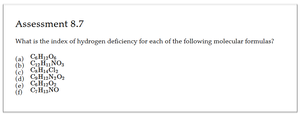
Calculate the IHD for the following molecular formulas:
C4H8O2
C9H11NO3
C7H6Cl2
C8H12N2O2
C4H7NO2
C6H13NO
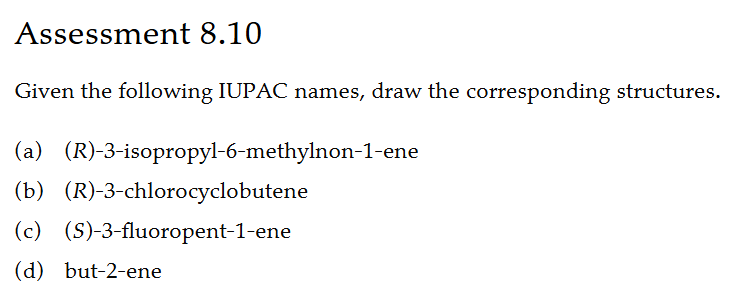
Assessment: Alkene Structure Drawing
Given the following IUPAC names, draw the corresponding structures:
(R)-3-isopropyl-6-methylnon-1-ene
(R)-3-chlorocyclobutene
(S)-3-fluoropent-1-ene
but-2-ene
Key Takeaways
Alkenes are nucleophilic and undergo electrophilic addition reactions.
The degree of unsaturation (IHD) is a valuable tool for deducing molecular structure.
Alkene nomenclature follows specific IUPAC rules, including for cyclic and polyunsaturated compounds.
Carbocation stability and rearrangement are crucial for predicting reaction products.
Markovnikov and anti-Markovnikov additions are important for regioselectivity in alkene reactions.
Oxymercuration-reduction and hydroboration-oxidation are key methods for alkene hydration with different regio- and stereochemical outcomes.
