 Back
BackComprehensive Guide to Organic Compound Classification and Nomenclature
Study Guide - Smart Notes
 Tailored notes based on your materials, expanded with key definitions, examples, and context.
Classification of Organic Compounds
Overview of Organic Compound Classes
Organic compounds are systematically classified based on their functional groups, which determine their chemical properties and reactivity. Understanding these classes is foundational for studying organic chemistry.
Hydrocarbons: Compounds containing only carbon and hydrogen. Subdivided into:
Alkanes: Saturated hydrocarbons with only single bonds. General formula:
Alkenes: Unsaturated hydrocarbons with at least one double bond. General formula:
Alkynes: Unsaturated hydrocarbons with at least one triple bond. General formula:
Alkyl Halides (Haloalkanes): Hydrocarbons containing halogen atoms (F, Cl, Br, I).
Alcohols, Aldehydes, Ketones, Carboxylic Acids & Derivatives: Compounds containing oxygen in various functional groups.
Amines: Compounds containing nitrogen atoms bonded to carbon.
Structural Formulae in Organic Chemistry
Types of Structural Representations
Organic molecules can be depicted in several ways, each providing different levels of detail:
Dash Formulae: Shows all bonds explicitly.
Condensed Formulae: Groups atoms together for simplicity (e.g., CH3CH2CH2CH3).
Line (Skeletal) Formulae: Uses lines to represent carbon chains, omitting hydrogen atoms bonded to carbons.
Dash-Wedge Formulae: Indicates 3D orientation of bonds.
Newman Projections: Visualizes conformations around single bonds.
Nomenclature of Organic Compounds
Principles of IUPAC Nomenclature
The International Union of Pure and Applied Chemistry (IUPAC) provides systematic rules for naming organic compounds to ensure each has a unique, unambiguous name.
Prefix: Indicates substituents attached to the main chain.
Parent: The longest continuous carbon chain.
Suffix: Identifies the main functional group (highest priority).
Locant: Specifies the position of substituents and functional groups.
Alkanes
Properties and Nomenclature of Alkanes
Alkanes are saturated hydrocarbons containing only single bonds. They can be straight-chained, branched, or cyclic. Their general formula is .
Naming: Identify the longest chain as the parent; number from the end nearest a branch; name and number substituents; use prefixes (di-, tri-, etc.) for identical groups; list substituents alphabetically (ignoring prefixes).
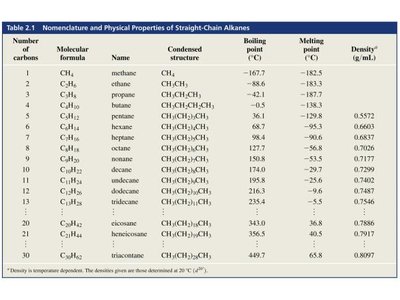
Physical Properties: Boiling and melting points increase with chain length; density is generally less than water.
Alkyl Substituents
Alkyl groups are derived from alkanes by removing one hydrogen atom. Their names are based on the parent alkane (e.g., methyl from methane, ethyl from ethane).
Branched and Complex Alkanes
When multiple substituents are present, number the chain to give the lowest possible numbers to the substituents. For "branched branches," systematic naming starts at the point of attachment to the main chain.
Cycloalkanes
Cycloalkanes are ring-shaped alkanes with the general formula . Naming rules are similar to those for alkanes, with special attention to numbering substituents for the lowest set of locants.
Alkenes and Alkynes
Structure and Nomenclature
Alkenes contain at least one double bond, while alkynes contain at least one triple bond. The longest chain containing the multiple bond is chosen as the parent, and numbering gives the lowest possible locant to the multiple bond.
Alkenes: Suffix "-ene"; general formula
Alkynes: Suffix "-yne"; general formula
Multiple Bonds and Substituents
Substituents are named and numbered as in alkanes. For cycloalkenes, the double bond is always given positions 1 and 2.
Alkyl Halides and Ethers
Alkyl Halides (Haloalkanes)
Alkanes with halogen substituents are named as haloalkanes. The chain is numbered to give the halogen the lowest possible number, and alphabetical precedence is used when necessary.
Ethers
Ethers have the general formula R-O-R. They can be named by:
IUPAC: The smaller alkyl group becomes the alkoxy substituent (e.g., methoxy, ethoxy).
Common Name: List alkyl groups alphabetically followed by "ether" (e.g., ethyl propyl ether).
Alcohols
Structure, Properties, and Nomenclature
Alcohols contain the hydroxyl group (-OH). They are classified as primary (1°), secondary (2°), or tertiary (3°) based on the number of carbon atoms attached to the carbon bearing the -OH group.
Primary (1°): -OH carbon attached to two hydrogens.
Secondary (2°): -OH carbon attached to one hydrogen.
Tertiary (3°): -OH carbon attached to no hydrogens.
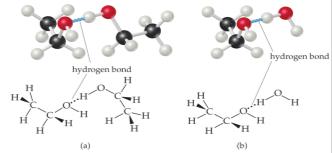
Alcohols can hydrogen bond, making them more soluble in water and giving them higher boiling points than alkanes of similar mass.
Solubility Trends
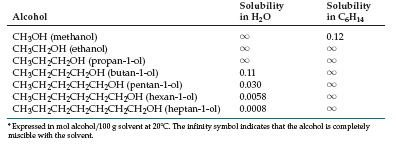
Solubility in water decreases as the hydrocarbon chain length increases, while solubility in nonpolar solvents like hexane increases with chain length.
Nomenclature of Alcohols
Choose the longest chain containing the -OH group, number to give the -OH the lowest possible number, and use the suffix "-ol" (e.g., hexan-1-ol).
Amines
Classification and Nomenclature
Amines are organic derivatives of ammonia and are classified as primary, secondary, or tertiary based on the number of organic groups attached to the nitrogen atom.
Common Name: List alkyl groups attached to nitrogen alphabetically, followed by "amine" (e.g., butylethylamine).
IUPAC: Replace the "e" of the parent hydrocarbon with "amine"; use "N-" to indicate substituents on nitrogen (e.g., N-ethyl-1-butanamine).
Carbonyl Compounds
Aldehydes and Ketones
Both contain the carbonyl group (C=O). Aldehydes have the carbonyl at the end of the chain (suffix "-al"), while ketones have it within the chain (suffix "-one").
Amides, Esters, Carboxylic Acids, and Nitriles
Amides: Suffix "-amide"; substituents on nitrogen are indicated with "N-".
Esters: Name the alkyl group from the alcohol, then the acid part with "-oate" (e.g., methyl butanoate).
Carboxylic Acids: Suffix "-oic acid"; always at position 1.
Nitriles: Suffix "-nitrile"; the nitrile group gets the lowest possible number.
Nomenclature with Multiple Functional Groups
Priority of Functional Groups
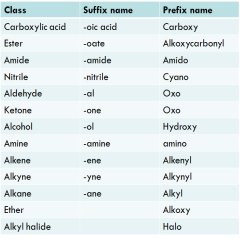
When multiple functional groups are present, the one with the highest priority determines the suffix, while others are named as prefixes. The order of priority is essential for correct naming.
Examples
N-methyl-5-oxopentanamide: Amide is the highest priority; ketone is named as "oxo" substituent.
5-hydroxy-5-methylhexanal: Aldehyde is the highest priority; hydroxy and methyl are substituents.
Summary Table: Functional Group Priorities
Class | Suffix name | Prefix name |
|---|---|---|
Carboxylic acid | -oic acid | Carboxy |
Ester | -oate | Alkoxycarbonyl |
Amide | -amide | Amido |
Nitrile | -nitrile | Cyano |
Aldehyde | -al | Oxo |
Ketone | -one | Oxo |
Alcohol | -ol | Hydroxy |
Amine | -amine | amino |
Alkene | -ene | Alkenyl |
Alkyne | -yne | Alkynyl |
Alkane | -ane | Alkyl |
Ether | Alkoxy | |
Alkyl halide | Halo |
Additional info: This guide covers the foundational nomenclature and classification principles for organic compounds, as required for introductory college-level organic chemistry. It includes systematic naming rules, functional group priorities, and examples for each major class.
