Back
BackConformational Analysis of Acyclic Alkanes and Cyclohexanes
Study Guide - Smart Notes
 Tailored notes based on your materials, expanded with key definitions, examples, and context.
Acyclic Alkanes and Cyclohexanes
Conformations of Open-Chain Compounds
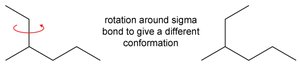
Alkanes with only single (σ) bonds can undergo free rotation about these bonds, resulting in different spatial arrangements called conformations (or rotamers). The study of the energy changes associated with these rotations is known as conformational analysis. Although all conformers are possible, some are more energetically favorable due to intramolecular forces.
Conformation: Temporary molecular shape resulting from rotation about single bonds.
Conformational analysis: Study of energy changes as a molecule rotates about single bonds.
Example: Rotation around the C–C bond in butane produces different conformers.
Three-Dimensional Representations of Ethane
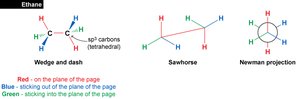
There are three common ways to represent the 3D structure of ethane on paper: wedge-and-dash, sawhorse, and Newman projection. Each highlights different aspects of molecular geometry and conformation.
Wedge-and-dash: Shows 3D orientation using solid and dashed wedges.
Sawhorse: Displays the molecule at an angle, emphasizing the spatial relationship between atoms.
Newman projection: Views the molecule down the axis of a bond, ideal for visualizing conformational changes.
Dihedral Angle and Conformations
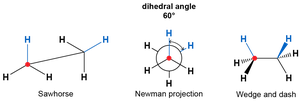
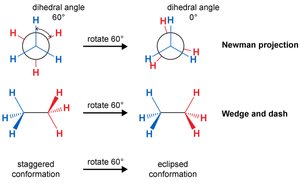
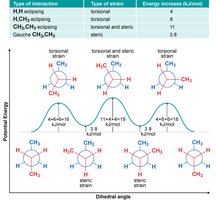
The dihedral angle is the angle between a bond on one atom and a bond on an adjacent atom. In ethane, the most stable conformation is the staggered conformation, where the dihedral angle is 60°. Rotation by 60° leads to the eclipsed conformation, where bonds are aligned, increasing repulsion and energy.
Staggered conformation: Dihedral angle = 60°, lower energy, more stable.
Eclipsed conformation: Dihedral angle = 0°, higher energy, less stable.
Torsional Strain in Ethane
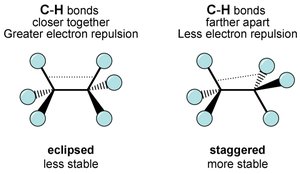
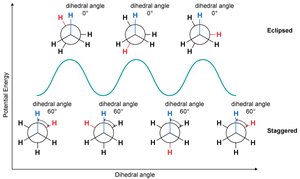
At room temperature, 99% of ethane molecules are in the staggered conformation. The energy difference between staggered and eclipsed conformations is called torsional strain, which is 12 kJ/mol for ethane. This strain arises from electron repulsion between eclipsed C–H bonds.
Torsional strain: Energy difference due to eclipsing bonds.
Staggered conformation: More stable due to minimized electron repulsion.
Eclipsed conformation: Less stable due to increased electron repulsion.
Conformational Analysis of Butane
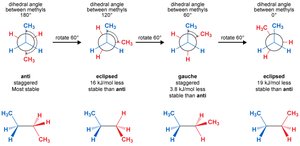
Butane (CH3CH2CH2CH3) exhibits more complex conformational behavior due to the presence of larger substituents. Free rotation around the C2–C3 bond is hindered by steric interactions and torsional strain. The most stable conformation is the anti conformation, where the two methyl groups are 180° apart. Other conformations include gauche (60° apart) and eclipsed (0° or 120° apart).
Anti conformation: Methyl groups are opposite each other (180°), lowest energy.
Gauche conformation: Methyl groups are 60° apart, higher energy due to steric strain.
Eclipsed conformation: Methyl groups overlap, highest energy due to torsional and steric strain.
Cycloalkanes: Ring Strain and Stability
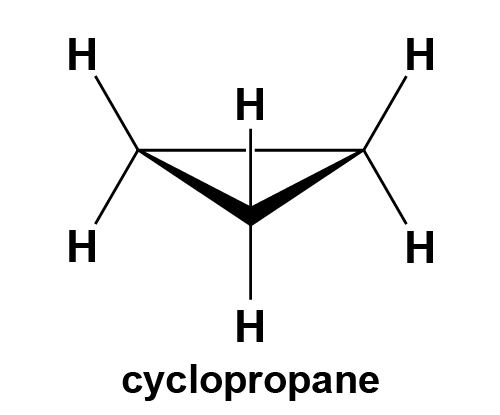
Cycloalkanes are alkanes with carbon atoms arranged in a ring. Their stability depends on angle strain (deviation from the ideal 109.5° bond angle) and torsional strain (eclipsing interactions). The heat of combustion per CH2 group is used to compare their relative stabilities. Cyclohexane is the most stable monocyclic alkane due to minimal angle and torsional strain, while cyclopropane is the least stable due to severe angle strain (60° bond angles).
Angle strain: Caused by bond angles deviating from 109.5°.
Torsional strain: Caused by eclipsing C–H bonds on adjacent carbons.
Heat of combustion: Used to experimentally determine relative stability.
Conformations of Cyclohexane
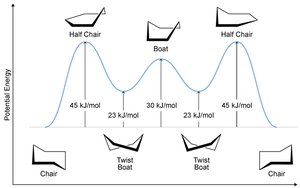
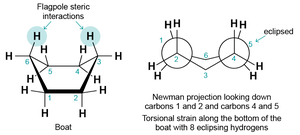
Cyclohexane adopts several conformations to minimize strain, the most important being the chair conformation. The chair form has no angle or torsional strain, making it the most stable. Other conformations include the boat, twist-boat, and half-chair, which are higher in energy due to increased strain.
Chair conformation: All bond angles are ~109.5°, all C–H bonds are staggered.
Boat conformation: No angle strain, but significant torsional strain and steric interactions (flagpole hydrogens).
Twist-boat and half-chair: Intermediate energy conformations.
Drawing Chair Conformations
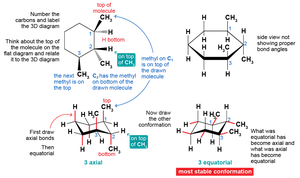
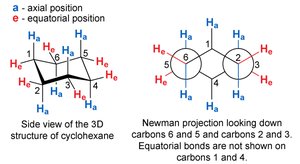
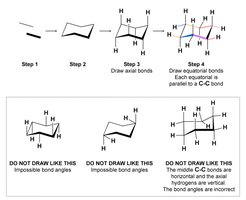
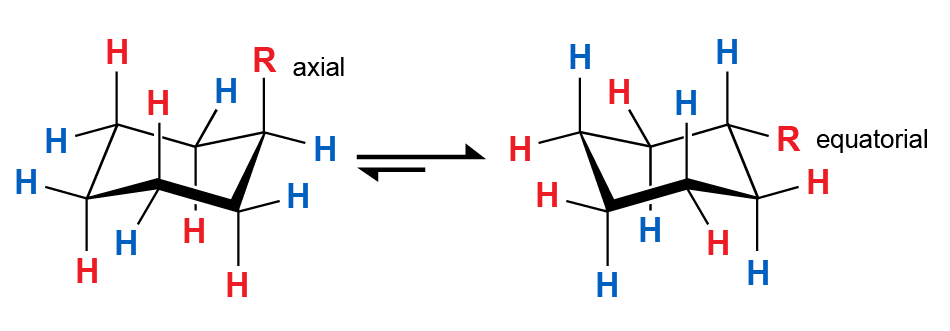
Properly drawing the chair conformation is essential for understanding cyclohexane chemistry. Axial bonds are perpendicular to the ring, while equatorial bonds are oriented outward, roughly parallel to the ring plane. Each carbon alternates between axial and equatorial positions.
Axial bonds: Point straight up or down from the ring.
Equatorial bonds: Point outward, away from the ring.
Ring Flip in Cyclohexane
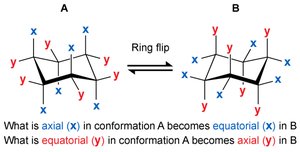
A ring flip interconverts the two chair conformations of cyclohexane. During a ring flip, all axial positions become equatorial and vice versa. This process is important for understanding the dynamic behavior of substituted cyclohexanes.
Ring flip: Interconversion between two chair forms, exchanging axial and equatorial positions.
Substituted Cyclohexanes: Methylcyclohexane
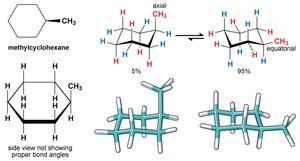
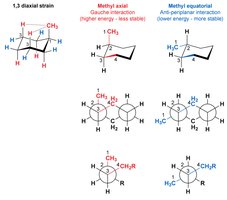
When cyclohexane is substituted, such as in methylcyclohexane, the position of the substituent (axial or equatorial) greatly affects stability. The equatorial position is favored due to reduced steric interactions (1,3-diaxial interactions). For methylcyclohexane, the equatorial conformer is more stable by about 7.17 kJ/mol.
Axial substituent: Experiences steric repulsion with axial hydrogens on the same side of the ring (1,3-diaxial interactions).
Equatorial substituent: More stable due to minimized steric interactions.
Effect of Substituent Size
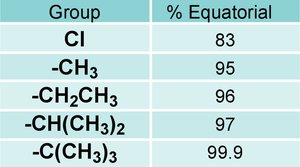
Larger substituents show an even greater preference for the equatorial position in cyclohexane due to increased steric hindrance in the axial position. The percentage of molecules with the substituent in the equatorial position increases with substituent size.
Group | % Equatorial |
|---|---|
Cl | 83 |
-CH3 | 95 |
-CH2CH3 | 96 |
-CH(CH3)2 | 97 |
-C(CH3)3 | 99.9 |
Conformers of Disubstituted Cyclohexanes
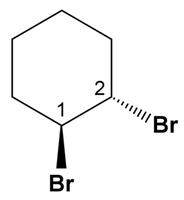
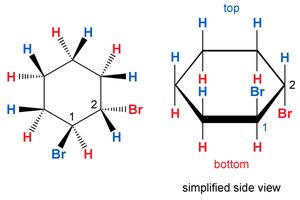
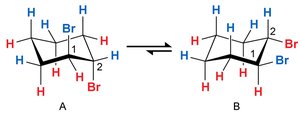
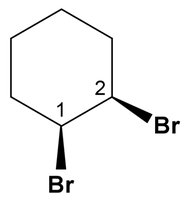
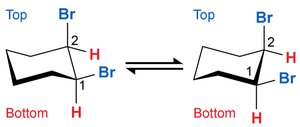
Disubstituted cyclohexanes, such as trans-1,2-dibromocyclohexane and cis-1,2-dibromocyclohexane, can exist in multiple chair conformations. For the trans isomer, both substituents can be axial or both equatorial. For the cis isomer, one substituent is axial and the other is equatorial in each chair form, resulting in equal energies and a 50:50 mixture.
Trans-1,2-dibromocyclohexane: Two axial or two equatorial conformers.
Cis-1,2-dibromocyclohexane: One axial and one equatorial in each conformer; both conformers have equal energy.

Practice: Drawing Chair Conformations
To determine the most stable conformation of a substituted cyclohexane, draw both chair forms and compare the positions of the substituents. The conformation with bulky groups in the equatorial positions is generally more stable.