 Back
BackConformations and Conformational Analysis in Organic Chemistry
Study Guide - Smart Notes
 Tailored notes based on your materials, expanded with key definitions, examples, and context.
Conformations and Conformational Analysis
Introduction to Conformations
Conformations are the different spatial arrangements of atoms in a molecule that result from rotation about single (sigma) bonds. Each specific arrangement is called a conformer. These conformers are a type of stereoisomer because they differ only in the orientation of their atoms in space, not in connectivity.
Rotation about Sigma Bonds: In molecules like ethane, the methyl groups are not fixed and can rotate freely about the C–C sigma bond, maintaining the linear overlap of orbitals.
Conformational Isomerism: Since conformers differ only by rotation, they are interconvertible and generally cannot be isolated at room temperature.
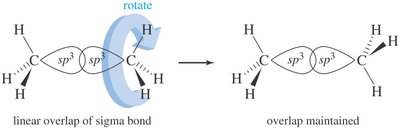
Representation of Conformations
Conformations can be represented using different projection formulas to visualize the spatial arrangement of atoms:
Sawhorse Formula: Shows the molecule at an angle, highlighting the spatial relationship between atoms.
Newman Projection: Views the molecule along the axis of a bond, with the front atom represented by a point and the back atom by a circle.
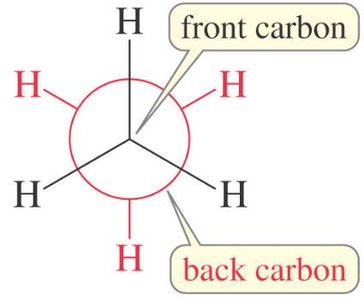
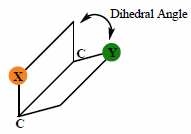
Dihedral Angle and Types of Conformations
The dihedral angle (θ) is the angle between two bonds on adjacent atoms, as seen in a Newman projection. The value of θ determines the type of conformation:
Eclipsed Conformation: θ = 0°, bonds on adjacent carbons align, leading to maximum repulsion.
Staggered Conformation: θ = 60°, bonds are as far apart as possible, minimizing repulsion.
Gauche Conformation: θ = 60° (for larger groups), a type of staggered conformation with substituents 60° apart.
Anti Conformation: θ = 180°, substituents are opposite each other, often the most stable arrangement for larger groups.
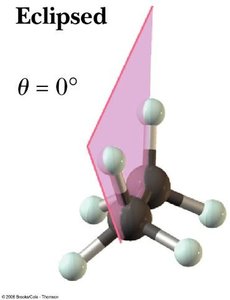
Conformational Analysis and Energetics
Conformational analysis studies the energetics of different conformations. The potential energy of a molecule changes as groups rotate about a bond:
Staggered conformations are at energy minima due to minimized electron repulsion.
Eclipsed conformations are at energy maxima due to increased torsional strain.
Torsional Strain: The resistance to twisting as a molecule rotates toward an eclipsed conformation. The energy difference between staggered and eclipsed conformers is called torsional energy.
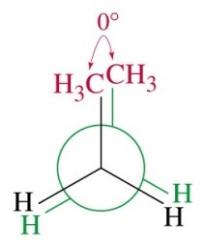
Example: For ethane, the torsional energy is about 12.6 kJ/mol; for propane, it is about 13.8 kJ/mol due to the bulkier methyl group.
Conformational Analysis of n-Butane
n-Butane exhibits several conformations due to rotation about the central C–C bond:
Highest energy: Methyl groups are eclipsed (0° dihedral angle).
Lowest energy: Methyl groups are anti (180° dihedral angle).
Gauche conformation: Methyl groups are 60° apart, intermediate in energy.

Factors Affecting Stability of Conformers
The stability of a conformer is influenced by:
Steric Interactions: Repulsion between bulky groups increases energy.
Torsional Strain: Repulsion between bonding electrons in eclipsed conformations.
Angle Strain: Deviation from ideal bond angles (109.5° for sp3 carbon).
In ethane, torsional strain is the main contributor to the rotational barrier, while steric factors are minor.
Conformations of 1,2-Dihaloethanes and the Gauche Effect
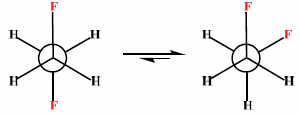
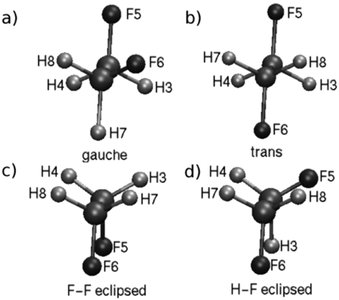
In 1,2-dihaloethanes (e.g., 1,2-dichloroethane, 1,2-difluoroethane), the energy difference between anti and gauche conformers is influenced by both steric and electronic effects:
Dipole Repulsion: Increases the energy barrier when polar bonds approach each other.
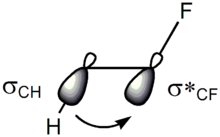
Gauche Effect: Compounds with electronegative groups (X–C–C–Y) often prefer the gauche conformation due to stabilizing hyperconjugative interactions (σ → σ*).
Hydrogen Bonding and Other Effects
Intramolecular hydrogen bonding can stabilize certain conformers, as seen in 1,2-ethanediol and related compounds. Other factors such as van der Waals interactions and dipole-dipole interactions also play a role in conformational stability.
Conformations of Cycloalkanes
Ring Strain in Cycloalkanes
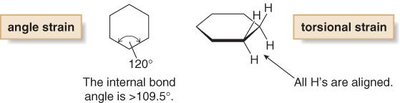
Cycloalkanes experience angle strain (deviation from ideal tetrahedral angles) and torsional strain (eclipsing interactions). To minimize these strains, cycloalkanes with more than three carbons adopt non-planar, puckered conformations.
Angle Strain: Caused by bond angles deviating from 109.5°.
Torsional Strain: Caused by eclipsed C–H bonds.

Conformations of Cyclopentane and Cyclohexane
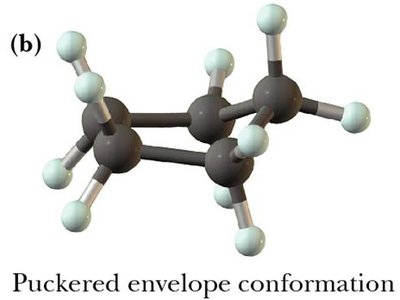
Cyclopentane: Adopts a puckered "envelope" conformation to reduce torsional strain, though some angle strain remains.
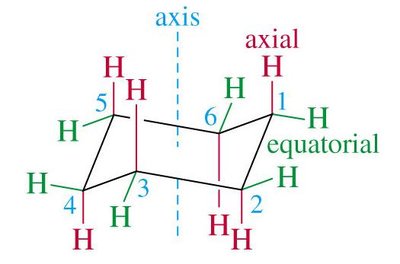
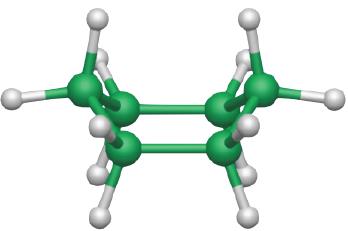
Cyclohexane: The most stable conformation is the "chair" form, which eliminates both angle and torsional strain. Other conformations include the boat and twist-boat forms, which are higher in energy due to increased steric and torsional strain.

Ring Flipping in Cyclohexane
Ring flipping interconverts axial and equatorial positions of substituents in cyclohexane, but all "up" and "down" positions remain unchanged. This process is important for understanding the relative stability of substituted cyclohexanes.
Steric Strain in Substituted Cyclohexanes
Substituents prefer the equatorial position to minimize steric (1,3-diaxial) interactions. The energy difference between axial and equatorial positions depends on the size and nature of the substituent.
X | Eaxial – Eeq (kJ/mol) |
|---|---|
-H | 0.0 |
-CH3 | 3.8 |
-Cl | 1.0 |
-OH | 2.1 |
-C(CH3)3 | 11.4 |
Example: In monosubstituted cyclohexanes, the equatorial conformer is more stable. In disubstituted cyclohexanes, the relative positions (cis/trans) and the size of substituents determine the most stable conformation.
Summary
Conformational analysis is essential for understanding the stability and reactivity of organic molecules.
Rotation about single bonds leads to different conformers, whose stability is influenced by steric, torsional, and angle strain.
Cycloalkanes adopt non-planar conformations to minimize strain, with cyclohexane chair being the most stable.
Substituents on cyclohexane rings prefer equatorial positions to reduce steric interactions.
