Back
Conformations of Alkanes and Cycloalkanes: Structured Study Notes
Study Guide - Smart Notes
 Tailored notes based on your materials, expanded with key definitions, examples, and context.
Module 3: Conformations of Alkanes and Cycloalkanes
3.1 Conformational Analysis of Ethane
Conformational analysis explores the different spatial arrangements of a molecule that arise from rotation about single bonds. These arrangements, called conformations, are fundamental to understanding the physical and chemical properties of alkanes.
Definition: Conformations are distinct spatial arrangements generated by rotation about sigma (single) bonds.
Importance: The energy differences between conformations affect molecular stability and reactivity.
Eclipsed and Staggered Conformations
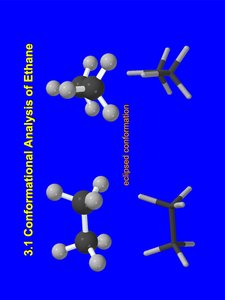
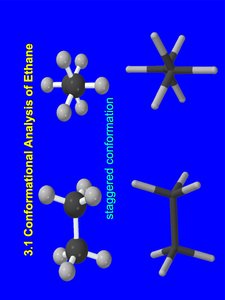
Ethane exhibits two primary conformations: eclipsed and staggered. The staggered conformation is more stable due to minimized electron repulsion.
Eclipsed: Hydrogens on adjacent carbons are aligned, leading to increased torsional strain.
Staggered: Hydrogens are offset, reducing repulsion and strain.
Projection Formulas
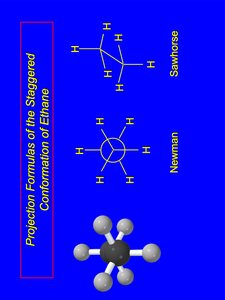
Conformations can be represented using Newman and Sawhorse projection formulas, which help visualize spatial relationships.
Newman projection: Views the molecule along the bond axis.
Sawhorse projection: Shows the molecule at an angle, highlighting bond angles.
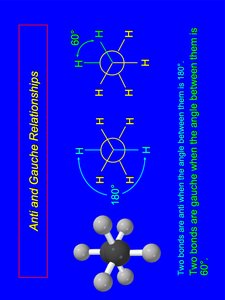
Anti and Gauche Relationships
Bond relationships are classified based on the dihedral angle between them:
Anti: Bonds are 180° apart.
Gauche: Bonds are 60° apart.
Energy Profile of Ethane Rotation
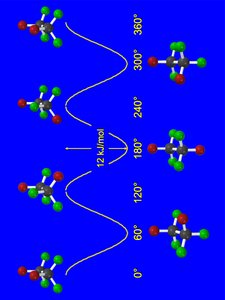
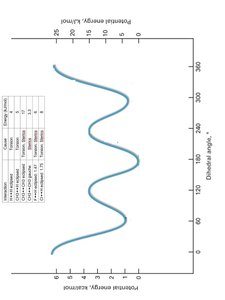
The energy changes as ethane rotates about its C–C bond, with staggered conformations at energy minima and eclipsed at maxima.
Torsional strain: Energy difference between staggered and eclipsed conformations (about 12 kJ/mol).
Unbranched Alkanes
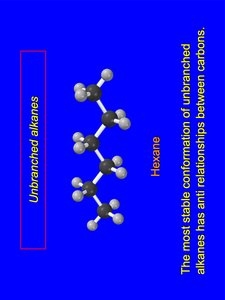
For unbranched alkanes like hexane, the most stable conformation has anti relationships between carbon atoms, minimizing steric and torsional strain.
Example: Hexane adopts a zigzag conformation for maximum stability.
3.4 The Shapes of Cycloalkanes: Planar or Nonplanar?
Cycloalkanes can adopt planar or nonplanar shapes depending on ring size and strain. The stability of these rings is influenced by several types of strain.
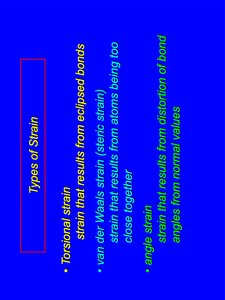
Types of Strain
Torsional strain: Results from eclipsed bonds.
van der Waals strain (steric strain): Results from atoms being too close together.
Angle strain: Results from distortion of bond angles from normal values.
Historical Perspective: Adolf von Baeyer (19th century)
Baeyer assumed cycloalkanes were planar polygons, attributing instability to angle strain from bond angles deviating from 109.5°. However, this assumption was later found incorrect for larger rings.
Contribution: Advanced the concept of angle strain as a destabilizing factor.
Limitation: Cycloalkanes are not always planar; nonplanar conformations relieve strain.

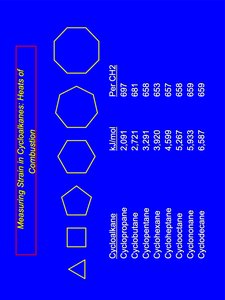
Measuring Strain in Cycloalkanes: Heats of Combustion
Heats of combustion provide a quantitative measure of ring strain in cycloalkanes. Higher strain correlates with higher heat of combustion per CH2 group.
Cycloalkane | Per CH2 (kJ/mol) | Total (kJ/mol) |
|---|---|---|
Cyclopropane | 697 | 2,091 |
Cyclobutane | 693 | 2,771 |
Cyclopentane | 681 | 3,290 |
Cyclohexane | 658 | 3,951 |
Cycloheptane | 657 | 4,599 |
Cyclooctane | 659 | 5,269 |
Cyclononane | 659 | 5,931 |
Cyclodecane | 659 | 6,587 |
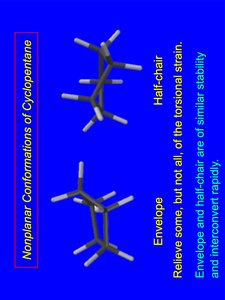
Nonplanar Conformations of Cyclopentane
Cyclopentane adopts nonplanar conformations (envelope and half-chair) to relieve torsional strain. These conformations are of similar stability and interconvert rapidly.
Envelope: One carbon is out of the plane.
Half-chair: Two adjacent carbons are out of the plane.
Conformations of Cyclohexane
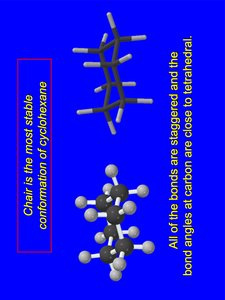
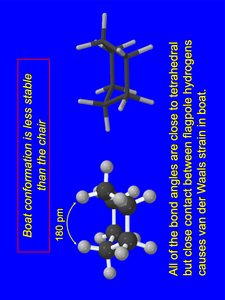
Cyclohexane is most stable in the chair conformation, where all bonds are staggered and bond angles are close to tetrahedral (109.5°). Other conformations include boat and skew boat, which are less stable due to increased strain.
Chair: All bonds staggered, minimal strain.
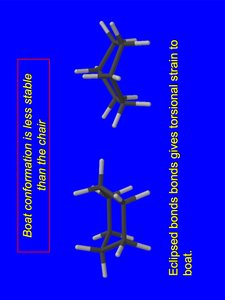
Boat: Some bonds eclipsed, increased van der Waals and torsional strain.
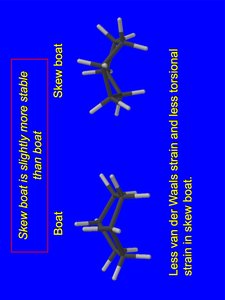
Skew boat: Slightly more stable than boat, less strain.
3.8 Axial and Equatorial Bonds in Cyclohexane
In the chair conformation, cyclohexane has two types of bonds: axial (parallel to the ring axis) and equatorial (around the ring's equator). Substituents prefer the equatorial position to minimize steric interactions.
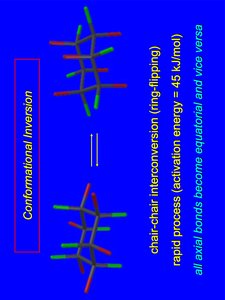
3.9 Conformational Inversion (Ring-Flipping) in Cyclohexane
Cyclohexane undergoes rapid ring-flipping, interconverting between two chair conformations. During this process, all axial bonds become equatorial and vice versa. The activation energy for ring-flipping is about 45 kJ/mol.
Chair-chair interconversion: Rapid and reversible.
Effect: Substituents can switch between axial and equatorial positions.