Back
BackCycloalkanes and Stereochemistry: Chirality, Enantiomers, and Optical Activity
Study Guide - Smart Notes
 Tailored notes based on your materials, expanded with key definitions, examples, and context.
Organic Compounds: Cycloalkanes and Their Stereochemistry
Polycyclic Molecule Conformations – Norbornane
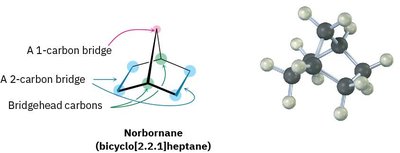
Polycyclic molecules are compounds containing more than one ring in their structure. Norbornane is a classic example, featuring a bicyclic system with unique conformational properties due to its rigid structure.
Norbornane (bicyclo[2.2.1]heptane) consists of two bridgehead carbons connected by three bridges: a 1-carbon bridge and two 2-carbon bridges.
Its rigid framework restricts rotation, influencing its chemical reactivity and stereochemistry.
Polycyclic systems like norbornane are important in understanding ring strain and stereochemical outcomes in organic reactions.
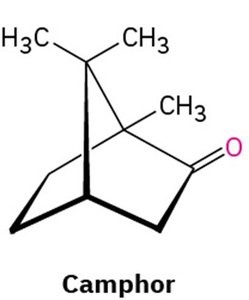
Example: Camphor is another polycyclic molecule with significant biological and synthetic importance.
Stereochemistry at Tetrahedral Centers
Stereochemistry – Handedness and Mirror Images
Stereochemistry is the study of the spatial arrangement of atoms in molecules and its impact on their chemical behavior. Handedness, or chirality, is a key concept, especially for tetrahedral (sp3 hybridized) carbon centers.
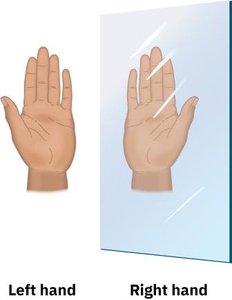
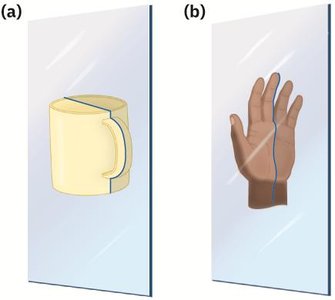
Handedness refers to the property where objects (or molecules) are non-superimposable on their mirror images, much like left and right hands.
This property is crucial in organic and biological chemistry, affecting the function of drugs, amino acids, carbohydrates, and nucleic acids.
Enantiomers and the Tetrahedral Carbon
Enantiomers are a type of stereoisomer that are non-superimposable mirror images of each other. This phenomenon arises when a carbon atom is bonded to four different substituents, forming a chiral center.
CH3X and CH2XY molecules are identical to their mirror images (achiral).
CHXYZ molecules, with four different groups attached to carbon, are not identical to their mirror images and are chiral.
Enantiomers have identical physical properties except for their interaction with plane-polarized light and reactions in chiral environments.
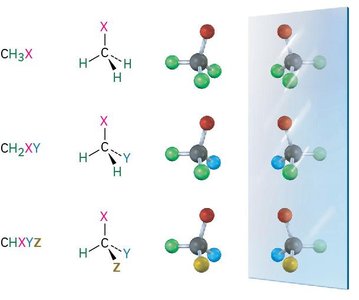
Example: Lactic acid exists as two enantiomers, (+)-lactic acid and (−)-lactic acid, which are mirror images but not superimposable.
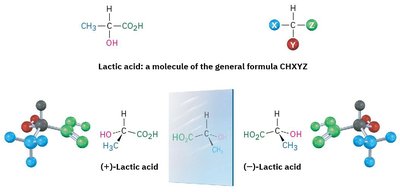
Superimposability of Enantiomers
Attempts to superimpose enantiomers, such as the two forms of lactic acid, demonstrate that matching one pair of substituents leads to a mismatch in the others, confirming their non-superimposable nature.
When −H and −OH are matched, −CO2H and −CH3 do not align, and vice versa.

The Reason for Handedness in Molecules: Chirality
Definition and Prediction of Chirality
A molecule is chiral if it is not identical to its mirror image. The presence or absence of a plane of symmetry is a key criterion for chirality.
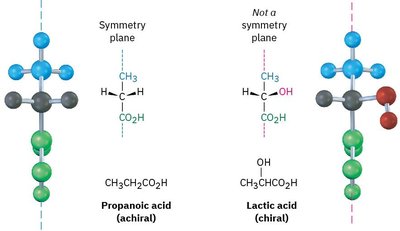
Plane of symmetry: A plane dividing a molecule into two mirror-image halves. If present, the molecule is achiral.
Achiral molecules have at least one plane of symmetry in any conformation.
Chiral molecules lack a plane of symmetry in all conformations.
Example: Propanoic acid is achiral due to its plane of symmetry, while lactic acid is chiral as it lacks such a plane.
Examples of Chirality in Organic Molecules
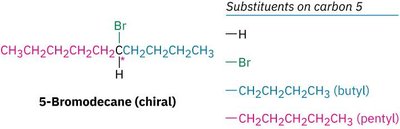
5-Bromodecane is chiral because carbon 5 is attached to four different groups: H, Br, butyl, and pentyl.
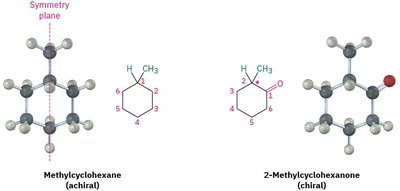
Methylcyclohexane is achiral due to a plane of symmetry, while 2-methylcyclohexanone is chiral as it lacks such symmetry.
Optical Activity
Interaction with Plane-Polarized Light
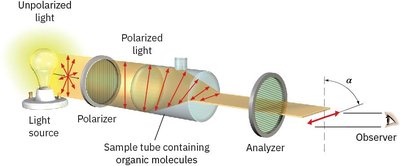
Chiral molecules can rotate the plane of polarized light, a property known as optical activity. This is measured using a polarimeter.
Levorotatory compounds rotate light to the left (counterclockwise, − sign).
Dextrorotatory compounds rotate light to the right (clockwise, + sign).
The degree of rotation depends on the path length, concentration, and the specific nature of the compound.
The specific rotation is defined as:
= observed rotation (degrees)
= path length (dm)
= concentration (g/cm3)
where the measurement is made using light of 589.6 nm wavelength, a path length of 1 dm, and a concentration of 1 g/cm3.
Pasteur’s Discovery of Enantiomers
Historical Context
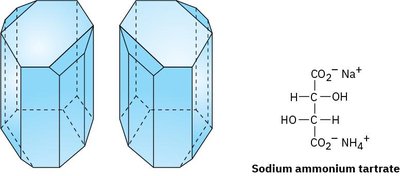
Louis Pasteur discovered enantiomers by observing that sodium ammonium tartrate crystals could exist in two mirror-image forms, each rotating plane-polarized light in opposite directions. This was the first demonstration of molecular chirality and optical activity.