 Back
BackDelocalized Electrons: Stability, Aromaticity, and Effects on Organic Reactions
Study Guide - Smart Notes
 Tailored notes based on your materials, expanded with key definitions, examples, and context.
Delocalized Electrons and Their Effect on Stability and Reactions
Delocalized vs. Localized Electrons
Electrons in organic molecules can be either localized (confined to a single atom or bond) or delocalized (spread over several atoms through overlapping p orbitals). Delocalization is a key concept in understanding molecular stability and reactivity.
Localized electrons: Found in sigma bonds or lone pairs not involved in resonance.
Delocalized electrons: Result from p orbital overlap across adjacent atoms, forming resonance structures.
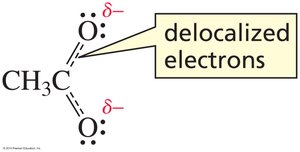
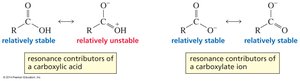
Example: In carboxylate ions, the negative charge is shared between two oxygens, increasing stability.

Structure and Aromaticity of Benzene
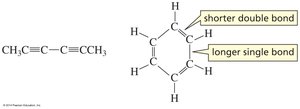
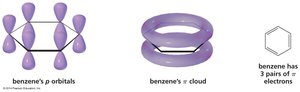
Benzene is a classic example of a molecule with delocalized electrons. Its structure and reactivity are explained by resonance and aromaticity.
Molecular formula: C6H6
Degree of unsaturation: 4 (indicating multiple double bonds or rings)
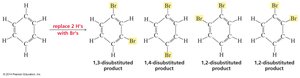
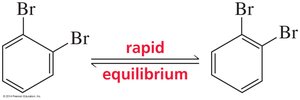
Substitution reactions: Benzene yields one monosubstituted product and three disubstituted products, reflecting its symmetry and electron delocalization.


Resonance and Delocalization Energy
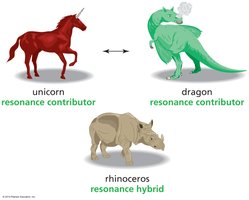
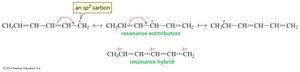
Resonance describes the delocalization of electrons across multiple atoms, resulting in increased stability. The resonance hybrid is the true structure, more stable than any individual resonance contributor.
Delocalization energy: The extra stability from electron delocalization.
Resonance contributors: Different possible electron arrangements; the hybrid is a weighted average.
Example: Carboxylate ions have greater delocalization energy than carboxylic acids.
Rules for Drawing Resonance Contributors
Resonance structures are drawn following specific rules to ensure chemical accuracy:
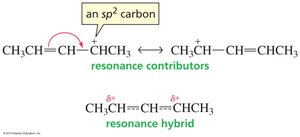
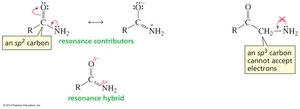
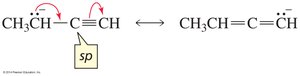
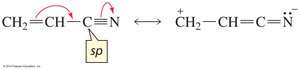
Only electrons move, not atoms.
Only π electrons and lone pairs participate.
The total number of electrons remains constant.
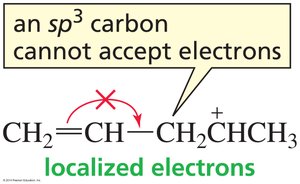
An sp3 carbon cannot accept electrons; it already has an octet.
Sigma bonds are not broken.
Stability of Resonance Contributors
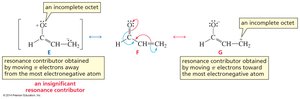
The stability of resonance contributors depends on the distribution of charges and the completeness of octets:
Structures with complete octets and charges on electronegative atoms are more stable.
The greater the number of stable contributors, the greater the delocalization energy.
Resonance contributors with incomplete octets or charges on less electronegative atoms are less stable.

Aromaticity: Criteria and Examples
Aromatic compounds are exceptionally stable due to electron delocalization. To be aromatic, a compound must:
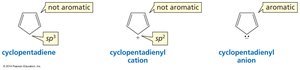
Have an uninterrupted cloud of π electrons (cyclic, planar, every ring atom with a p orbital).
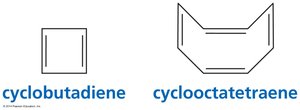
Contain an odd number of pairs of π electrons (Hückel's rule: 4n+2 π electrons).
Resonance in Aromatic and Heterocyclic Compounds
Many aromatic compounds, including heterocycles, exhibit resonance and delocalization:
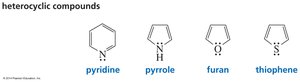
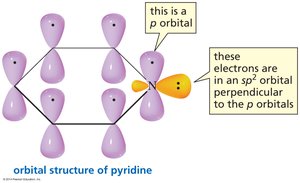
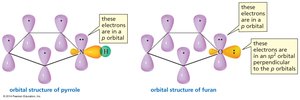
Heterocyclic aromatics: Pyridine, pyrrole, furan, and thiophene have delocalized electrons in their rings.
Orbital structure: The arrangement of p orbitals and lone pairs determines aromaticity.
Relative Stabilities: Aromatic, Nonaromatic, and Antiaromatic Compounds
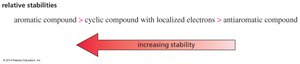
The stability of cyclic compounds depends on electron delocalization:
Aromatic compounds: Most stable due to delocalization.
Nonaromatic compounds: Less stable, localized electrons.
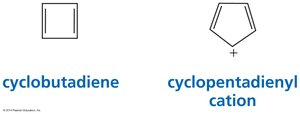
Antiaromatic compounds: Least stable, even number of pairs of π electrons, planar, cyclic.
Conjugated and Isolated Dienes
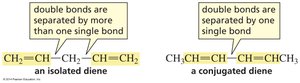
Dienes are compounds with two double bonds. Their stability depends on whether the double bonds are conjugated (separated by one single bond) or isolated (separated by more than one single bond).
Conjugated dienes: More stable due to delocalization.
Isolated dienes: Less stable, localized electrons.
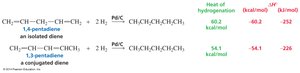
Heat of hydrogenation: Lower for conjugated dienes, indicating greater stability.
Delocalized Electrons and Carbocation Stability
Carbocations are stabilized by resonance and delocalization:
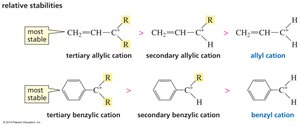
Benzylic and allylic carbocations: Highly stabilized by resonance.
Resonance contributors: Show charge delocalization across the molecule.
Stability order: Benzylic > allylic > tertiary > secondary > primary > methyl > vinyl.


Delocalized Electrons Affect pKa Values
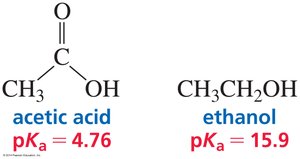
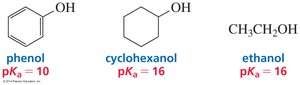
Electron delocalization increases the stability of conjugate bases, lowering the pKa of acids:
Acetic acid: pKa = 4.76 (delocalized electrons in acetate ion)
Ethanol: pKa = 15.9 (localized electrons in ethoxide ion)
Phenol: More acidic than alcohols due to resonance stabilization of the phenoxide ion.
Electron Withdrawing and Donating by Resonance
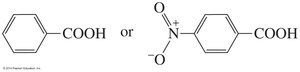
Substituents on aromatic rings can withdraw or donate electrons by resonance, affecting reactivity and acidity:
Electron-withdrawing groups: Stabilize negative charges, increase acidity.
Electron-donating groups: Destabilize negative charges, decrease acidity.
Summary Table: Resonance and Stability
The following table summarizes the relationship between resonance, delocalization, and stability:
Compound Type | Electron Delocalization | Stability |
|---|---|---|
Aromatic | Delocalized | Highest |
Conjugated Diene | Delocalized | High |
Isolated Diene | Localized | Moderate |
Antiaromatic | Delocalized (unstable) | Lowest |
Additional info: Resonance and delocalization are central to understanding organic reactivity, stability, and acidity. The concepts are foundational for aromaticity, carbocation stability, and acid-base chemistry in organic molecules.
