 Back
BackEfficiency and Directing Effects in Electrophilic Aromatic Substitution (EAS)
Study Guide - Smart Notes
 Tailored notes based on your materials, expanded with key definitions, examples, and context.
Electrophilic Aromatic Substitution (EAS): Efficiency and Directing Effects
Overview of EAS and Substituent Effects
Electrophilic Aromatic Substitution (EAS) is a fundamental reaction in organic chemistry, particularly involving aromatic compounds such as benzene. The efficiency and outcome of EAS reactions are strongly influenced by the nature and position of substituents already present on the aromatic ring. These substituents can either activate or deactivate the ring towards further substitution, and their directing effects determine the position where new substituents are introduced.
Kinetic Product: EAS reactions typically yield the kinetic product, which forms via the lowest energy transition state.
Activating Groups: Groups that donate electrons to the ring (e.g., alkyl, methoxy) increase reactivity and direct new substituents to the ortho and para positions.
Deactivating Groups: Electron-withdrawing groups (e.g., nitro, sulfonic acid) decrease reactivity and direct new substituents to the meta position.
Friedel-Crafts Reactions: Alkylation and acylation are inefficient on deactivated benzene rings due to poor reactivity.
Nucleophilic Aromatic Substitution (NAS)
Nucleophilic aromatic substitution is favored when electron-withdrawing groups are positioned ortho and/or para to the leaving group. These groups create electron deficiency at the reactive carbon, facilitating nucleophilic attack and stabilizing the intermediate through resonance.
Electron-Withdrawing Groups: Enhance NAS by stabilizing the negative charge developed during the reaction.
Resonance Stabilization: The intermediate can delocalize electrons into the electron-withdrawing group, restoring aromaticity after the leaving group is displaced.
Directing Effects in EAS: When Substituents Conflict
Summary Table: Effects of Substituents on EAS
The table below summarizes how different substituents affect the outcome of EAS reactions, especially when their directing effects conflict:
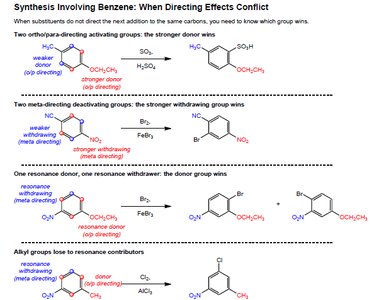
Key Scenarios Illustrated in the Table
Two Ortho/Para-Directing Activating Groups: The stronger donor group dominates, directing substitution to its preferred position.
Two Meta-Directing Deactivating Groups: The stronger withdrawing group wins, guiding substitution to the meta position relative to itself.
One Resonance Donor, One Resonance Withdrawer: The donor group typically prevails, directing substitution to the ortho/para positions.
Alkyl Groups vs. Resonance Contributors: Alkyl groups lose to resonance contributors, as resonance effects are more influential in directing substitution.
Definitions and Examples
Activating Groups: Substituents that increase the electron density of the aromatic ring, making it more reactive toward electrophiles. Examples: -OH, -OCH3, -NH2.
Deactivating Groups: Substituents that decrease the electron density of the ring, making it less reactive. Examples: -NO2, -SO3H, -COOH.
Ortho/Para Directing: Groups that direct new substituents to the positions adjacent (ortho) or opposite (para) to themselves.
Meta Directing: Groups that direct new substituents to the position one carbon away (meta) from themselves.
Resonance and Inductive Effects
Resonance effects occur when substituents can delocalize electrons through the aromatic ring, significantly impacting the reactivity and directing effects. Inductive effects involve the transmission of charge through sigma bonds, also influencing substitution patterns.
Resonance Donors: Groups with lone pairs adjacent to the ring (e.g., -OCH3) donate electrons via resonance.
Resonance Withdrawers: Groups with double bonds to electronegative atoms (e.g., -NO2) withdraw electrons via resonance.
Equations and Mechanisms
The general mechanism for EAS involves the following steps:
Formation of the electrophile
Attack of the aromatic ring on the electrophile
Formation of the arenium ion intermediate
Restoration of aromaticity by loss of a proton
Example equation for EAS:
Example equation for NAS:
Applications
Synthesis of Pharmaceuticals: EAS is used to introduce functional groups into aromatic rings, a key step in drug synthesis.
Material Science: Modification of aromatic polymers via EAS and NAS reactions.
