 Back
BackElements, Atomic Structure, and Periodic Properties: Foundations for Organic Chemistry
Study Guide - Smart Notes
 Tailored notes based on your materials, expanded with key definitions, examples, and context.
Elements and Chemical Symbols
Definition and Classification of Elements
Elements are pure substances from which all other substances are built. They cannot be broken down into simpler substances by chemical means. Each element is represented by a unique chemical symbol, typically one or two letters, where the first letter is always capitalized and the second letter, if present, is lowercase.
Element Names: Derived from various sources including planets, mythological figures, minerals, colors, geographic locations, and famous people.
Chemical Symbols: For example, Co is cobalt, while CO indicates both carbon and oxygen.
Latin Names: Some symbols are based on Latin names, e.g., Au for gold (aurum), Ag for silver (argentum).
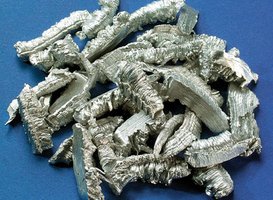
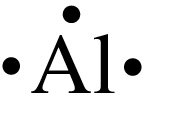
Example: Aluminum is represented by the symbol Al.



The Periodic Table
Organization and Group Names
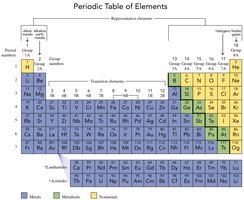
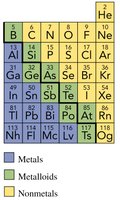
The periodic table organizes 118 elements into groups with similar properties and arranges them in order of increasing atomic mass. Elements are classified as metals, nonmetals, or metalloids based on their physical and chemical properties.
Groups: Vertical columns; elements in the same group share similar properties.
Periods: Horizontal rows; elements are arranged by increasing atomic number.
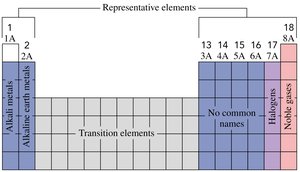
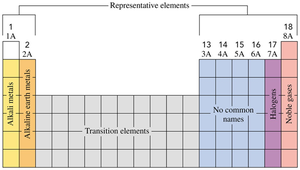
Common Group Names: Alkali metals (Group 1), alkaline earth metals (Group 2), halogens (Group 17), noble gases (Group 18).
Metals, Nonmetals, and Metalloids
Physical and Chemical Properties
Elements are classified based on their location relative to the zigzag line on the periodic table:
Metals: Left of the zigzag line; shiny, ductile, malleable, good conductors, high melting points, mostly solid at room temperature (except mercury).
Nonmetals: Right of the zigzag line; not shiny, poor conductors, low melting points and densities.
Metalloids: Along the zigzag line; exhibit properties of both metals and nonmetals.
Elements Essential to Health
Macrominerals and Microminerals
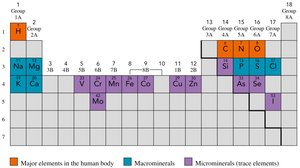
About 20 elements are essential for human health. Four elements—oxygen, carbon, hydrogen, and nitrogen—make up 96% of body mass. Macrominerals (Ca, P, K, Cl, S, Na, Mg) are involved in bone formation, heart and blood vessel maintenance, muscle contraction, nerve impulses, acid–base balance, and cellular metabolism. Microminerals (trace elements) are present in very small amounts and are mostly transition elements.
Atomic Structure
Atoms and Subatomic Particles
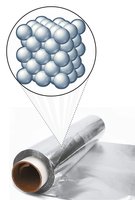
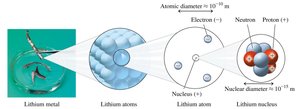
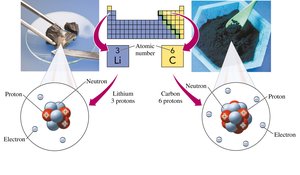
An atom is the smallest particle of an element that retains its properties. Atoms consist of a nucleus (containing protons and neutrons) and electrons in a large space around the nucleus.
Proton: Positive charge, located in the nucleus.
Neutron: No charge, located in the nucleus.
Electron: Negative charge, found outside the nucleus.
Historical Models of the Atom
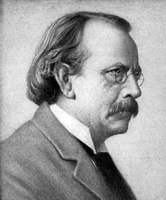
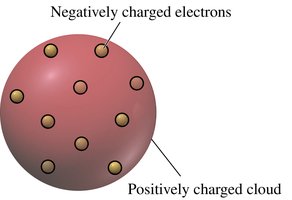
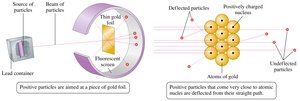
Dalton's atomic theory (1808) proposed that matter is made of atoms, which combine to form compounds. J.J. Thomson's cathode ray experiment (1897) led to the discovery of electrons and the "plum-pudding" model. Rutherford's gold foil experiment (1911) revealed the nucleus as a small, positively charged region.

Atomic Number and Mass Number
Definitions and Calculations
All atoms of an element have the same number of protons (atomic number). The mass number is the sum of protons and neutrons in the nucleus.
Atomic Number (Z): Number of protons in the nucleus.
Mass Number (A): Number of protons plus neutrons.
Neutral Atom: Number of protons equals number of electrons.
Isotopes and Atomic Mass
Isotopes
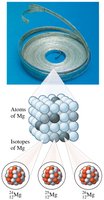
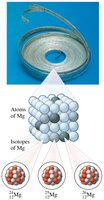
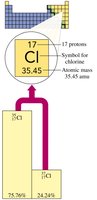
Isotopes are atoms of the same element with different mass numbers due to varying numbers of neutrons. Atomic symbols indicate the number of protons, neutrons, and electrons in a specific isotope.
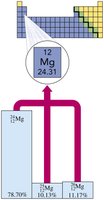
Example: Magnesium has three naturally occurring isotopes.
Atomic Mass: Weighted average of all naturally occurring isotopes, listed below the element symbol on the periodic table.


Electron Energy Levels
Electromagnetic Radiation and Atomic Spectra
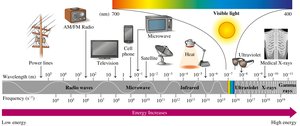
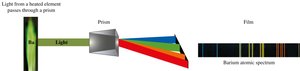
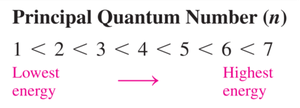
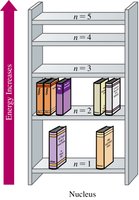
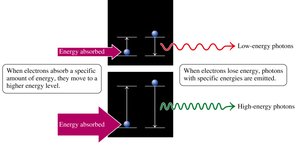
Electrons occupy specific energy levels in an atom, which are quantized. The arrangement of electrons determines the atomic spectrum, unique for each element. Energy levels are assigned principal quantum numbers (n), increasing in energy as n increases.
Electromagnetic Spectrum: Includes radio waves, microwaves, infrared, visible light, ultraviolet, X-rays.
Atomic Spectrum: Lines of color associated with electron energy changes.

Electron Arrangements and Periodic Properties
Electron Configurations
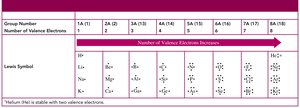
Electron arrangements for elements follow the filling of energy levels. The number of valence electrons (outermost electrons) determines chemical properties and is given by the group number for representative elements.
Lewis Symbols: Dots around the element symbol represent valence electrons.

Trends in Periodic Properties
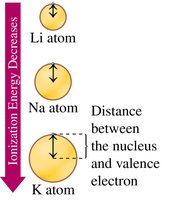
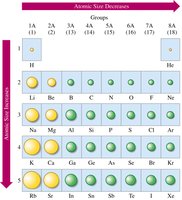
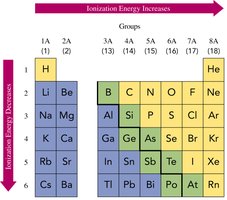
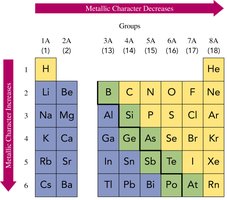
Periodic properties such as atomic size, ionization energy, and metallic character show predictable trends across periods and groups.
Atomic Size: Increases down a group, decreases across a period.
Ionization Energy: Decreases down a group, increases across a period.
Metallic Character: Increases down a group, decreases across a period.
Summary Table: Periodic Trends
Comparison of Properties
The following table summarizes the trends in atomic size, ionization energy, and metallic character for representative elements:
Property | Trend Down a Group | Trend Across a Period |
|---|---|---|
Atomic Size | Increases | Decreases |
Ionization Energy | Decreases | Increases |
Metallic Character | Increases | Decreases |
Additional info: These foundational concepts are essential for understanding organic chemistry, as the behavior of atoms and elements underpins molecular structure, reactivity, and the mechanisms of organic reactions.
