 Back
BackEpoxide Chemistry: Synthesis, Reactivity, and Mechanisms
Study Guide - Smart Notes
 Tailored notes based on your materials, expanded with key definitions, examples, and context.
Q1. Draw the structure and name of the epoxide product formed from each alkene precursor (propene, cyclopentene, styrene, alpha-pinene) after oxidation.
Background
Topic: Epoxide Synthesis from Alkenes
This question tests your understanding of how alkenes are converted to epoxides via oxidation, and how to name the resulting epoxides.
Key Terms and Formulas:
Epoxide: A three-membered cyclic ether formed by oxidation of an alkene.
Oxidizing agent: Commonly mCPBA (meta-chloroperoxybenzoic acid) or peracids.
Naming: Add "oxide" to the alkene name (e.g., cyclohexene → cyclohexene oxide).
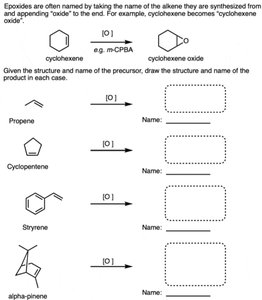
Step-by-Step Guidance
Identify the alkene group in each precursor molecule.
Draw the three-membered ring (epoxide) by connecting the two alkene carbons with an oxygen atom.
Ensure the rest of the molecule remains unchanged except for the new epoxide ring.
Name the product by taking the alkene name and appending "oxide" (e.g., propene → propene oxide).
Try solving on your own before revealing the answer!
Final Answer:
Each alkene forms its corresponding epoxide (e.g., propene oxide, cyclopentene oxide, styrene oxide, alpha-pinene oxide).
The epoxide ring is drawn by connecting the alkene carbons with an oxygen atom.
Q2. Explain why propylene oxide reacts with aqueous base to form a diol, but tetrahydrofuran does not.
Background
Topic: Epoxide Reactivity vs. Cyclic Ethers
This question tests your understanding of ring strain and electrophilicity in epoxides compared to other cyclic ethers.
Key Terms and Concepts:
Epoxide: Highly strained three-membered ring, making it more reactive.
Tetrahydrofuran (THF): Five-membered ring ether, less strained and less reactive.
Ring-opening: Nucleophilic attack on the epoxide carbon, leading to diol formation.
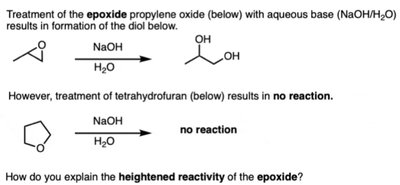
Step-by-Step Guidance
Compare the ring strain in epoxides (three-membered) versus THF (five-membered).
Discuss how ring strain increases electrophilicity of the epoxide carbons.
Explain why nucleophilic attack (by OH-) is favored in epoxides but not in THF.
Relate this to the observed reactivity: epoxide opens to form a diol, THF does not react.
Try solving on your own before revealing the answer!
Final Answer:
Epoxides are more reactive due to ring strain, making them susceptible to nucleophilic attack and ring opening, while THF is less strained and unreactive under similar conditions.
Q3. Draw the product formed when bromohydrins are treated with potassium carbonate (K2CO3).
Background
Topic: Epoxide Formation from Bromohydrins
This question tests your understanding of intramolecular SN2 reactions leading to epoxide formation.
Key Terms and Concepts:
Bromohydrin: Compound with adjacent bromine and hydroxyl groups.
Epoxide formation: Base deprotonates OH, which attacks the carbon bearing Br, displacing Br and forming an epoxide.
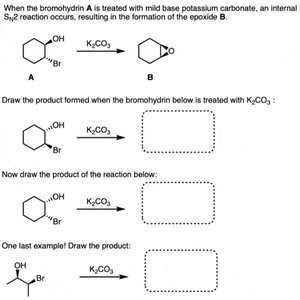
Step-by-Step Guidance
Identify the bromohydrin functional groups (Br and OH on adjacent carbons).
Use K2CO3 to deprotonate the OH, forming an alkoxide.
The alkoxide attacks the carbon bearing Br, displacing Br via SN2 mechanism.
Draw the resulting three-membered epoxide ring.
Try solving on your own before revealing the answer!
Final Answer:
The product is the corresponding epoxide, formed by intramolecular SN2 displacement of Br by the alkoxide.
Q4. Find the stereogenic carbon centers (chiral centers) present in these epoxides.
Background
Topic: Chirality in Epoxides
This question tests your ability to identify chiral centers in cyclic ethers.
Key Terms:
Stereogenic center: Carbon atom attached to four different groups.
Epoxide: Three-membered cyclic ether, often with chiral centers.
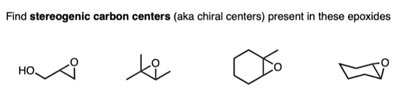
Step-by-Step Guidance
Examine each epoxide structure for carbons attached to four distinct groups.
Mark each stereogenic center in the structure.
Count the number of chiral centers in each molecule.
Try solving on your own before revealing the answer!
Final Answer:
Each epoxide may have one or more chiral centers, depending on the substituents attached to the ring.
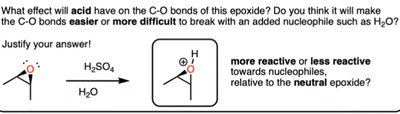
Q5. What effect will acid have on the C–O bonds of an epoxide? Will it make the bonds easier or more difficult to break with a nucleophile?
Background
Topic: Acid-Catalyzed Epoxide Ring Opening
This question tests your understanding of how acid activation increases electrophilicity and facilitates nucleophilic attack.
Key Terms and Concepts:
Epoxide: Cyclic ether, susceptible to ring opening.
Acid activation: Protonation of the oxygen increases ring strain and electrophilicity.
Nucleophile: Species that attacks the activated epoxide.
Step-by-Step Guidance
Describe how acid protonates the epoxide oxygen, increasing positive charge on the ring.
Explain how this makes the C–O bonds more susceptible to nucleophilic attack.
Discuss whether the ring opening is easier or harder after acid activation.
Try solving on your own before revealing the answer!
Final Answer:
Acid makes the C–O bonds easier to break, increasing reactivity towards nucleophiles.
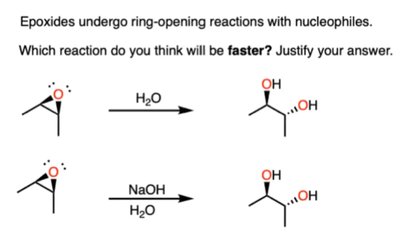
Q6. Which epoxide ring-opening reaction is faster: with water or with aqueous base? Justify your answer.
Background
Topic: Epoxide Ring-Opening Reaction Rates
This question tests your understanding of nucleophilicity and reaction conditions affecting epoxide ring opening.
Key Terms and Concepts:
Nucleophile: Water (neutral) vs. hydroxide (strong base).
Epoxide ring opening: Nucleophilic attack on the strained ring.
Reaction rate: Depends on nucleophile strength and ring strain.
Step-by-Step Guidance
Compare the nucleophilicity of water and hydroxide ion.
Discuss how a stronger nucleophile (OH-) increases the rate of ring opening.
Relate this to the observed product formation and reaction speed.
Try solving on your own before revealing the answer!
Final Answer:
The reaction with aqueous base (OH-) is faster due to stronger nucleophilicity.
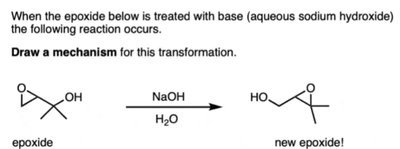
Q7. Draw a mechanism for the transformation of an epoxide with NaOH/H2O to a new epoxide.
Background
Topic: Epoxide Ring Opening and Formation
This question tests your ability to draw a stepwise mechanism for nucleophilic ring opening and subsequent epoxide formation.
Key Terms and Concepts:
Epoxide: Cyclic ether, susceptible to nucleophilic attack.
Mechanism: Stepwise movement of electrons (arrow pushing).
Base: NaOH deprotonates and initiates ring opening.
Step-by-Step Guidance
Show nucleophilic attack by OH- on the less hindered carbon of the epoxide.
Draw the ring opening to form an alkoxide intermediate.
Show proton transfer to form a new alcohol group.
Indicate how the new epoxide is formed from the intermediate.
Try solving on your own before revealing the answer!
Final Answer:
The mechanism involves nucleophilic attack, ring opening, proton transfer, and re-formation of an epoxide.
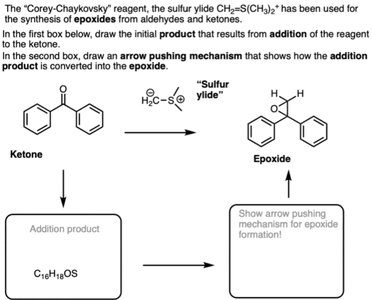
Q8. Draw the initial product and arrow pushing mechanism for epoxide formation from a ketone using the Corey-Chaykovsky reagent (sulfur ylide).
Background
Topic: Epoxide Synthesis via Sulfur Ylide
This question tests your understanding of the Corey-Chaykovsky reaction and mechanism for epoxide formation from ketones.
Key Terms and Concepts:
Corey-Chaykovsky reagent: Sulfur ylide (CH2S(CH3)2).
Epoxide formation: Addition to ketone, followed by ring closure.
Arrow pushing: Mechanistic depiction of electron movement.
Step-by-Step Guidance
Draw the initial addition product of the sulfur ylide to the ketone carbonyl.
Show the electron movement (arrow pushing) leading to ring closure and epoxide formation.
Label the intermediate and final epoxide product.
Try solving on your own before revealing the answer!
Final Answer:
The initial product is a betaine intermediate, which undergoes ring closure to form the epoxide via electron movement.
