 Back
BackEthers, Epoxides, and Sulfides: Structure, Properties, Synthesis, and Reactions
Study Guide - Smart Notes
 Tailored notes based on your materials, expanded with key definitions, examples, and context.
Ethers, Epoxides, and Sulfides
Introduction
This unit explores the structure, nomenclature, physical properties, synthesis, and reactions of ethers, epoxides, and sulfides. These functional groups are essential in organic chemistry due to their unique reactivity and roles in synthesis.
Physical Properties of Ethers
Polarity and Intermolecular Forces
Ethers are weakly polar compounds. Their molecules associate via weak dipole-dipole interactions and dispersion forces, but they do not form hydrogen bonds with themselves because they lack an -OH group.
Boiling Points: Ethers have boiling points close to those of hydrocarbons of similar molecular weight, but much lower than those of corresponding alcohols.
Hydrogen Bonding: Ethers are hydrogen bond acceptors (due to lone pairs on oxygen) but not donors.
Solubility: Ethers are more soluble in water than hydrocarbons of comparable molecular weight, but less so than alcohols.
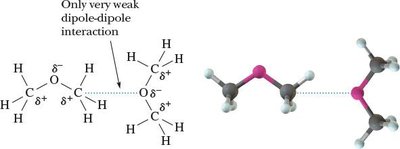
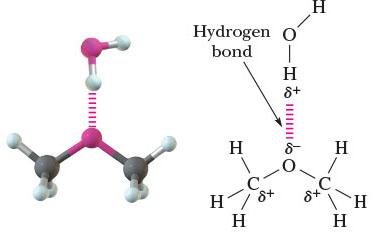
Comparison of Boiling Points and Solubility
The table below compares the boiling points and water solubility of ethers and alcohols with similar molecular weights.
Structural Formula | Name | Molecular Weight | Boiling Point (°C) | Solubility in Water |
|---|---|---|---|---|
CH3CH2OH | Ethanol | 46 | 78 | Infinite |
CH3OCH3 | Dimethyl ether | 46 | -24 | 7.8 g/100 g |
CH3CH2CH2CH2OH | 1-Butanol | 74 | 117 | 7.4 g/100 g |
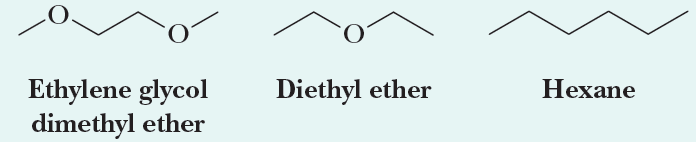
CH3CH2OCH2CH3 | Diethyl ether | 74 | 35 | 8.0 g/100 g |
HOCH2CH2CH2CH2OH | 1,4-Butanediol | 90 | 230 | Infinite |
CH3CH2CH2CH2CH2OH | 1-Pentanol | 88 | 138 | 2.3 g/100 g |
CH3OCH2CH2OCH3 | Ethylene glycol dimethyl ether | 90 | 84 | Infinite |
CH3CH2CH2CH2OCH3 | Butyl methyl ether | 88 | 71 | Slight |
Solubility and Boiling Point Trends
Solubility in Water: Compounds with more oxygen atoms (and thus more lone pairs) are generally more soluble in water due to increased hydrogen bonding with water molecules.
Boiling Point: Alcohols > Ethers ≈ Hydrocarbons (of similar molecular weight).

Synthesis of Ethers
Williamson Ether Synthesis
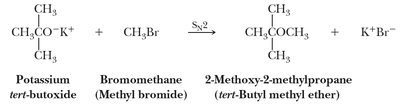
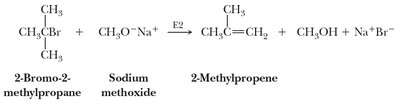
The Williamson ether synthesis is a classic method for preparing ethers via an SN2 reaction between an alkoxide ion and a primary haloalkane. The reaction is most efficient with methyl or primary halides; secondary halides give lower yields due to competing elimination, and tertiary halides react mainly by elimination (E2 mechanism).
General Reaction:
Limitation: Tertiary halides undergo elimination rather than substitution.

Acid-Catalyzed Dehydration of Alcohols
This method is used industrially to synthesize symmetrical ethers, such as diethyl ether, by dehydrating primary alcohols in the presence of acid (e.g., sulfuric acid) at elevated temperatures.
General Reaction:
Mechanism: Involves protonation of the alcohol, nucleophilic attack by a second alcohol molecule, and loss of a proton to yield the ether.
Best Yields: Achieved with unbranched primary alcohols; secondary and tertiary alcohols tend to undergo elimination to form alkenes.



Epoxides
Structure and Nomenclature
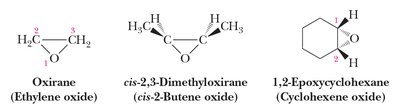
Epoxides are three-membered cyclic ethers. They are named as derivatives of oxirane (IUPAC) or as epoxy-substituted compounds when part of a larger ring. Common names are based on the parent alkene plus "oxide."
Examples: Oxirane (ethylene oxide), cis-2,3-dimethyloxirane, 1,2-epoxycyclohexane.
Synthesis of Epoxides
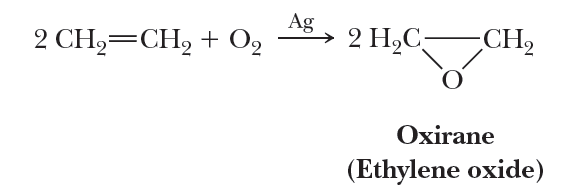
1. Industrial Synthesis (Ethylene Oxide)
Ethylene oxide is produced by passing ethylene and oxygen over a silver catalyst:
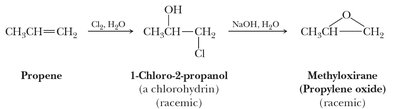
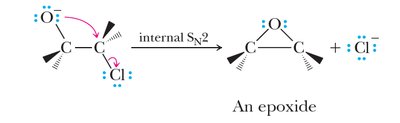
2. From Halohydrins (Internal Nucleophilic Substitution)
Alkenes react with halogen and water to form halohydrins, which are then treated with base to yield epoxides via an internal SN2 reaction. This process is regio- and stereoselective.
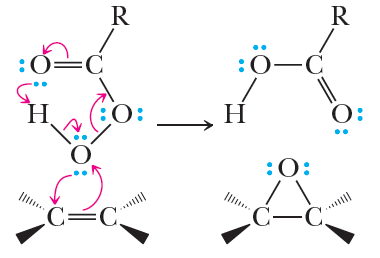
3. Oxidation of Alkenes with Peroxycarboxylic Acids
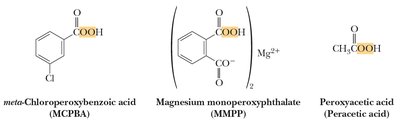
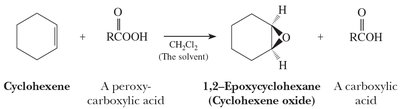
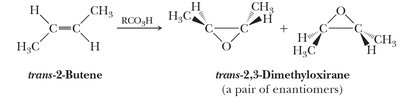
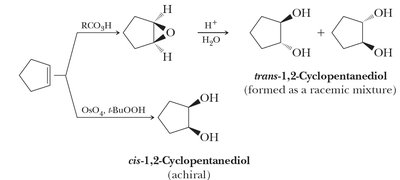
Alkenes are converted to epoxides using peroxycarboxylic acids (e.g., mCPBA, peracetic acid). The reaction is stereospecific: cis-alkenes give meso-epoxides, trans-alkenes give racemic mixtures of enantiomers.
Reactions of Epoxides
Ring-Opening Reactions
Epoxides undergo ring-opening reactions due to ring strain. Nucleophilic substitution occurs at one of the carbons, with the oxygen atom acting as the leaving group.

Acid-Catalyzed Ring Opening
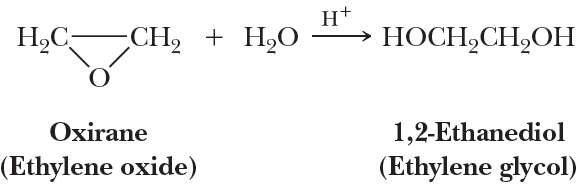
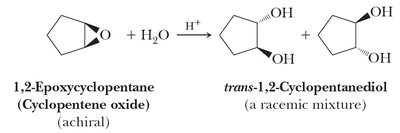
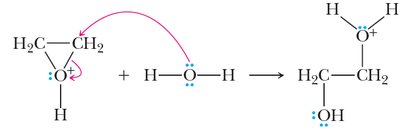
In the presence of acid, epoxides are hydrolyzed to glycols (1,2-diols). The nucleophile attacks the more substituted carbon (if unsymmetrical), and the reaction is stereoselective (anti addition).
General Reaction:
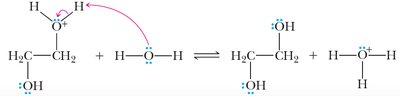
Mechanism of Acid-Catalyzed Hydrolysis
Add a proton to the epoxide oxygen, forming a bridged oxonium ion.
Nucleophilic attack (usually by water) opens the ring via backside attack.
Deprotonation yields the glycol.

Sulfides (Thioethers) and Disulfides
Structure and Nomenclature
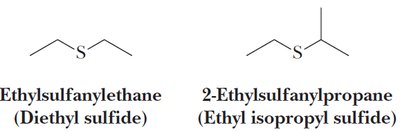
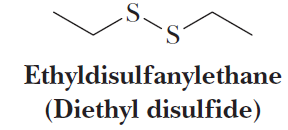
Sulfides are sulfur analogs of ethers (R–S–R'). In IUPAC nomenclature, the longest chain is the parent, and the sulfur-containing group is named as an alkylsulfanyl group. Disulfides contain an –S–S– linkage.
Preparation of Sulfides
Symmetrical Sulfides: Prepared by reacting Na2S with two equivalents of a haloalkane (SN2 mechanism).
Unsymmetrical Sulfides: Prepared by converting a thiol to its sodium salt, then reacting with a haloalkane (analogous to Williamson ether synthesis).
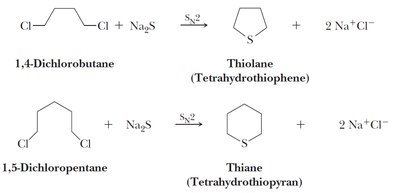
Cyclic Sulfides: Five- and six-membered rings can be synthesized from appropriate dihalides and Na2S.
Oxidation of Sulfides
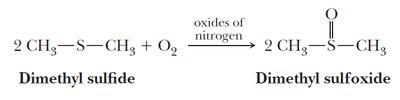
Sulfides can be oxidized to sulfoxides (with one equivalent of oxidant) and further to sulfones (with excess oxidant). For example, methyl phenyl sulfide can be oxidized to methyl phenyl sulfoxide and then to methyl phenyl sulfone.

Summary Table: Key Reactions and Properties
Functional Group | Key Reaction | Product |
|---|---|---|
Ether | Williamson synthesis (SN2) | R–O–R' |
Epoxide | Ring opening (acid/base catalyzed) | 1,2-diol (glycol) |
Sulfide | Oxidation | Sulfoxide/Sulfone |
Additional info: Epoxides are highly strained and thus more reactive than typical ethers. Sulfides and disulfides are important in biological systems (e.g., cystine in proteins) and as reagents in organic synthesis.
