 Back
BackEthers, Epoxides, Thiols, and Sulfides: Structure, Synthesis, and Reactions
Study Guide - Smart Notes
 Tailored notes based on your materials, expanded with key definitions, examples, and context.
Ethers and Epoxides; Thiols and Sulfides
Introduction to Ethers
Ethers are organic compounds in which an oxygen atom is bonded to two alkyl, aryl, or vinyl groups. They are common in both natural and synthetic chemistry and serve as important solvents and intermediates.
Definition: An ether has the general structure R–O–R', where R and R' are not acyl groups.
Examples: Diethyl ether, methyl tert-butyl ether (MTBE).
Naming Ethers
Ethers can be named using common or IUPAC systematic nomenclature.
Common Names: Name each R group alphabetically, followed by "ether" (e.g., ethyl methyl ether).
IUPAC Names: The larger R group is the parent chain; the smaller is named as an alkoxy substituent (e.g., methoxyethane).
Structure and Properties of Ethers
The oxygen atom in ethers is sp3 hybridized, resulting in bond angles similar to those in water and alcohols. Ethers are relatively unreactive and have lower boiling points than alcohols due to their inability to hydrogen bond with themselves.
Hydrogen Bonding: Ethers can only act as hydrogen bond acceptors.
Boiling Point: Lower than comparable alcohols; increases with molecular size due to London dispersion forces.
Solvent Use: Ethers are common solvents due to their low reactivity and ease of removal by evaporation.
Crown Ethers
Crown ethers are cyclic polyethers that can strongly bind metal cations, facilitating their solubility in organic solvents. The size of the crown ether must match the metal ion for optimal binding (e.g., 18-crown-6 for K+).
Preparation of Ethers
Ethers can be synthesized by several methods, including industrial dehydration of alcohols and the Williamson ether synthesis.
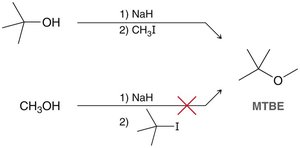
Williamson Ether Synthesis: Involves the reaction of an alkoxide ion with a primary alkyl halide via an SN2 mechanism. This method is not suitable for tertiary alkyl halides due to elimination side reactions.
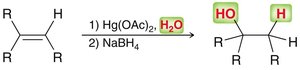
Oxymercuration-Demercuration: Used to synthesize alcohols from alkenes with Markovnikov regioselectivity.
Alkoxymercuration-Demercuration: Similar to oxymercuration, but uses an alcohol instead of water to yield ethers.
Reactions of Ethers
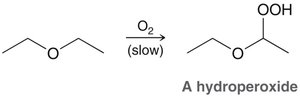
Ethers are generally unreactive but can undergo acid-promoted cleavage with strong acids like HI or HBr, producing alkyl halides. Ethers are also susceptible to autooxidation, forming explosive hydroperoxides.
Autooxidation: Ethers react slowly with oxygen to form hydroperoxides via a free radical mechanism.
Nomenclature and Preparation of Epoxides
Epoxides (oxiranes) are three-membered cyclic ethers. They can be named as oxiranes or as epoxy-substituted alkanes. Epoxides are synthesized by treating alkenes with peroxy acids (e.g., MCPBA) or from halohydrins.
Epoxidation: Stereospecific reaction; the stereochemistry of the alkene is retained in the epoxide.
From Halohydrins: Halohydrins are formed by the addition of Br2 and H2O to alkenes, followed by base-induced cyclization to the epoxide.


Ring-Opening Reactions of Epoxides
Epoxides are reactive due to ring strain and can be opened by nucleophiles under either basic or acidic conditions. The regioselectivity and stereochemistry of the ring-opening depend on the reaction conditions.
Strong Nucleophiles (Basic Conditions): Attack occurs at the less hindered carbon (SN2 mechanism), with inversion of configuration.
Acidic Conditions: Protonation of the epoxide increases electrophilicity; nucleophilic attack occurs at the more substituted carbon if it is tertiary, otherwise at the less hindered carbon. Inversion of configuration is still observed.
Thiols and Sulfides
Thiols (R–SH) are sulfur analogs of alcohols, known for their strong odors. Sulfides (thioethers, R–S–R') are sulfur analogs of ethers. Thiols can be oxidized to disulfides, and sulfides can be further oxidized to sulfoxides or sulfones.
Preparation of Thiols: SN2 reaction of NaSH with alkyl halides yields primary and secondary thiols.
Disulfide Formation: Thiols are oxidized to disulfides with Br2 under basic conditions.
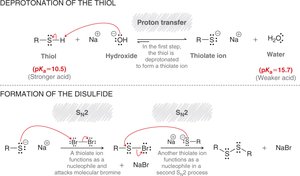
Sulfide Synthesis: Nucleophilic attack of a thiolate on an alkyl halide.
Oxidation of Sulfides: Sulfides can be oxidized to sulfoxides (with sodium metaperiodate) or sulfones (with hydrogen peroxide).
Synthetic Strategies with Epoxides
Epoxides are valuable intermediates for installing two functional groups on adjacent carbons. They can be opened with nucleophiles to extend carbon chains or introduce new functional groups.
Functional Group in Target Molecule | Possible Starting Material | Examples |
|---|---|---|
1,2-Disubstituted (e.g., HO, Nu) | Epoxide | 1) NaSH 2) H2O |
1,2-Disubstituted (e.g., HO, Br) | Alkene | 1) OsO4 2) NaHSO3, H2O |
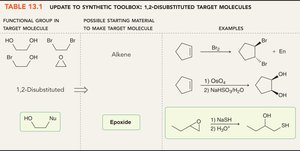
Example: To add a three-carbon chain with a functional group on the second carbon, use an epoxide as the electrophile and a Grignard reagent as the nucleophile.
Additional info: Epoxides are especially useful in synthesis for their ability to undergo regio- and stereoselective ring-opening, allowing for precise installation of functional groups and carbon chains.
