Back
BackFree Radical Chemistry Study Guide
Study Guide - Smart Notes
 Tailored notes based on your materials, expanded with key definitions, examples, and context.
Q1. Which of these are true and which are false about free radicals?
Background
Topic: Free Radical Stability and Reactivity
This question tests your understanding of the properties, stability, and behavior of free radicals in organic chemistry, including their formation, stabilization, and reactivity.
Key Terms:
Free radical: A species with an unpaired electron.
Hyperconjugation: Stabilization by adjacent C-H bonds.
Inductive effects: Electron donation or withdrawal through sigma bonds.
Bond dissociation energy (BDE): Energy required to break a bond homolytically.
Conjugation: Stabilization by adjacent pi bonds.
Step-by-Step Guidance
Read each statement carefully and identify the concept being tested (e.g., stability, initiation, propagation, BDE).
Recall the general rules for free radical stability: tertiary > secondary > primary, and stabilization by resonance or conjugation.
Consider the role of bond dissociation energy and how it relates to radical stability.
Think about the effects of adjacent atoms (O, N) and groups (electron-withdrawing/donating) on radical stability.
For each statement, decide if it aligns with these principles or contradicts them.
Try solving on your own before revealing the answer!
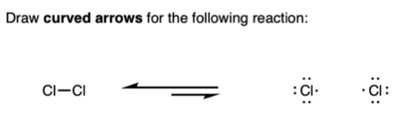
Q2. Draw curved arrows for the following reaction: Cl-Cl → 2 Cl•
Background
Topic: Homolytic Bond Cleavage
This question tests your ability to represent the movement of electrons during the homolytic cleavage of a covalent bond, which is a key step in radical formation.
Key Terms:
Curved arrow: Shows electron movement.
Homolytic cleavage: Each atom takes one electron from the bond.
Step-by-Step Guidance
Identify the bond being broken (Cl-Cl single bond).
Recall that in homolytic cleavage, each atom receives one electron from the bond.
Draw a single-headed (fishhook) arrow from the bond to each Cl atom, indicating the movement of one electron to each.
Check that the resulting products are two Cl radicals, each with an unpaired electron.
Try drawing the arrows before checking the answer!
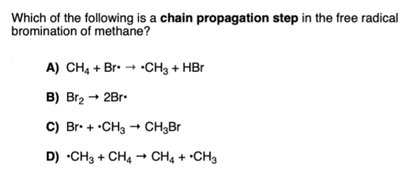
Q3. Which of the following is a chain propagation step in the free radical bromination of methane?
Background
Topic: Radical Chain Mechanism
This question tests your understanding of the steps in a radical chain reaction, specifically identifying propagation steps versus initiation or termination steps.
Key Terms:
Chain propagation: Steps that sustain the radical chain reaction.
Initiation: Formation of radicals.
Termination: Radicals combine to end the chain.
Step-by-Step Guidance
Recall the general mechanism for radical bromination: initiation, propagation, termination.
Identify which steps involve radicals reacting to produce new radicals and products (propagation).
Look for steps where a radical reacts with a stable molecule to produce a new radical and a product.
Compare each option to the typical propagation steps in methane bromination.
Try identifying the propagation step before checking the answer!
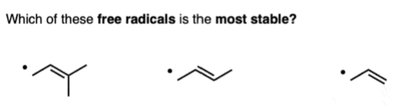
Q4. Which of these free radicals is the most stable?
Background
Topic: Radical Stability
This question tests your ability to compare the stability of different free radicals based on their structure and possible resonance stabilization.
Key Terms:
Resonance stabilization: Delocalization of the unpaired electron.
Allylic and benzylic radicals: Radicals adjacent to double bonds or aromatic rings are more stable.
Step-by-Step Guidance
Examine each radical and determine if the unpaired electron is adjacent to a double bond (allylic position).
Recall that allylic and benzylic radicals are stabilized by resonance.
Compare the degree of resonance stabilization for each radical.
Rank the radicals based on their expected stability.
Try ranking the radicals before checking the answer!
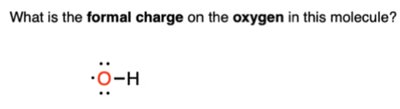
Q5. What is the formal charge on the oxygen in this molecule?
Background
Topic: Formal Charge Calculation
This question tests your ability to calculate the formal charge on an atom in a molecule using Lewis structures.
Key Formula:
Step-by-Step Guidance
Count the number of valence electrons for oxygen (usually 6).
Count the number of nonbonding electrons (lone pairs) on oxygen.
Count the number of bonding electrons shared with hydrogen.
Plug these values into the formal charge formula.
Try calculating the formal charge before checking the answer!
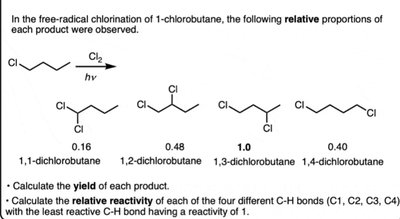
Q6. In the free-radical chlorination of 1-chlorobutane, the following relative proportions of each product were observed. Calculate the yield of each product and the relative reactivity of each C-H bond.
Background
Topic: Radical Chlorination and Reactivity
This question tests your ability to interpret product ratios from a radical chlorination reaction and calculate the relative reactivity of different C-H bonds in the molecule.
Key Terms and Formula:
Yield: The proportion of each product formed.
Relative reactivity: Comparison of how likely each C-H bond is to be substituted.
Step-by-Step Guidance
Identify the number of equivalent hydrogens for each C-H bond (C1, C2, C3, C4).
Divide the observed product ratio by the number of equivalent hydrogens for each position.
Set the least reactive C-H bond's reactivity to 1 and scale the others accordingly.
Calculate the yield of each product based on the observed ratios.
Try calculating the relative reactivity before checking the answer!
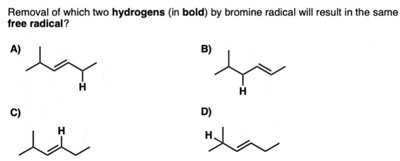
Q7. Removal of which two hydrogens (in bold) by bromine radical will result in the same free radical?
Background
Topic: Radical Formation and Structural Equivalence
This question tests your ability to identify equivalent hydrogens in a molecule that, when removed, produce the same free radical species.
Key Terms:
Equivalent hydrogens: Hydrogens that, when removed, yield identical radicals.
Free radical: A carbon with an unpaired electron after hydrogen abstraction.
Step-by-Step Guidance
Examine the structure of each molecule and identify the position of the bold hydrogens.
Consider the resulting radical after removal of each hydrogen.
Determine if the radicals formed are identical (same structure and stability).
Compare the options to find which pair of hydrogens yields the same radical.
Try identifying the equivalent hydrogens before checking the answer!