 Back
BackFunctional Groups in Organic and Medicinal Chemistry: Properties, Reactions, and Pharmaceutical Relevance
Study Guide - Smart Notes
 Tailored notes based on your materials, expanded with key definitions, examples, and context.
Functional Groups: Introduction and Importance
Definition and Role in Drug Chemistry
Functional groups are specific atoms or groups of atoms within molecules that confer characteristic physical and chemical properties. Their presence and combination largely determine the behavior, reactivity, and biological activity of organic compounds, especially drugs. Understanding functional groups is essential for predicting drug properties, mechanisms of action, and interactions.
Definition: An atom or group of atoms within a molecule that displays predictable physical and chemical properties and undergoes similar types of reactions regardless of the molecule.
Pharmaceutical Relevance: Functional groups influence extraction, synthesis, formulation, drug-drug interactions, mechanism of action, side effects, pharmacokinetics, stability, shelf life, solubility, and derivatization.
Learning Outcomes:
Recognize and name pharmaceutically relevant functional groups
Predict physico-chemical characteristics and typical reactions
Understand the prodrug concept
Alcohols
Structure, Classification, and Properties
Alcohols are organic compounds containing one or more hydroxyl (-OH) groups bonded to a carbon atom. Their classification and properties are central to their chemical behavior and pharmaceutical applications.
Nomenclature: Alkyl group + 'alcohol' (e.g., ethanol) or alkan-ol (e.g., methanol).
Classification:
Primary (1°): -OH attached to a carbon bonded to one other carbon
Secondary (2°): -OH attached to a carbon bonded to two other carbons
Tertiary (3°): -OH attached to a carbon bonded to three other carbons
Physical Properties:
C1–C3: Colourless, neutral liquids, miscible with water
C4–C11: Oily liquids, partially water-miscible
>C11: Solids, insoluble in water
Boiling points increase with molecular weight and are higher than corresponding alkanes/haloalkanes due to hydrogen bonding
Chemical Properties:
Neutral compounds
Undergo esterification reactions
Oxidation:
1° alcohol → aldehyde → carboxylic acid
2° alcohol → ketone
3° alcohol → C–C bond cleavage (no simple oxidation)
Aromatic Alcohols (Phenols)
Phenols are aromatic compounds with a hydroxyl group directly attached to a benzene ring. They exhibit distinct properties compared to aliphatic alcohols.
Acidity: Phenols are much more acidic (pKa ~9) than aliphatic alcohols (pKa ~16) due to the electron-withdrawing effect of the aromatic ring.
Applications: Halogenated phenols (e.g., chloroxylenol, hexachlorophene) are used as antiseptics.
Pharmaceutical Examples: Parabens (preservatives), α-tocopherol (Vitamin E), Δ9-tetrahydrocannabinol (THC).



Ethers
Structure, Properties, and Examples
Ethers are compounds in which an oxygen atom is bonded to two alkyl or aryl groups (R–O–R'). They can be considered derivatives of alcohols where the hydrogen is replaced by an alkyl or arene group.
Nomenclature: List residues (R1, R2) alphabetically + 'ether' (e.g., diethyl ether).
Physical Properties: Simple ethers are volatile, flammable liquids; more complex ethers are often solids. Generally less water-soluble than alcohols and relatively inert, but can form explosive peroxides upon storage.
Examples: Diethyl ether (solvent), anisol (methoxybenzene), dioxin (toxic), morphine and codeine (contain ether linkages), macrogols (polyethylene glycols, used as lubricants and additives), nonoxynol-9 (spermicide).

Aldehydes and Ketones
Structure, Properties, and Reactions
Aldehydes and ketones are carbonyl-containing compounds. Aldehydes have the structure R–CHO (R1 = H), while ketones have the structure R1–CO–R2 (both R groups are alkyl or aryl).
Physical Properties: Often have distinct odors; simple aliphatic carbonyls are water-soluble, but solubility decreases with increasing molecular weight.
Chemical Properties: Undergo nucleophilic addition and substitution reactions.
Key Reactions:
With alcohols: Formation of hemiacetals/hemiketals and acetals/ketals (important in carbohydrate chemistry)
Reduction: Aldehydes → 1° alcohols; Ketones → 2° alcohols
Oxidation: Only aldehydes oxidized to carboxylic acids; ketones are resistant
Identification: Reaction with 2,4-dinitrophenylhydrazine (DNP) forms orange hydrazones
Carboxylic Acids and Derivatives
Structure, Properties, and Reactions
Carboxylic acids contain the carboxyl group (-COOH), which is planar and nearly triangular. They are key intermediates and products in biological and pharmaceutical chemistry.
Physical Properties: Simple acids are water-soluble due to hydrogen bonding and ionic dissociation; higher molecular weight acids are solids with higher boiling points.
Chemical Properties: Undergo nucleophilic substitution reactions, forming derivatives such as esters, lactones (cyclic esters), amides, and lactams (cyclic amides).
Pharmaceutical Relevance: Carboxylic acid derivatives are common in drug metabolism and formulation. Esters are often used to mask carboxylic acids, increasing lipophilicity and improving absorption (prodrug concept).

Amines
Classification, Properties, and Applications
Amines are organic derivatives of ammonia, classified by the number of organic groups attached to the nitrogen atom.
Classification:
Primary (1°): RNH2
Secondary (2°): R1R2NH
Tertiary (3°): R1R2R3N
Quaternary ammonium: R1R2R3R4N+
Physical Properties: Polar due to electronegative nitrogen; capable of hydrogen bonding. Water-soluble up to 6 carbons; 1° and 2° amines have high boiling points.
Chemical Properties: 1°, 2°, and 3° amines act as bases (lone electron pair on N); basic strength increases from 1° to 3°, with aliphatic amines being stronger bases than aromatic amines.
Applications: Quaternary ammonium salts (e.g., benzalkonium chloride, cetylpyridinium chloride) have antibacterial and surfactant properties.

The Prodrug Concept
Definition and Pharmaceutical Application
The prodrug concept involves temporarily converting a drug into a labile, inactive compound to address formulation or administration challenges. The prodrug is designed to revert to the active drug in vivo, often improving absorption, distribution, or targeting.
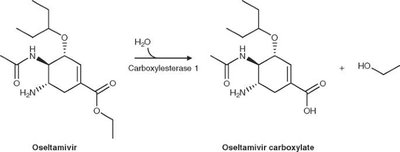
Example: Oseltamivir (Tamiflu®) is an ester prodrug of the neuraminidase inhibitor oseltamivir carboxylate.
Rationale: The active carboxylate is highly hydrophilic and poorly absorbed; conversion to an ester increases lipophilicity and absorption. In vivo, esterases rapidly hydrolyze the ester, releasing the active drug.


Further Reading
Basic information on functional group chemistry can be found in any standard organic chemistry textbook, many of which are available in university libraries.
