 Back
BackFundamentals of Organic Chemistry: Structure, Bonding, and the Chemistry of Carbon
Study Guide - Smart Notes
 Tailored notes based on your materials, expanded with key definitions, examples, and context.
What is Organic Chemistry?
Definition and Historical Context
Organic chemistry is the study of compounds that contain carbon. Historically, organic compounds were thought to originate only from living organisms, while inorganic compounds came from minerals. This distinction was disproven when urea, an organic compound, was synthesized from ammonium cyanate, an inorganic mineral, demonstrating that organic compounds can be derived from inorganic sources.
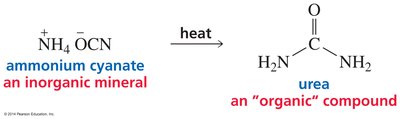
Organic compounds: Contain carbon; originally thought to require a 'vital force' from living organisms.
Inorganic compounds: Derived from minerals; do not necessarily contain carbon.
Key experiment: Synthesis of urea from ammonium cyanate by heating, bridging the gap between organic and inorganic chemistry.
The Special Nature of Carbon
Position in the Periodic Table
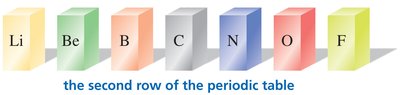
Carbon is found in the second row of the periodic table, between boron and nitrogen. Its unique ability to form stable covalent bonds with itself and other elements underlies the vast diversity of organic compounds.
Valence electrons: Carbon has four valence electrons, allowing it to form up to four covalent bonds.
Bonding versatility: Can form single, double, and triple bonds, as well as chains and rings.
Atomic Structure and Subatomic Particles
Components of the Atom
Atoms consist of a dense nucleus containing protons and neutrons, surrounded by an electron cloud. The atomic number is defined by the number of protons in the nucleus.
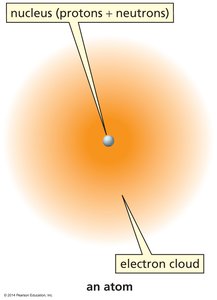
Protons: Positively charged particles in the nucleus.
Neutrons: Neutral particles in the nucleus.
Electrons: Negatively charged particles in orbitals around the nucleus.
Atomic number: Number of protons; for carbon, this is 6.
Isotopes
Isotopes are atoms of the same element with different numbers of neutrons, resulting in different mass numbers but the same atomic number.
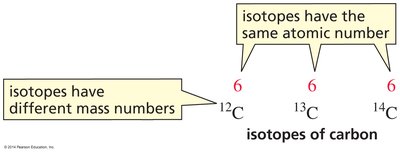
Example: 12C, 13C, and 14C all have 6 protons but different numbers of neutrons.
Electron Configuration and Atomic Orbitals
Electron Shells and Orbitals
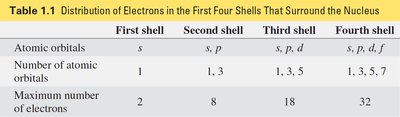
Electrons occupy shells around the nucleus, with each shell containing one or more types of atomic orbitals (s, p, d, f). The arrangement of electrons in these orbitals determines the chemical properties of the element.
Shell | Atomic Orbitals | Number of Orbitals | Max Electrons |
|---|---|---|---|
First | s | 1 | 2 |
Second | s, p | 1, 3 | 8 |
Third | s, p, d | 1, 3, 5 | 18 |
Fourth | s, p, d, f | 1, 3, 5, 7 | 32 |
s orbital: Spherical shape, holds 2 electrons.
p orbital: Dumbbell-shaped, three orientations (x, y, z), each holds 2 electrons.
Electron Configuration Principles
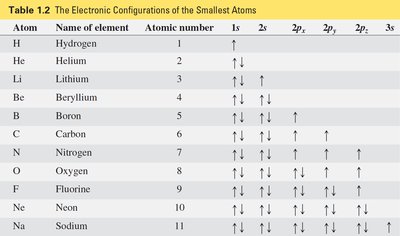
Aufbau Principle: Electrons fill the lowest energy orbitals first.
Pauli Exclusion Principle: No more than two electrons per orbital, and they must have opposite spins.
Hund’s Rule: Electrons occupy empty degenerate orbitals singly before pairing up.
Atom | Atomic Number | 1s | 2s | 2px | 2py | 2pz | 3s |
|---|---|---|---|---|---|---|---|
H | 1 | ↑ | |||||
He | 2 | ↑↓ | |||||
Li | 3 | ↑↓ | ↑ | ||||
Be | 4 | ↑↓ | ↑↓ | ||||
B | 5 | ↑↓ | ↑↓ | ↑ | |||
C | 6 | ↑↓ | ↑↓ | ↑ | ↑ | ||
N | 7 | ↑↓ | ↑↓ | ↑ | ↑ | ↑ | |
O | 8 | ↑↓ | ↑↓ | ↑↓ | ↑ | ↑ | |
F | 9 | ↑↓ | ↑↓ | ↑↓ | ↑↓ | ↑ | |
Ne | 10 | ↑↓ | ↑↓ | ↑↓ | ↑↓ | ↑↓ |
Order of orbital energies:
Ions and the Periodic Table
Electron Loss and Gain
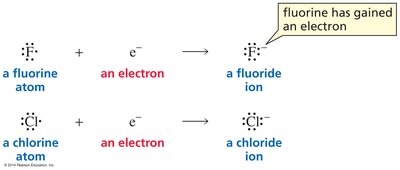
Atoms on the left side of the periodic table (e.g., Group 1 and 2 metals) tend to lose electrons to form cations, while atoms on the right side (e.g., halogens) tend to gain electrons to form anions.
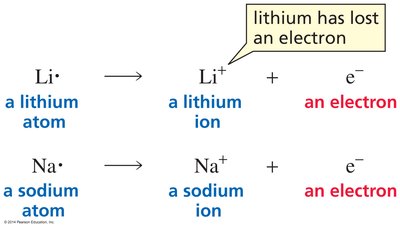
Group 1: Lose 1 electron (e.g., Na → Na+ + e−).
Group 2: Lose 2 electrons.
Halogens: Gain 1 electron (e.g., Cl + e− → Cl−).
Covalent and Ionic Bonding
Ionic Bonds
Ionic bonds are formed by the electrostatic attraction between oppositely charged ions, typically between metals and non-metals. Ionic compounds conduct electricity when dissolved in water.
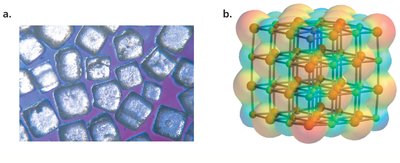
Example: NaCl (sodium chloride) is formed from Na+ and Cl−.
Covalent Bonds
Covalent bonds are formed when two nonmetal atoms share one or more pairs of valence electrons to achieve stability, usually satisfying the octet rule.

Single bond: One pair of shared electrons.
Double bond: Two pairs of shared electrons.
Triple bond: Three pairs of shared electrons.
Bond Polarity and Electronegativity
Electronegativity
Electronegativity is the ability of an atom to attract electrons in a chemical bond. It increases across a period (left to right) and decreases down a group in the periodic table.
Fluorine: Most electronegative element.
Bond polarity: Determined by the difference in electronegativity between bonded atoms.
Types of Bonds
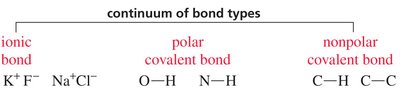
Nonpolar covalent bond: Electrons are shared equally (e.g., C–H, C–C).
Polar covalent bond: Electrons are shared unequally (e.g., O–H, N–H).
Ionic bond: Complete transfer of electrons (e.g., Na+Cl−).
Dipole Moments
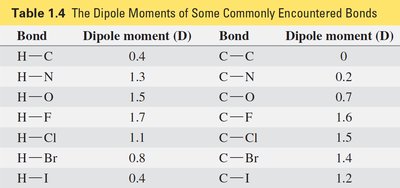
The dipole moment is a measure of the separation of positive and negative charges in a bond or molecule. The greater the difference in electronegativity, the greater the dipole moment.
Bond | Dipole Moment (D) |
|---|---|
H–C | 0.4 |
H–N | 1.3 |
H–O | 1.5 |
H–F | 1.7 |
H–Cl | 1.1 |
Lewis Structures and Formal Charge
Drawing Lewis Structures
Lewis structures represent the arrangement of valence electrons in molecules. Steps include counting valence electrons, arranging atoms, and assigning lone pairs and bonds to satisfy the octet rule.
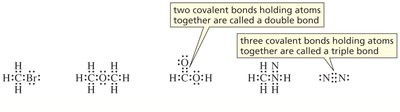
Octet rule: Atoms (except H) tend to have 8 electrons in their valence shell.
Lone pairs: Non-bonding pairs of electrons.
Formal Charge
Formal charge is used to determine the most stable Lewis structure. It is calculated as:

Best structure: The one with formal charges closest to zero and negative charges on the most electronegative atoms.
Bonding Patterns of Common Elements
Typical Number of Bonds and Lone Pairs
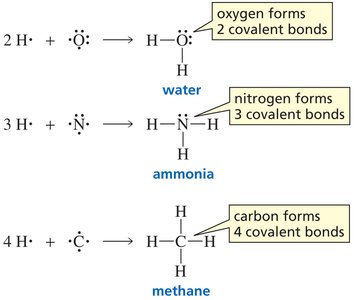
Carbon: 4 bonds, 0 lone pairs (neutral).
Nitrogen: 3 bonds, 1 lone pair (neutral).
Oxygen: 2 bonds, 2 lone pairs (neutral).
Halogens: 1 bond, 3 lone pairs (neutral).

Hybridization and Molecular Geometry
Hybridization of Atomic Orbitals
Hybridization explains the observed shapes of molecules by mixing atomic orbitals to form new, equivalent hybrid orbitals.
sp3 hybridization: Four hybrid orbitals, tetrahedral geometry, bond angle 109.5° (e.g., methane).
sp2 hybridization: Three hybrid orbitals, trigonal planar geometry, bond angle 120° (e.g., ethene).
sp hybridization: Two hybrid orbitals, linear geometry, bond angle 180° (e.g., ethyne).
Bond Types and Strengths
Single bond: 1 sigma (σ) bond.
Double bond: 1 sigma (σ) + 1 pi (π) bond.
Triple bond: 1 sigma (σ) + 2 pi (π) bonds.
Bond strength: Shorter bonds are stronger; π bonds are weaker than σ bonds.
Summary Table: Hybridization, Geometry, and Bonding
Hybridization | Geometry | Bond Angle | Example |
|---|---|---|---|
sp3 | Tetrahedral | 109.5° | CH4 |
sp2 | Trigonal planar | 120° | C2H4 |
sp | Linear | 180° | C2H2 |
Conclusion
Understanding the structure of atoms, the nature of chemical bonds, and the unique properties of carbon is foundational to organic chemistry. Mastery of these concepts enables the prediction of molecular geometry, reactivity, and the physical properties of organic compounds.
