 Back
BackHybridization and Resonance in Organic Molecules
Study Guide - Smart Notes
 Tailored notes based on your materials, expanded with key definitions, examples, and context.
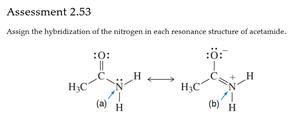
Q1. Assign the hybridization of the nitrogen in each resonance structure of acetamide.
Background
Topic: Hybridization & Resonance
This question tests your understanding of how resonance affects the hybridization of atoms, specifically nitrogen, in organic molecules. Resonance structures show the delocalization of electrons, which can change the apparent bonding and hybridization of atoms involved.
Key Terms and Formulas
Hybridization: The mixing of atomic orbitals to form new hybrid orbitals suitable for bonding.
Resonance: The concept that some molecules can be represented by two or more valid Lewis structures, called resonance structures.
sp3 hybridization: Four electron domains (bonds or lone pairs) around the atom.
sp2 hybridization: Three electron domains (bonds or lone pairs) around the atom.
Electron domain: Any region where electrons are found—either a bond (single, double, triple) or a lone pair.
Step-by-Step Guidance
Examine each resonance structure and count the number of electron domains (bonds and lone pairs) around the nitrogen atom.
For structure (a): Identify the bonds and lone pairs on nitrogen. Consider how many regions of electron density surround the nitrogen.
For structure (b): Notice the change in bonding and charge. Again, count the electron domains around nitrogen in this resonance form.
Recall that the hybridization is determined by the number of electron domains: for four domains, for three domains, for two domains.
Think about how resonance can allow lone pairs to participate in pi bonding, which may change the hybridization from to .
Try solving on your own before revealing the answer!
Final Answer:
In structure (a), nitrogen is sp2 hybridized because its lone pair participates in resonance with the carbonyl group, creating three electron domains. In structure (b), nitrogen is sp3 hybridized because it has three bonds and one lone pair, totaling four electron domains.
Resonance allows the lone pair to delocalize, changing the hybridization in different resonance forms.
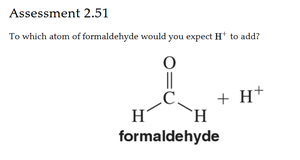
Q2. To which atom of formaldehyde would you expect H+ to add?
Background
Topic: Electrophilic Addition
This question tests your understanding of how electrophiles (like H+) interact with organic molecules, specifically formaldehyde. You need to identify which atom is most likely to attract the proton based on electron density and charge.
Key Terms and Formulas
Electrophile: A species that accepts electrons (H+ is a classic example).
Nucleophile: A species that donates electrons.
Formaldehyde: , with a carbonyl group (C=O).
Partial charges: Oxygen is more electronegative, so it pulls electron density away from carbon, making carbon partially positive () and oxygen partially negative ().
Step-by-Step Guidance
Identify the atoms in formaldehyde: carbon, oxygen, and hydrogen.
Consider the electronegativity of oxygen compared to carbon. Oxygen pulls electrons toward itself, making the carbon more positive.
Recall that H+ (a proton) is attracted to regions of high electron density or negative charge.
Analyze the partial charges: Oxygen is , carbon is .
Think about which atom would be most likely to attract the H+ based on these charges.
Try solving on your own before revealing the answer!
Final Answer:
H+ would add to the oxygen atom in formaldehyde because oxygen has a partial negative charge and is more likely to attract the proton.
The carbon is partially positive, so it would not attract H+ as strongly as oxygen.
