 Back
BackIsomerism in Organic Chemistry: Constitutional, Geometric, and Stereoisomers
Study Guide - Smart Notes
 Tailored notes based on your materials, expanded with key definitions, examples, and context.
Isomerism in Organic Chemistry
Constitutional Isomers
Constitutional isomers are compounds that share the same molecular formula but differ in the connectivity of their atoms. This difference in bonding sequence leads to distinct physical and chemical properties.
Definition: Molecules with identical formulas but different atom-to-atom connections.
Example: Ethyl alcohol (CH3CH2OH) and dimethyl ether (CH3OCH3) are constitutional isomers.

Conformations
Conformations refer to the different spatial arrangements of atoms in a molecule that result from rotation around single (σ) bonds. These are not true isomers, as they interconvert rapidly at room temperature.
Key Point: Conformations are momentary and do not involve breaking bonds.
Stereoisomerism
Stereoisomers have the same molecular formula and atom connectivity but differ in the three-dimensional arrangement of their atoms. These differences are not interconvertible by simple bond rotations.
Types: Includes cis-trans (geometric) isomers and enantiomers.
Cis-Trans (Geometric) Isomerism of Alkenes
Structure and Restricted Rotation
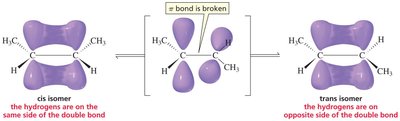
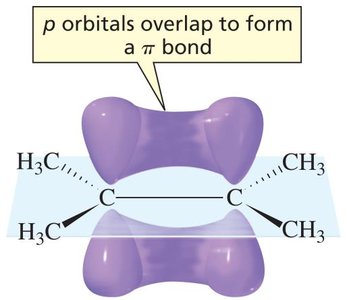
Alkenes consist of two adjacent sp2-hybridized carbons, each with a trigonal planar geometry. The unhybridized p orbitals overlap to form a π bond, which restricts rotation around the double bond.
Key Point: The π bond prevents free rotation, making cis-trans isomerism possible.
Energetics: Rotation about the double bond requires breaking the π bond, which is energetically unfavorable.
Cis-Trans Isomerism Explained
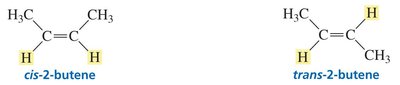
Cis-trans isomers differ in the relative positions of substituents attached to the carbons of the double bond. The cis isomer has substituents on the same side, while the trans isomer has them on opposite sides.
Requirement: Each carbon of the double bond must have two different substituents for cis-trans isomerism to occur.
Example: cis-2-butene and trans-2-butene.
E,Z Nomenclature for Alkenes
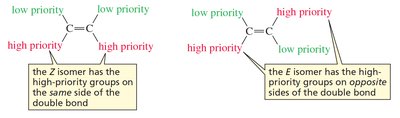
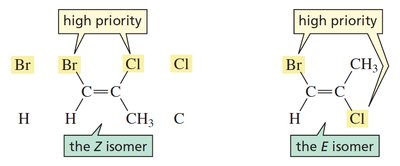
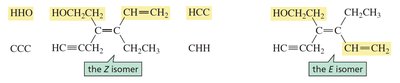
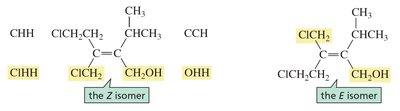
The E,Z system is used for alkenes with more complex substituents. Priorities are assigned based on atomic number: higher atomic number means higher priority. The Z (zusammen) isomer has high-priority groups on the same side, while the E (entgegen) isomer has them on opposite sides.
Key Point: If two atoms attached to the sp2 carbon are the same, consider the next atoms along the chain.
Double Bonds: Treat doubly bonded atoms as if bonded to two of those atoms.
Chirality and R/S Configuration
Chirality and Enantiomers
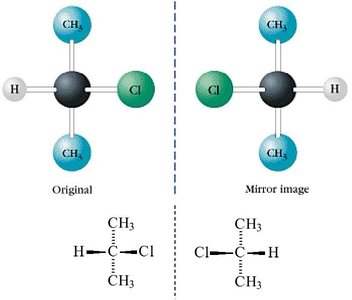
Chirality arises when a molecule has a non-superimposable mirror image, typically due to an asymmetric (chiral) center. Enantiomers are pairs of molecules that are mirror images but not superimposable.
Chiral Center: Usually a carbon atom bonded to four different groups.
Achiral: Molecules with a plane of symmetry; superimposable on their mirror images.
Example: 2-chlorobutane (chiral) vs. 2-chloropropane (achiral).
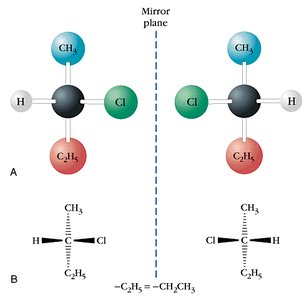
R/S Configuration
The R/S system specifies the absolute configuration of chiral centers. Assign priorities to the four groups attached to the stereocenter using the same rules as E/Z nomenclature. Orient the molecule so the lowest-priority group is at the back, then trace a path from highest to lowest priority.
Clockwise: R configuration
Counterclockwise: S configuration
Swapping Groups: Interchanging any two groups reverses the configuration.
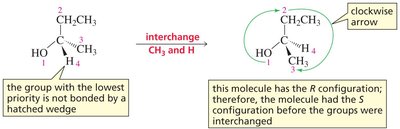
Optical Activity and Plane-Polarized Light
Optical Activity of Enantiomers
Enantiomers rotate plane-polarized light in opposite directions. This property is measured using a polarimeter, which determines the specific rotation () of a compound under standard conditions.
Dextrorotatory (+): Rotates light to the right
Levorotatory (−): Rotates light to the left
Racemic Mixture: A 1:1 mixture of enantiomers; optically inactive as rotations cancel.
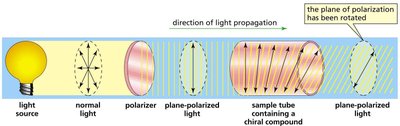
Molecules with Multiple Stereocentres
Enantiomers, Diastereomers, and Meso Compounds
Molecules with two or more stereocentres can have several stereoisomers. Enantiomers differ at all stereocentres, while diastereomers differ at one or more but not all. Meso compounds have an internal plane of symmetry and are achiral despite having stereocentres.
Maximum Number of Stereoisomers: , where n is the number of stereocentres.
Meso Compounds: Achiral, optically inactive, due to internal symmetry.
Example: Tartaric acid has three stereoisomers: two enantiomers and one meso compound.
Type | Relationship |
|---|---|
Enantiomers | Opposite configuration at all stereocentres |
Diastereomers | At least one stereocentre in common |
Meso | Internal plane of symmetry; achiral |
Separation of Enantiomers
Chiral Chromatography
Enantiomers have identical physical properties and cannot be separated by standard methods. However, they interact differently with chiral substances and can be separated using chiral column chromatography.
Method: Pass the mixture through a column containing a chiral polymeric material.
Result: One enantiomer elutes faster due to weaker interaction with the chiral material.
Summary Table: Types of Isomerism
Type | Definition | Example |
|---|---|---|
Constitutional Isomers | Same formula, different connectivity | Ethyl alcohol vs. dimethyl ether |
Cis-Trans Isomers | Same connectivity, different spatial arrangement around double bond | cis-2-butene vs. trans-2-butene |
Enantiomers | Non-superimposable mirror images | 2-chlorobutane enantiomers |
Diastereomers | Stereoisomers not related as mirror images | Threose vs. erythrose |
Meso Compounds | Achiral, internal symmetry | Meso-tartaric acid |
