 Back
BackIsomers: The Arrangement of Atoms in Space (Stereochemistry)
Study Guide - Smart Notes
 Tailored notes based on your materials, expanded with key definitions, examples, and context.
Isomers: The Arrangement of Atoms in Space
Stereoisomers
Stereoisomers (also called configurational isomers) are compounds with the same molecular formula and connectivity of atoms, but differ in the three-dimensional arrangement of their atoms in space. These isomers are distinct compounds and can be separated because they do not easily interconvert.
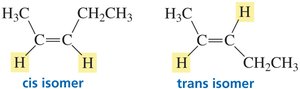
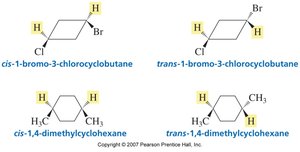
Cis-trans isomers: Isomers that differ in the relative positions of substituents on either side of a double bond or ring system.
Isomers with asymmetric centers: Compounds containing one or more chiral (asymmetric) centers, leading to non-superimposable mirror images.
Cis & Trans Isomers
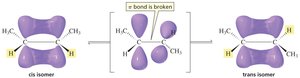
Cis-trans isomerism arises due to restricted rotation, typically around double bonds or within rings.
Cis isomer: Hydrogens (or other groups) are on the same side of the double bond or ring.
Trans isomer: Hydrogens (or other groups) are on opposite sides.
Restricted rotation is due to the side-to-side overlap of p orbitals forming a π bond, which must be broken to allow rotation.
Physical Properties of Cis and Trans Isomers
Cis and trans isomers often have different physical properties, such as boiling points and dipole moments, due to their spatial arrangements.

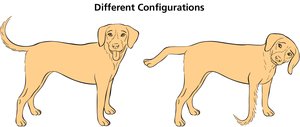
Conformation vs. Configuration
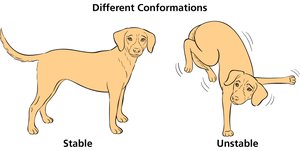
It is important not to confuse conformation (different spatial arrangements due to rotation about single bonds, which interconvert easily) with configuration (arrangements that require breaking bonds to interconvert, such as isomers).
Chirality and Asymmetric Centers
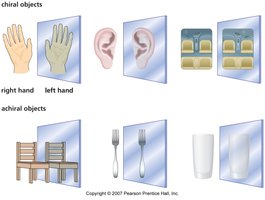
Chiral objects are those that are not superimposable on their mirror images (e.g., hands). Achiral objects are superimposable on their mirror images (e.g., a glass).
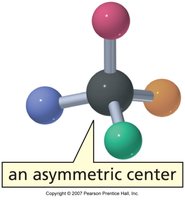
Asymmetric center (chiral center): A tetrahedral atom (usually carbon) bonded to four different groups.
Isomers with One Asymmetric Center: Enantiomers
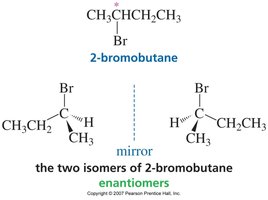
Compounds with one asymmetric center have two stereoisomers that are non-superimposable mirror images, called enantiomers.
Stereocenters
A stereocenter is any atom at which the interchange of two groups produces a stereoisomer. All asymmetric centers are stereocenters, but not all stereocenters are asymmetric centers.
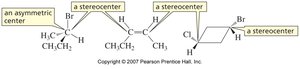
Drawing Enantiomers
Enantiomers can be represented in two main ways:
Perspective formula: Uses wedges and dashes to show 3D arrangement.
Fischer projection: A 2D representation where horizontal lines represent bonds coming out of the plane and vertical lines represent bonds going behind the plane.
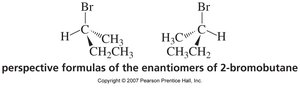
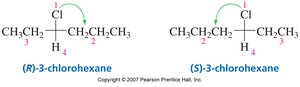
Naming Enantiomers: R and S System
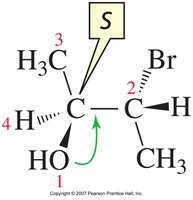
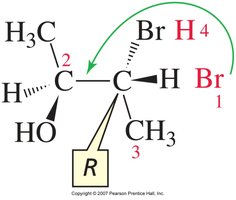
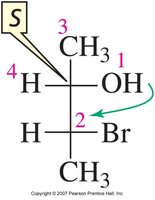
The Cahn-Ingold-Prelog system is used to assign absolute configuration (R or S) to asymmetric centers:
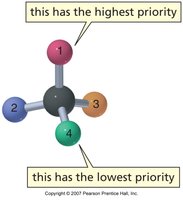
Rank the groups attached to the chiral center by atomic number (higher atomic number = higher priority).
Orient the molecule so the lowest priority group is directed away from you.
Trace a path from highest (1) to next highest (2) to third (3) priority group.
If the path is clockwise, the configuration is R; if counterclockwise, it is S.
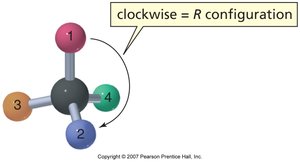
R/S Assignment in Fischer Projections
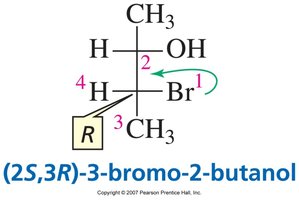
In Fischer projections, the lowest priority group should be on a vertical bond. If it is on a horizontal bond, the configuration is the opposite of what the arrow indicates.
Optical Activity of Chiral Compounds
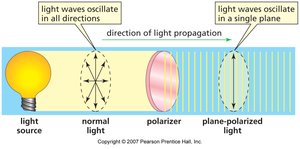
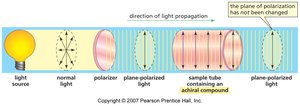
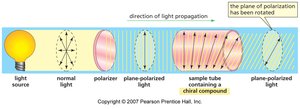
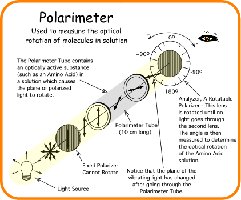
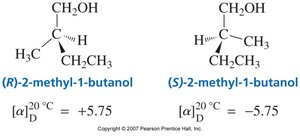
Enantiomers have identical physical properties except for their interaction with plane-polarized light. A chiral compound rotates the plane of polarized light (optically active), while an achiral compound does not (optically inactive).
Dextrorotatory (+): Rotates light clockwise.
Levorotatory (-): Rotates light counterclockwise.
Measurement of Specific Rotation
The specific rotation is a standardized measure of a compound's ability to rotate plane-polarized light, defined as:
= observed rotation (degrees)
= path length (dm)
= concentration (g/mL)
= temperature (°C)
= wavelength (usually sodium D line, 589 nm)
Racemic Mixtures and Enantiomeric Excess
A racemic mixture contains equal amounts of both enantiomers and is optically inactive. Enantiomeric excess (ee) quantifies the excess of one enantiomer over the other:
Isomers with Multiple Asymmetric Centers
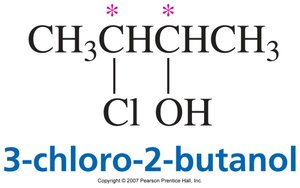
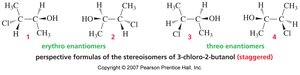
The number of possible stereoisomers increases with the number of asymmetric centers, following the formula (where is the number of centers, if no symmetry is present).
Diastereomers
Diastereomers are stereoisomers that are not mirror images of each other. They have different physical and chemical properties.
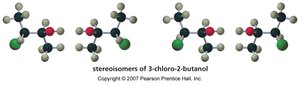
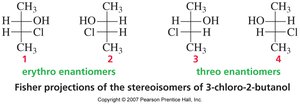
Cyclic Molecules with Multiple Asymmetric Centers
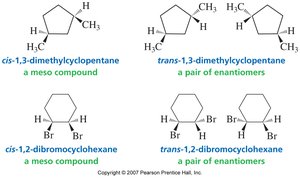
Cyclic molecules can also have cis and trans isomers, which may be enantiomers or diastereomers depending on the arrangement of substituents and the presence of asymmetric centers.
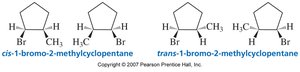
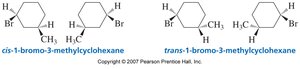
Meso Compounds
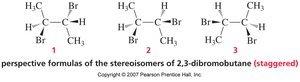
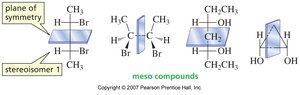
Meso compounds contain asymmetric centers but are achiral due to an internal plane of symmetry. They are optically inactive and reduce the total number of stereoisomers below .
Meso Compounds in Cyclic Molecules
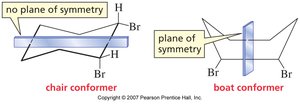
In cyclic systems, the presence of a plane of symmetry in one conformer is sufficient for the molecule to be achiral (meso).
Naming Isomers with Multiple Asymmetric Centers
Each asymmetric center must be assigned an R or S configuration. Enantiomers have opposite configurations at all centers, while diastereomers differ at one or more (but not all) centers.
Separation of Enantiomers (Resolution)
Enantiomers can be separated (resolved) using a chiral probe in column chromatography. The different affinities of enantiomers for the chiral stationary phase allow for their separation.
Asymmetric Centers on Atoms Other Than Carbon
Atoms such as phosphorus and nitrogen can also serve as asymmetric centers if bonded to four different groups. However, amines with a lone pair (three bonds) undergo rapid inversion, preventing separation of enantiomers.
Summary Table: Types of Stereoisomers
Type | Definition | Example |
|---|---|---|
Cis-trans isomers | Same connectivity, differ in arrangement around double bond or ring | cis-2-butene vs. trans-2-butene |
Enantiomers | Non-superimposable mirror images | (R)-2-butanol vs. (S)-2-butanol |
Diastereomers | Stereoisomers not related as mirror images | threo- and erythro-2,3-dibromobutane |
Meso compounds | Achiral despite asymmetric centers, due to symmetry | meso-tartaric acid |
