 Back
BackKetones and Aldehydes: Structure, Properties, Nomenclature, and Reactions
Study Guide - Smart Notes
 Tailored notes based on your materials, expanded with key definitions, examples, and context.
Ketones and Aldehydes: Structure, Properties, Nomenclature, and Reactions
Introduction to Carbonyl Compounds
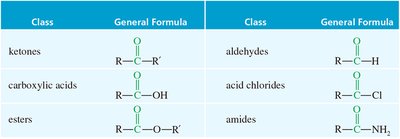
Ketones and aldehydes are two important classes of organic compounds containing the carbonyl group (C=O). The carbonyl group is a defining feature of several functional groups in organic chemistry, including carboxylic acids, esters, acid chlorides, and amides. The chemistry of ketones and aldehydes is central to organic synthesis and biological processes.
Structure of the Carbonyl Group
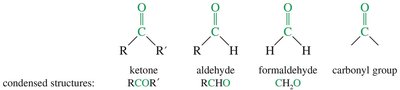
The carbonyl group consists of a carbon atom double-bonded to an oxygen atom. In ketones, the carbonyl carbon is bonded to two alkyl or aryl groups, while in aldehydes, it is bonded to one alkyl (or aryl) group and one hydrogen atom. The carbonyl carbon is sp2 hybridized, resulting in a planar structure with bond angles of approximately 120°.
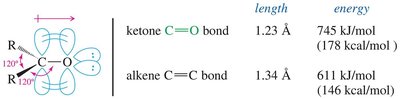
The C=O bond is shorter (1.23 Å) and stronger (745 kJ/mol) than the C=C bond in alkenes (1.34 Å, 611 kJ/mol), and it is highly polar due to the electronegativity difference between carbon and oxygen.
Resonance and Reactivity
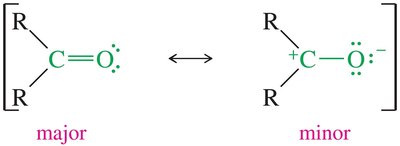
The carbonyl group exhibits resonance, with the major contributor being the neutral form where all atoms have complete octets. The minor contributor places a positive charge on carbon and a negative charge on oxygen. This resonance explains the partial positive charge on the carbonyl carbon, making it an electrophilic center susceptible to nucleophilic attack.
Dipole Moments
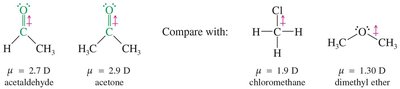
Ketones and aldehydes have significant dipole moments due to the polar C=O bond. For example, acetaldehyde has a dipole moment of 2.7 D, and acetone has 2.9 D, both higher than chloromethane (1.9 D) and dimethyl ether (1.3 D).
Nomenclature of Ketones and Aldehydes
Ketone Nomenclature
Ketones are named by replacing the -e ending of the parent alkane with -one. The chain is numbered to give the carbonyl carbon the lowest possible number. For cyclic ketones, the carbonyl carbon is always position 1. If both a carbonyl and a double bond are present, the carbonyl takes precedence in numbering.

Aldehyde Nomenclature
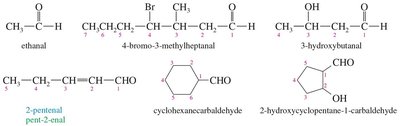
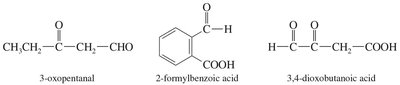
Aldehydes are named by replacing the -e ending of the parent alkane with -al. The aldehyde carbon is always carbon 1. If the aldehyde group is attached to a ring, the suffix -carbaldehyde is used. When a higher-priority functional group is present, the carbonyl is named as an oxo (for ketones) or formyl (for aldehydes) substituent. Aldehydes have higher priority than ketones in nomenclature.
Priority of Functional Groups
The IUPAC system assigns priorities to functional groups for nomenclature purposes. The order from highest to lowest is: acids, esters, aldehydes, ketones, alcohols, amines, alkenes/alkynes, alkanes, ethers, halides.
Practice Problems: Nomenclature
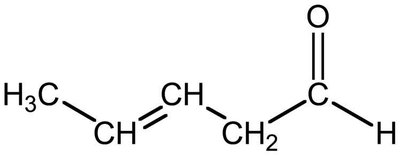
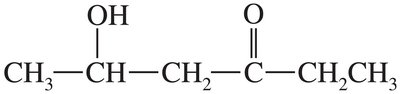
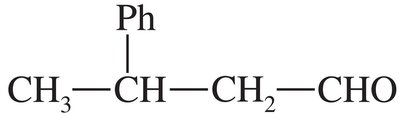
Practice problems help reinforce the rules of nomenclature for ketones and aldehydes, including compounds with multiple functional groups and rings.
Physical Properties of Ketones and Aldehydes
Boiling Points
Ketones and aldehydes have higher boiling points than alkanes and ethers of similar molecular weight due to their polarity, but lower boiling points than alcohols because they cannot hydrogen-bond to each other.

Solubility
Ketones and aldehydes are good solvents for alcohols and can accept hydrogen bonds from O—H or N—H groups. Small ketones and aldehydes (e.g., acetone, acetaldehyde) are miscible with water.
Formaldehyde
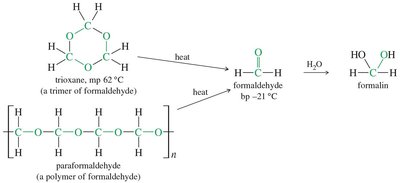
Formaldehyde is a gas at room temperature. It is commonly used as a 40% aqueous solution called formalin. Trioxane and paraformaldehyde are polymeric forms of formaldehyde that release the monomer upon heating.
Spectroscopic Properties
Infrared (IR) Spectroscopy
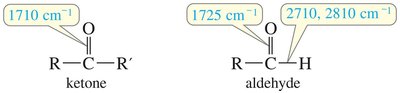
The C=O stretch is a strong, characteristic absorption in the IR spectrum: around 1710 cm–1 for ketones and 1725 cm–1 for simple aldehydes. Aldehydes also show two C—H stretches at 2710 and 2810 cm–1. Conjugation lowers the C=O stretching frequency, while ring strain increases it.
Nuclear Magnetic Resonance (NMR) Spectroscopy
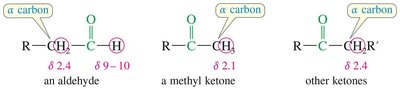
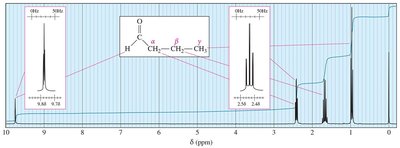
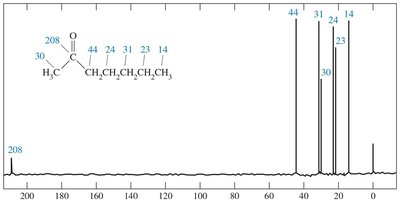
In 1H NMR, aldehyde protons absorb between δ 9–10. Protons on the α-carbon appear at δ 2.1–2.4. Protons further from the carbonyl are less deshielded and appear at lower δ values. In 13C NMR, the carbonyl carbon of ketones appears around 200–220 ppm.
Mass Spectrometry (MS)
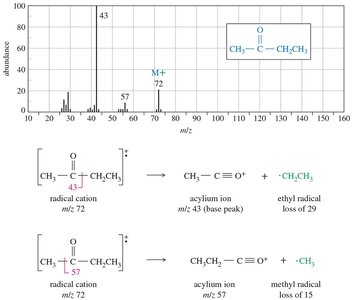
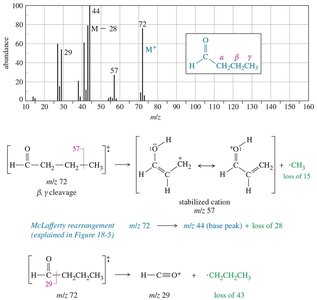
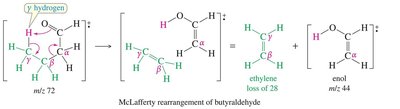
Ketones and aldehydes show characteristic fragmentation patterns in mass spectrometry. The McLafferty rearrangement is a common fragmentation for compounds with γ-hydrogens, resulting in the loss of an alkene and formation of an enol.
Ultraviolet (UV) Spectroscopy
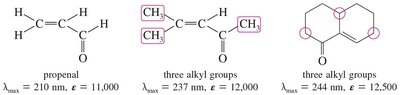
Conjugated carbonyl compounds exhibit π → π* transitions in the UV spectrum. Conjugation with additional C=C bonds or alkyl groups increases the wavelength of maximum absorption (λmax).
Synthesis of Ketones and Aldehydes
Oxidation of Alcohols
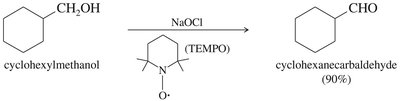
Primary alcohols can be oxidized to aldehydes using reagents such as pyridinium chlorochromate (PCC) or Swern oxidation. Secondary alcohols are oxidized to ketones.

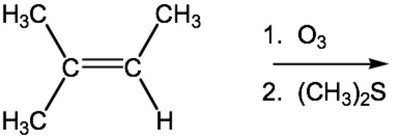
Ozonolysis of Alkenes
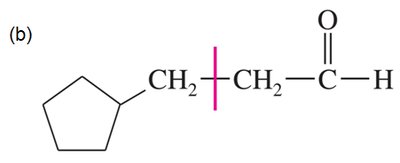
Ozonolysis cleaves alkenes to give ketones and/or aldehydes, depending on the substitution pattern of the double bond.

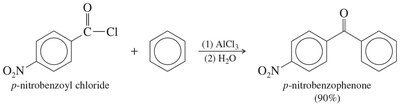
Friedel–Crafts Acylation
The reaction of an acyl halide with an aromatic ring in the presence of AlCl3 produces a ketone (Friedel–Crafts acylation).

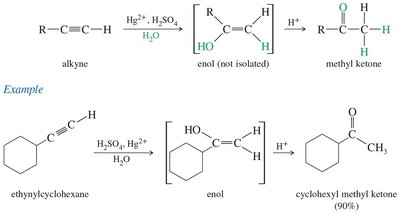
Hydration of Alkynes
Hydration of alkynes (Markovnikov addition) yields ketones via enol intermediates. Hydroboration-oxidation of alkynes gives anti-Markovnikov addition, leading to aldehydes.
Synthesis from Carboxylic Acids and Nitriles
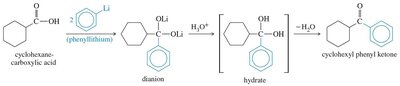
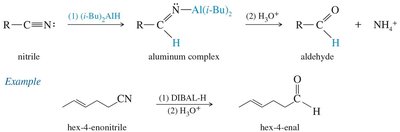
Ketones can be synthesized from carboxylic acids using organolithium reagents. Grignard or organolithium reagents can also convert nitriles to ketones via imine intermediates. Reduction of nitriles with DIBAL-H yields aldehydes.

Other Synthetic Methods
Aldehydes can be prepared from acid chlorides using lithium tri-tert-butoxyaluminum hydride, which selectively reduces acid chlorides to aldehydes.

Reactivity of Ketones and Aldehydes
Nucleophilic Addition
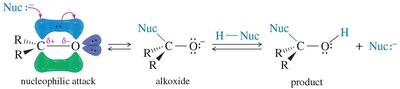
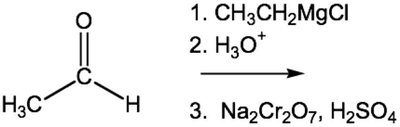
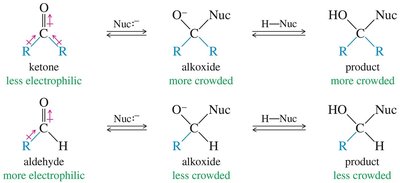
The most important reaction of ketones and aldehydes is nucleophilic addition to the carbonyl carbon. Strong nucleophiles (e.g., Grignard reagents, hydride ions) attack the electrophilic carbon, forming an alkoxide intermediate that is then protonated to give an alcohol. Aldehydes are generally more reactive than ketones due to less steric hindrance and greater partial positive charge on the carbonyl carbon.


Hydration and Cyanohydrin Formation
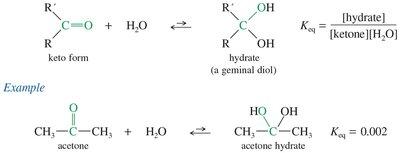
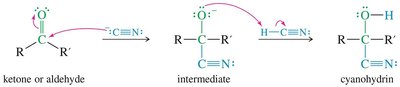
In aqueous solution, ketones and aldehydes are in equilibrium with their hydrates (geminal diols). The equilibrium favors the carbonyl form for ketones. Cyanohydrins are formed by nucleophilic addition of cyanide ion to the carbonyl group, followed by protonation.

Summary Table: Classes of Carbonyl Compounds
Class | General Formula |
|---|---|
Ketones | R–C(=O)–R' |
Aldehydes | R–C(=O)–H |
Carboxylic acids | R–C(=O)–OH |
Esters | R–C(=O)–O–R' |
Acid chlorides | R–C(=O)–Cl |
Amides | R–C(=O)–NH2 |
Additional info: This summary covers the structure, nomenclature, physical properties, spectroscopic characteristics, synthesis, and reactivity of ketones and aldehydes, as well as their relationship to other carbonyl compounds. The included images reinforce key concepts and mechanisms relevant to undergraduate organic chemistry.
