 Back
BackMidterm Study Guide: Alkenes, Stability, Reaction Mechanisms, and Carbocation Chemistry
Study Guide - Smart Notes
 Tailored notes based on your materials, expanded with key definitions, examples, and context.
Alkenes: Structure, Stability, and Reactions
Major Products of Alkene Reactions
Alkenes undergo a variety of reactions, often producing multiple products depending on the reagents and conditions. Stereochemistry plays a crucial role in determining the major product.
Electrophilic Addition: Alkenes react with electrophiles (e.g., HX, X2, H2O) to form addition products. The regioselectivity and stereoselectivity depend on the stability of intermediates and the mechanism.
Markovnikov's Rule: In addition reactions, the electrophile adds to the carbon with more hydrogens, while the nucleophile adds to the more substituted carbon.
Anti and Syn Addition: The orientation of addition (anti or syn) affects the stereochemistry of the product.
Example: Addition of Br2 to trans-2-butene yields a single meso product due to anti addition.
Stability of Alkenes
The stability of alkenes is influenced by substitution and geometry. More substituted and trans (E) alkenes are generally more stable.
Substitution: Tetra-substituted alkenes are more stable than tri-, di-, or mono-substituted alkenes.
Geometry: (E)-alkenes are more stable than (Z)-alkenes due to reduced steric hindrance.
Example: (E)-2-methyl-3-octene is more stable than 5-methyl-1-octene.
Stability of Cycloalkenes and Substituted Alkenes
Cycloalkenes and their substituted derivatives show varying stability based on ring strain and substitution patterns.
Ring Strain: Smaller rings (cyclopentene) are less stable than larger rings (cyclohexene).
Substitution: More substituted cycloalkenes are generally more stable.
Reaction Thermodynamics and Kinetics
Thermodynamic vs. Kinetic Stability
Reactions can be classified based on their thermodynamic and kinetic properties. Thermodynamic stability refers to the energy difference between reactants and products, while kinetic stability refers to the activation energy required for the reaction.
Thermodynamically Stable: Product is lower in energy than reactant ().
Kinetically Stable: High activation energy () prevents rapid reaction.
Spontaneous: Reaction proceeds without external input ().
Temperature Dependence: Reactions with high activation energy occur only at high temperatures.
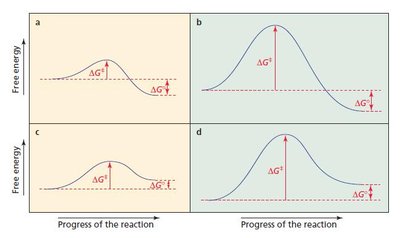
Additional info: The image above illustrates four scenarios for reaction progress: (a) low activation energy and negative free energy change (spontaneous and fast), (b) high activation energy and negative free energy change (spontaneous but slow), (c) low activation energy and positive free energy change (non-spontaneous but fast), and (d) high activation energy and positive free energy change (non-spontaneous and slow).
Carbocation Stability
Ranking Carbocation Stability
Carbocations are intermediates in many organic reactions. Their stability is influenced by substitution, resonance, and inductive effects.
Substitution: Tertiary carbocations are more stable than secondary, which are more stable than primary.
Resonance: Carbocations stabilized by resonance (e.g., allylic, benzylic) are more stable.
Inductive Effects: Electron-donating groups stabilize carbocations.
Example: A tertiary carbocation with resonance stabilization is the most stable.
Mechanisms of Alkene Reactions
Arrow-Pushing Mechanisms
Understanding the stepwise mechanism of alkene reactions is essential for predicting products and their stereochemistry.
Electrophilic Addition: The alkene attacks the electrophile, forming a carbocation intermediate, which is then attacked by a nucleophile.
Halogenation: Addition of X2 (e.g., Br2) proceeds via a cyclic halonium ion intermediate, leading to anti addition.
Hydration: Acid-catalyzed addition of water to alkenes forms alcohols, often yielding regioisomeric products.
Hydroboration-Oxidation: Borane adds to the alkene in a syn fashion, followed by oxidation to yield alcohols.
Epoxidation: Peroxy acids react with alkenes to form epoxides.
Examples of Mechanisms
(E)-3-methyl-2-pentene + HBr: Markovnikov addition yields a single product.
(E)-3-methyl-2-pentene + Cl2 in water: Forms two products via halohydrin formation.
trans-2-butene + H2O (acidic): Forms two alcohols; these are enantiomers.
trans-2-butene + Br2: Forms a single meso dibromide due to anti addition.
(Z)-3-methyl-2-pentene + Borane/THF, then NaOH/H2O2: Forms two alcohols via syn addition.
(Z)-3-methyl-2-pentene + peroxy acid: Forms two epoxide products.
Summary Table: Thermodynamic vs. Kinetic Properties
Property | Thermodynamically Stable | Kinetically Stable |
|---|---|---|
Free Energy Change () | Negative | Irrelevant |
Activation Energy () | Irrelevant | High |
Spontaneity | Yes | No |
Reaction Rate | Fast or Slow | Slow |
Additional info: This table summarizes the differences between thermodynamic and kinetic stability in organic reactions.
