 Back
BackMolecular Representations and Functional Groups in Organic Chemistry
Study Guide - Smart Notes
 Tailored notes based on your materials, expanded with key definitions, examples, and context.
2. Molecular Representations
Intermolecular Forces (IMFs)
Intermolecular forces are the attractive forces that exist between molecules, playing a crucial role in determining the physical properties of substances such as boiling point and melting point. Without IMFs, all substances would exist as gases under standard conditions.
Hydrogen Bonding: A strong type of dipole-dipole interaction that occurs when hydrogen is bonded to small, highly electronegative atoms such as fluorine (F), oxygen (O), or nitrogen (N).
Dipole-Dipole Forces: These forces occur between molecules that have a permanent net dipole moment due to differences in electronegativity.
Van der Waals (London Dispersion) Forces: Present in all molecules, these forces increase with molecular size and are stronger in rings than in chains, and in chains more than in branched structures.
Boiling point and melting point questions are always directly related to the strength of IMFs between molecules.
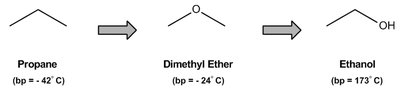
Example: The boiling points of propane, dimethyl ether, and ethanol increase as the strength of intermolecular forces increases, with hydrogen bonding in ethanol resulting in the highest boiling point.
Polarity and Solubility
Polarity is a key factor in determining the solubility of molecules. The general rule is: like dissolves like. Polar substances tend to dissolve in polar solvents, while nonpolar substances dissolve in nonpolar solvents.
Polar molecules are miscible with water (a polar solvent).
Nonpolar molecules are not miscible with water but dissolve in nonpolar solvents.
Example: Ethanol (a polar molecule) is miscible in water due to hydrogen bonding.
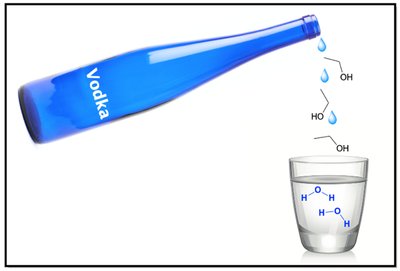
Practice: To determine if a molecule is miscible in water, look for the presence of polar functional groups (e.g., -OH, -NH2).
Functional Groups
Classification of Organic Molecules by Functional Groups
Functional groups are specific groups of atoms within molecules that are responsible for the characteristic chemical reactions of those molecules. Organic molecules can be classified into subsets based on their functional groups.
Hydrocarbons: Compounds containing only carbon and hydrogen.
Alkanes: Only single bonds.
Alkenes: At least one double bond.
Alkynes: At least one triple bond.
All carbon groups, regardless of size, can be symbolized using an R group.
When an alkane is attached to a larger carbon chain, it is given an -yl suffix (e.g., methyl group).
Carbons are classified by their degree, which is based on the number of other carbons to which they are attached:
Primary (1°): Attached to one other carbon
Secondary (2°): Attached to two other carbons
Tertiary (3°): Attached to three other carbons
Quaternary (4°): Attached to four other carbons
Hydrogens possess the same degree as the carbon to which they are attached.
Common Functional Groups
Alkyl Halide: An R group directly attached to a halogen. The degree is determined by the carbon to which the halogen is attached.
Alcohol: Contains an -OH group. The degree is determined by the carbon to which the -OH is attached.
Amine: Contains a nitrogen atom bonded to carbon(s) and/or hydrogen(s).
Ether: An oxygen atom connected to two alkyl or aryl groups.
Amide: Contains a carbonyl group (C=O) attached to a nitrogen atom.
Ester: Contains a carbonyl group adjacent to an ether linkage.
Carboxylic Acid: Contains a carbonyl group bonded to an -OH group; the acid of organic chemistry.
Ketone: A carbonyl group bonded to two carbons.
Aldehyde: A carbonyl group bonded to at least one hydrogen.
Nitrile: Contains a carbon triple-bonded to nitrogen.
Benzene (Aromatic): A six-membered ring with alternating double bonds (aromaticity).
Acyl Chloride: A carbonyl group bonded to a chlorine atom.
Anhydride: Two acyl groups bonded to the same oxygen atom.
Sulfur Compounds: Contain sulfur atoms, such as thiols and thioethers.
Note: The term "carbonyl" refers to the C=O group, but the functionality depends on its location in the molecule.
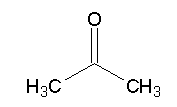
Example: Acetone is a ketone, with the carbonyl group bonded to two methyl groups.
Degrees of Functional Groups
The degree of a functional group (such as alcohols, alkyl halides, and amines) is determined by the number of carbon atoms attached to the carbon or nitrogen bearing the functional group.
Practice: Identifying Functional Groups
To identify functional groups in a molecule, look for characteristic atoms or bonding patterns (e.g., C=O for carbonyls, -OH for alcohols, -NH2 for amines). Assign degrees where applicable based on the number of carbons attached to the functional group-bearing atom.
Summary Table: Common Functional Groups
Functional Group | General Structure | Example |
|---|---|---|
Alkane | R-H | Methane |
Alkene | R-CH=CH-R | Ethene |
Alkyne | R-C≡C-R | Ethyne |
Alcohol | R-OH | Ethanol |
Ether | R-O-R' | Dimethyl ether |
Ketone | R-CO-R' | Acetone |
Aldehyde | R-CHO | Formaldehyde |
Carboxylic Acid | R-COOH | Acetic acid |
Amine | R-NH2 | Methylamine |
Amide | R-CONH2 | Acetamide |
Ester | R-COOR' | Ethyl acetate |
Nitrile | R-CN | Acetonitrile |
Benzene (Aromatic) | C6H6 | Benzene |
Additional Examples
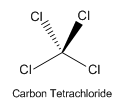
Example: Carbon tetrachloride (CCl4) is a nonpolar molecule due to its symmetrical tetrahedral geometry, despite the presence of polar C-Cl bonds.
Practice Problems: Identify all functional groups and assign degrees where applicable in given molecular structures.
Additional info: Some content and examples have been expanded for clarity and completeness based on standard organic chemistry curriculum.
