 Back
BackMore About Amines and Reactions of Heterocyclic Compounds
Study Guide - Smart Notes
 Tailored notes based on your materials, expanded with key definitions, examples, and context.
More About Amines
Basicity and Nucleophilicity of Amines
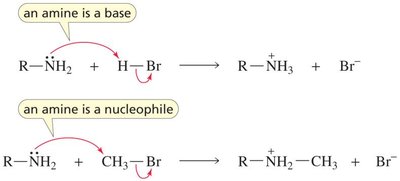
Amines are organic compounds derived from ammonia by replacement of one or more hydrogen atoms with alkyl or aryl groups. They act as both bases and nucleophiles due to the presence of a lone pair of electrons on the nitrogen atom.
As Bases: Amines accept protons (H+) to form ammonium ions.
As Nucleophiles: Amines donate their lone pair to electrophilic centers other than protons, participating in substitution and addition reactions.
Example: Reaction with HBr (as a base) and with CH3Br (as a nucleophile):
Classification and Nomenclature of Amines
Amines are classified based on the number of organic substituents attached to the nitrogen atom:
Primary (1°) amine: One alkyl or aryl group attached to nitrogen.
Secondary (2°) amine: Two alkyl or aryl groups attached to nitrogen.
Tertiary (3°) amine: Three alkyl or aryl groups attached to nitrogen.
Nomenclature: Systematic and common names are used, often based on the longest carbon chain attached to the nitrogen.

Saturated Heterocyclic Compounds
Saturated heterocycles are cyclic compounds containing at least one heteroatom (such as N, O, or S) and only single bonds. Common examples include aziridine, pyrrolidine, piperidine, and morpholine.
Azacyclopropane (aziridine): Three-membered ring with nitrogen.
Azacyclobutane (azetidine): Four-membered ring with nitrogen.
Azacyclopentane (pyrrolidine): Five-membered ring with nitrogen.
Azacyclohexane (piperidine): Six-membered ring with nitrogen.

Acidity of Amines and Related Compounds
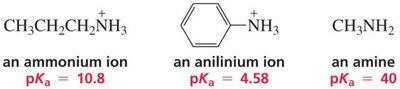
Amines are weak bases, and their conjugate acids (ammonium ions) have characteristic pKa values. The basicity of amines is influenced by the electronic environment around the nitrogen atom.
Ammonium ion: pKa ≈ 10.8
Anilinium ion: pKa ≈ 4.58
Methylamine: pKa ≈ 40 (very weak acid, strong base)

Relative Reactivities of Compounds with Electronegative Groups
The reactivity of compounds with electronegative groups attached to sp3 carbons varies depending on the leaving group ability and the stability of the conjugate base.
Order of Reactivity: RCH2F > RCH2OH > RCH2OCH3 > RCH2NH2
Explanation: The strongest acid has the weakest conjugate base, making it a better leaving group.

Nucleophilic Reactions of Amines
Amines participate in various nucleophilic reactions, including SN2 reactions, nucleophilic acyl substitution, and nucleophilic addition–elimination reactions.
SN2 Reaction: Amines attack alkyl halides to form substituted amines.
Nucleophilic Acyl Substitution: Amines react with acyl chlorides to form amides.
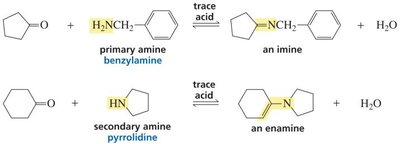
Nucleophilic Addition–Elimination: Amines react with carbonyl compounds to form imines or enamines.

Arenediazonium Salts Formation
Amines can react with nitrous acid (generated in situ from NaNO2 and HCl) to form arenediazonium salts, which are important intermediates in organic synthesis.
Reaction: Aromatic amine + NaNO2/HCl → Arenediazonium salt
Utility: Arenediazonium salts can undergo substitution with various nucleophiles.

Gabriel Synthesis of Primary Amines
The Gabriel synthesis is a method for preparing primary amines from alkyl halides using phthalimide as a nitrogen source.
Step 1: Alkylation of phthalimide with alkyl halide.
Step 2: Hydrolysis to yield the primary amine.

Reactions of Heterocyclic Compounds
Five-Membered Aromatic Heterocycles: Pyrrole, Furan, Thiophene
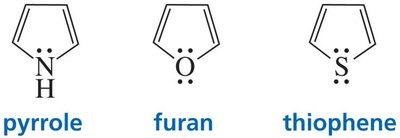
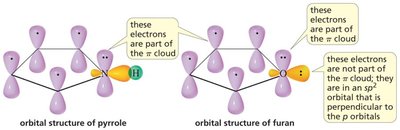
Five-membered aromatic heterocycles contain one heteroatom (N, O, or S) and exhibit aromaticity due to delocalized π electrons.
Pyrrole: Contains nitrogen; lone pair participates in aromaticity.
Furan: Contains oxygen; one lone pair participates in aromaticity.
Thiophene: Contains sulfur; one lone pair participates in aromaticity.
Aromaticity and Resonance in Heterocycles
Aromaticity in heterocycles is explained by resonance contributors and delocalization of π electrons. Pyrrole, furan, and thiophene each have six π electrons, satisfying Hückel's rule.
Resonance: Multiple resonance structures contribute to the stability of these rings.
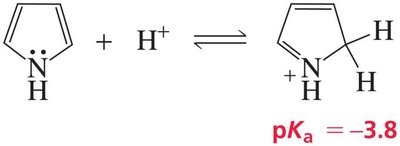
Pyrrole: Lone pair on nitrogen is part of the aromatic sextet, making it a weak base.
Dipole Moments and Delocalization Energy
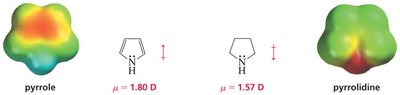
The dipole moment and delocalization energy of heterocycles reflect the distribution of electron density and the stability conferred by aromaticity.
Dipole Moment: Direction and magnitude depend on the heteroatom and its position.
Delocalization Energy: Increases with the number and equivalence of resonance contributors.

Electrophilic Aromatic Substitution in Pyrrole
Pyrrole undergoes electrophilic aromatic substitution (EAS) reactions, with substitution preferentially occurring at the 2-position due to resonance stabilization of the intermediate.
Mechanism: Electrophile attacks the 2-position, forming a resonance-stabilized cation.
Polymerization: Pyrrole can polymerize in acidic conditions.

Acidity of Pyrrole and Pyrrolidine
Pyrrole is more acidic than pyrrolidine because its conjugate base is stabilized by electron delocalization. The pKa values reflect this difference.
Pyrrole: pKa ≈ -17
Pyrrolidine: pKa ≈ 36

Acidity of Nitrogen-Containing Heterocycles
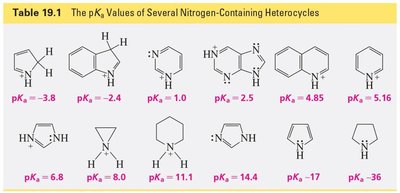
The acidity of nitrogen-containing heterocycles varies widely and is influenced by aromaticity and resonance stabilization of the conjugate base.
Compound | pKa |
|---|---|
Pyrrole | -3.8 |
Imidazole | 6.8 |
Pyridine | 5.16 |
Pyrrolidine | 36 |
Electrophilic Aromatic Substitution in Five-Membered Heterocycles
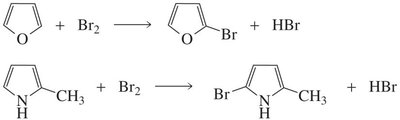
Electrophilic aromatic substitution in five-membered heterocycles (pyrrole, furan, thiophene) occurs most readily at the 2-position due to resonance stabilization. These compounds are more reactive than benzene in EAS reactions.
Order of Reactivity: Pyrrole > Furan > Thiophene > Benzene

Pyridine: Structure, Aromaticity, and Reactivity
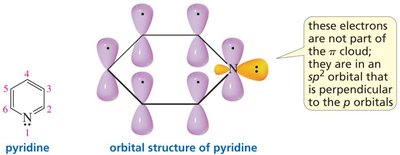
Pyridine is a six-membered aromatic heterocycle with one nitrogen atom. Its lone pair is in an sp2 orbital, perpendicular to the π system, making it less basic than aliphatic amines.
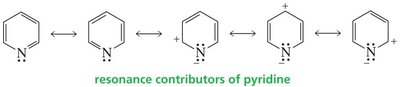
Aromaticity: Pyridine is aromatic, with six π electrons delocalized over the ring.
Reactivity: Pyridine is less reactive than benzene in electrophilic aromatic substitution but more reactive in nucleophilic aromatic substitution.
Acidity and Basicity of Pyridine and Pyridinium Ion
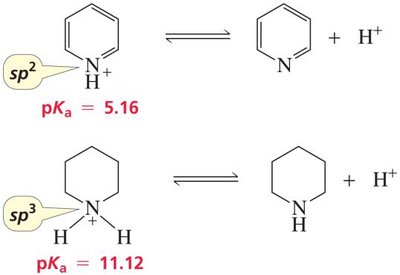
The pyridinium ion (protonated pyridine) is a stronger acid than a typical ammonium ion due to resonance stabilization. Pyridine can also act as a nucleophile in certain reactions.
Pyridinium ion: pKa ≈ 5.16
Piperidinium ion: pKa ≈ 11.12
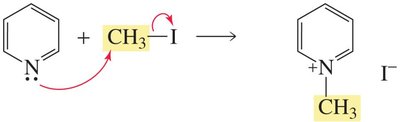
Electrophilic and Nucleophilic Substitution in Pyridine
Electrophilic aromatic substitution in pyridine occurs at the 3-position, while nucleophilic aromatic substitution occurs at the 2- and 4-positions. The reactivity is influenced by the electron-withdrawing effect of the nitrogen atom.
EAS: Substitution at the 3-position due to resonance stabilization.
NAS: Substitution at the 2- and 4-positions, especially when a good leaving group is present.


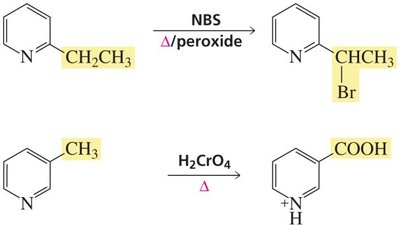
Reactions of the Side Chain in Substituted Pyridines
Substituted pyridines undergo similar side-chain reactions as substituted benzenes, including oxidation and halogenation.
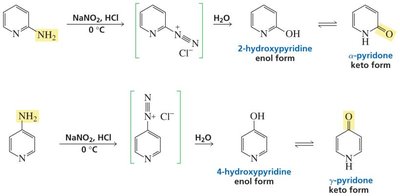
Diazonium Ion Formation and Keto-Enol Tautomerism
Pyridine derivatives can form diazonium ions, which can tautomerize between keto and enol forms. The keto form is generally more stable due to resonance stabilization.
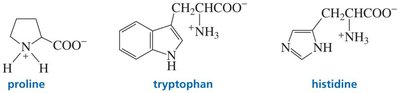
Heterocyclic Amino Acids and Imidazole
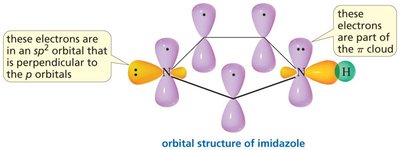
Several amino acids contain heterocyclic rings, such as proline, tryptophan, and histidine. Imidazole, the side chain of histidine, is aromatic and plays a crucial role in enzyme catalysis.
Imidazole: Contains two nitrogen atoms; both are equivalent in the protonated and anionic forms.
Biological Importance of Heterocycles
Heterocyclic compounds are found in many biologically important molecules, including nucleic acids (purines and pyrimidines), porphyrins (heme), and pharmaceuticals (antihistamines, ulcer drugs).
Purines and Pyrimidines: Bases in DNA and RNA.
Porphyrin Ring System: Found in heme, which binds iron in hemoglobin and myoglobin.
Additional info: The porphyrin ring system is a large, conjugated macrocycle that coordinates metal ions, essential for oxygen transport and electron transfer in biological systems.
