 Back
BackNBS Bromination of Cyclohexene Under UV Light
Study Guide - Smart Notes
 Tailored notes based on your materials, expanded with key definitions, examples, and context.
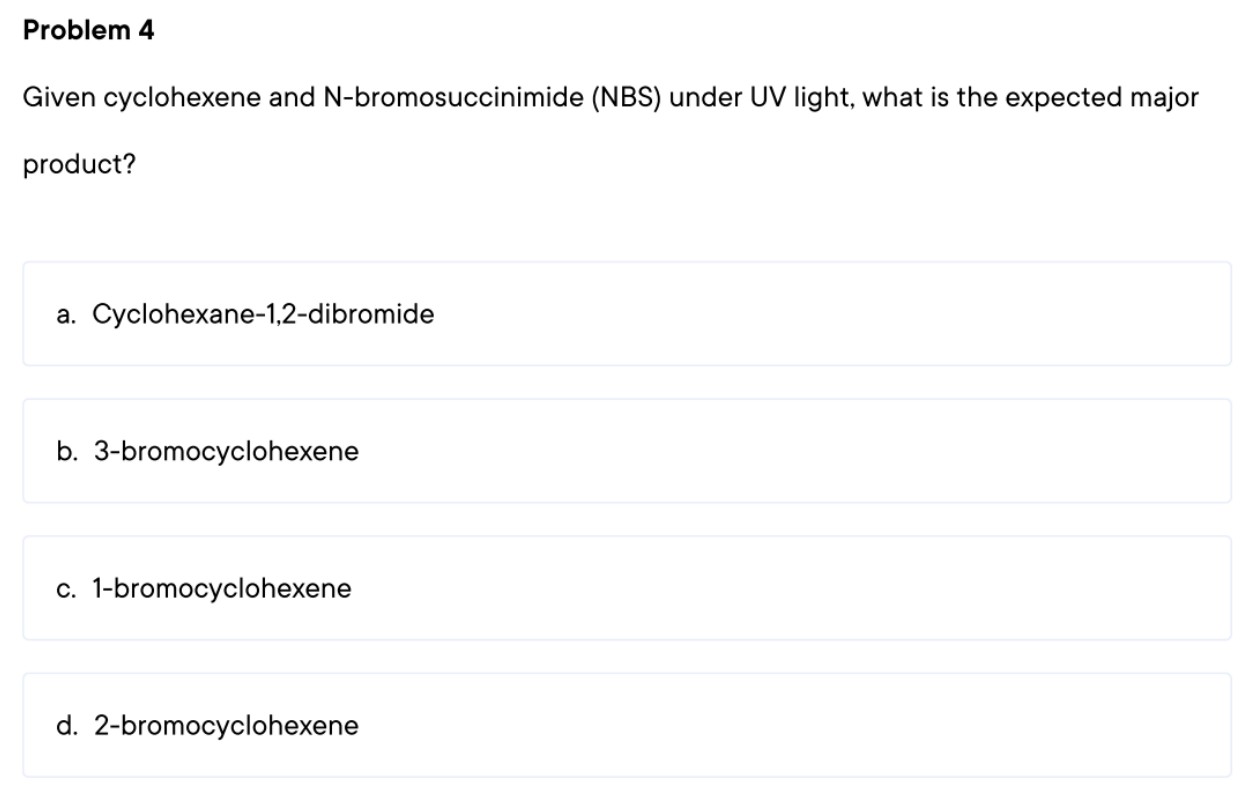
Q4. Given cyclohexene and N-bromosuccinimide (NBS) under UV light, what is the expected major product?
a. Cyclohexane-1,2-dibromide
b. 3-bromocyclohexene
c. 1-bromocyclohexene
d. 2-bromocyclohexene
Background
Topic: Allylic Bromination (Free Radical Mechanism)
This question tests your understanding of the reaction between cyclohexene and N-bromosuccinimide (NBS) under UV light, which is a classic method for selective bromination at the allylic position of alkenes via a free radical mechanism.
Key Terms and Formulas
Allylic position: The carbon atom adjacent to a double bond in an alkene.
NBS (N-bromosuccinimide): A reagent used for selective bromination at the allylic position.
Free radical mechanism: Initiated by UV light, leading to the formation of bromine radicals.
The general reaction is:
Step-by-Step Guidance
Identify the structure of cyclohexene and locate the allylic positions (the carbons adjacent to the double bond).
Recall that NBS under UV light does not add bromine across the double bond, but instead brominates the allylic position via a free radical mechanism.
Determine which carbon atoms in cyclohexene are allylic and consider the possible products from bromination at these positions.
Review the answer choices and eliminate any that involve dibromide formation or addition across the double bond, as NBS does not perform this reaction under these conditions.
Set up the structure for the possible allylic brominated products and compare them to the answer choices. Consider resonance stabilization and which product is most likely to form.
Try solving on your own before revealing the answer!
Final Answer: b. 3-bromocyclohexene
The major product is 3-bromocyclohexene. NBS under UV light selectively brominates the allylic position (carbon 3) of cyclohexene, not the double bond itself. This is due to the stability of the allylic radical formed during the reaction.
Other options either involve dibromide formation (not possible with NBS/UV) or bromination at non-allylic positions.
