 Back
BackNomenclature, Conformation, and Configuration in Organic Chemistry
Study Guide - Smart Notes
 Tailored notes based on your materials, expanded with key definitions, examples, and context.
Chapter 4: Nomenclature, Conformation, and Configuration
Introduction
This chapter explores the systematic nomenclature of organic compounds, the conformational flexibility of molecules, and the permanent spatial arrangements (configurations) that influence their physical and chemical properties. Understanding these principles is essential for identifying, naming, and predicting the behavior of organic molecules.
Nomenclature of Acyclic Alkanes and Alkyl Halides
Systematic Naming of Alkanes
Parent Chain: The longest continuous chain of carbon atoms in a molecule is identified as the parent chain. The name is based on the number of carbons (e.g., methane, ethane, propane, etc.).
Substituents: Groups branching from the parent chain are called substituents. Alkyl substituents are named by replacing the "-ane" suffix with "-yl" (e.g., methyl, ethyl, propyl).
Locants: Each substituent is assigned a number (locant) to indicate its position on the parent chain. Numbering is done to give the lowest possible numbers to the substituents.
Complex Substituents: Substituents with their own branches are named as substituted alkyl groups (e.g., 2-fluoropentyl).
Systematic Name Structure: The name is assembled as: locant(s) + substituent(s) (in alphabetical order) + parent chain + suffix (e.g., 3,4-diethyl-4-methyloctane).
Example: For a molecule with an 8-carbon chain and three substituents (two ethyl and one methyl), the name is 3,4-diethyl-4-methyloctane.
Nomenclature of Cyclic Alkanes
Add the prefix "cyclo" to the parent chain name.
For a single substituent, no locant is needed; for multiple, number to give the lowest possible locants, prioritizing alphabetical order in case of ties.
Rings are always treated as the parent chain in modern IUPAC nomenclature.
Conformations of Acyclic Molecules
Recognizing Change in Conformation
Molecules can adopt different shapes (conformations) by rotation around single bonds. These changes do not require breaking bonds and occur readily at room temperature.
Conformation: The spatial arrangement of atoms resulting from rotation about single bonds.
Newman Projection: A way to visualize conformations by looking straight down a bond axis.



Ethane Conformations and Dihedral Angles
Rotation around the C–C bond in ethane leads to different conformations with varying stability.
Staggered Conformation: Dihedral angle of 60°, most stable due to minimized torsional strain.
Eclipsed Conformation: Dihedral angle of 0°, least stable due to maximum torsional strain.
Torsion Angle: The angle between two planes through atoms connected by a bond.
Energy Difference: The staggered conformation is more stable than the eclipsed by about 12 kJ/mol.
Butane Conformations and Steric Interference
Butane can adopt anti, gauche, and eclipsed conformations.
Anti Conformation: Methyl groups are 180° apart, most stable due to minimized steric and torsional strain.
Gauche Conformation: Methyl groups are 60° apart, less stable due to steric interference.
Eclipsed Conformation: Methyl groups overlap, least stable due to maximum steric and torsional strain.
Conformations of Cycloalkanes
Cyclopropane
Three-membered ring with significant angle (60°) and torsional strain.
All C–H bonds are eclipsed, making cyclopropane highly reactive.
Cyclobutane
Four-membered ring with angle strain (88°) and torsional strain.
Adopts a "butterfly" conformation to relieve some torsional strain.
Cyclopentane
Five-membered ring with bond angles close to ideal (108°).
Adopts an "envelope" conformation to reduce torsional strain.
Cyclohexane
Six-membered ring adopts a "chair" conformation, which is virtually strain-free.
All bond angles are 109.5°, and all C–H bonds are staggered.
Hydrogens are classified as axial (parallel to ring axis) or equatorial (around the ring's equator).
Drawing Chair Conformations
Number the carbons in the chair form and add substituents according to their orientation (up/down, axial/equatorial).
Ring Flips and Conformational Stability
Cyclohexane can interconvert between two chair conformations via higher-energy intermediates (half-chair, boat, twist-boat).
During a ring flip, axial substituents become equatorial and vice versa.
The most stable conformation is the one with bulky substituents in the equatorial position, minimizing 1,3-diaxial interactions.
The energy difference between axial and equatorial positions is called the "A-value." Larger substituents have larger A-values.
Cyclohexanes with Multiple Substituents
Disubstituted cyclohexanes can exist as cis or trans isomers (geometric isomers).
Ring flips interconvert axial and equatorial positions but do not change the relative "up" or "down" orientation of substituents.
For trans-1,2-dimethylcyclohexane, the diequatorial conformation is most stable. For cis, both conformations have one axial and one equatorial group and are equal in energy.
With three or more substituents, the most stable conformation maximizes the number of equatorial substituents.
Nomenclature of Unsaturated Hydrocarbons
Naming Alkenes and Alkynes
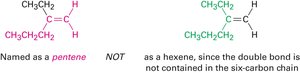
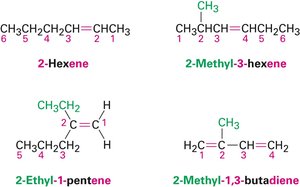
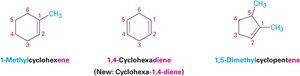
Alkenes are named with the suffix "-ene" and alkynes with "-yne." The parent chain must include the unsaturation.
Number the chain to give the double or triple bond the lowest possible number, even if substituents get higher numbers.
Multiple unsaturations are indicated with "di," "tri," etc., and locants for each.
Substituents are listed in alphabetical order with appropriate locants.

Alkene Configuration: Cis-Trans Isomers
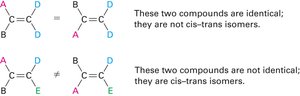
Alkenes with two different groups on each sp2 carbon can exist as cis (same side) or trans (opposite side) isomers.
Restricted rotation around the double bond prevents interconversion between isomers at room temperature.
Cis-trans isomerism requires that each carbon of the double bond has two different substituents.
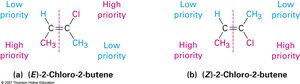
E,Z Nomenclature for Alkenes
The E,Z system is used for tri- and tetrasubstituted alkenes, where cis-trans is insufficient.
Cahn-Ingold-Prelog Rules:
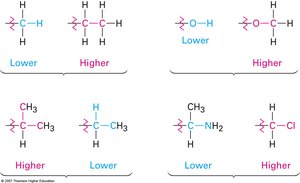
Rank atoms attached to each double-bonded carbon by atomic number (higher = higher priority).
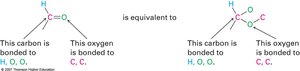
If atomic numbers are equal, compare the next set of atoms outward until a difference is found.
Multiple bonds are treated as an equivalent number of single-bonded atoms for ranking purposes.
E (entgegen): Higher priority groups on opposite sides of the double bond.
Z (zusammen): Higher priority groups on the same side of the double bond.
Nomenclature of Alcohols
Alcohols are named by replacing the "-e" ending of the parent hydrocarbon with "-ol." The parent chain is numbered to give the hydroxyl group the lowest possible number.
In cyclic alcohols, numbering starts at the carbon bearing the hydroxyl group.
Structural Principle: Conformation and Configuration Affect Physical Properties
The shape (conformation) and permanent arrangement (configuration) of a molecule influence its polarity and physical properties.
For example, cis-1,2-dichloroethene is more polar and has a higher boiling point than the trans isomer due to its net dipole moment.
Conformational flexibility can affect the average dipole moment and thus the observed physical properties of a compound.
Example: The dipole moment of 1,2-dichloroethane is a weighted average of its conformers, not just the anti form.
