 Back
BackNuclear Chemistry: Radioactivity, Nuclear Reactions, and Applications
Study Guide - Smart Notes
 Tailored notes based on your materials, expanded with key definitions, examples, and context.
Chapter 5: Nuclear Chemistry
5.1 Natural Radioactivity
Nuclear chemistry studies the changes in atomic nuclei, including the emission of radiation from unstable isotopes. Elements with atomic numbers 20 and higher often have isotopes with unstable nuclei, known as radioisotopes. These nuclei spontaneously emit energy and particles (radiation) to achieve greater stability.
Radioactive Isotope (Radioisotope): An isotope with an unstable nucleus that emits radiation.
Radiation: Small particles or energy emitted from the nucleus during radioactive decay.
Types of Radiation
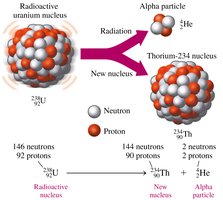
Alpha (α) particles: Identical to a helium nucleus, consisting of 2 protons and 2 neutrons, mass number 4, charge +2, low energy.
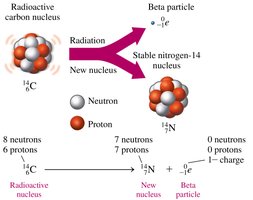
Beta (β) particles: High-energy electrons, mass number 0, charge -1, formed when a neutron converts to a proton and electron.
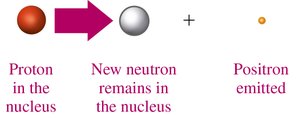
Positrons (β+): Mass number 0, charge +1, formed when a proton converts to a neutron and a positron.
Gamma (γ) rays: High-energy electromagnetic radiation, mass number 0, charge 0, emitted as the nucleus transitions to a lower energy state.
Stable and Radioactive Isotopes
Some isotopes are stable, while others are radioactive and decay over time. The stability depends on the ratio of neutrons to protons in the nucleus.
Biological Effects of Radiation
Ionizing radiation can knock electrons from molecules, forming ions or free radicals.
It can break covalent bonds, damaging or fragmenting molecules.
Rapidly dividing cells (bone marrow, skin, reproductive organs, cancer cells) are most sensitive.
Potential effects: tumors, leukemia, anemia, genetic mutations.
Radiation Protection
Alpha particles: shielded by paper or clothing.
Beta particles: shielded by lab coats or gloves.
Gamma rays: require lead shields or thick concrete walls.
Limit exposure time and increase distance from sources.
5.2 Nuclear Reactions
Nuclear reactions involve changes in the nucleus and are represented by nuclear equations. The sum of mass numbers and atomic numbers must be conserved on both sides of the equation.
Alpha Decay
In alpha decay, the nucleus emits an alpha particle, decreasing the mass number by 4 and the atomic number by 2.
General equation:
Beta Decay
In beta decay, a neutron converts to a proton and emits a beta particle (electron), increasing the atomic number by 1.
General equation:
Positron Emission
In positron emission, a proton is converted to a neutron and a positron, decreasing the atomic number by 1.
General equation:
Gamma Emission
Gamma emission involves the release of energy from an excited nucleus without changing the atomic or mass number.
General equation:
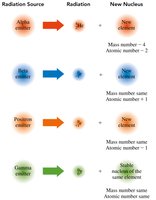
Summary of Radiation Types
Radiation Source | Radiation | New Nucleus |
|---|---|---|
Alpha emitter | α | Mass number - 4, Atomic number - 2 |
Beta emitter | β | Mass number same, Atomic number + 1 |
Positron emitter | β+ | Mass number same, Atomic number - 1 |
Gamma emitter | γ | Stable nucleus of the same element |
Producing Radioactive Isotopes
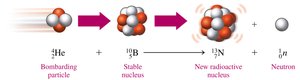
Radioisotopes can be produced by bombarding stable nuclei with high-speed particles (e.g., alpha particles, protons, neutrons).
5.3 Radiation Measurement
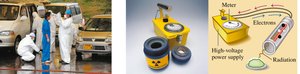
Radiation is measured using devices such as the Geiger counter, which detects beta and gamma radiation by measuring the ions produced in a gas-filled tube.
Units for Measuring Radiation
Curie (Ci): Number of disintegrations per second (1 g of radium = 3.7 × 10¹⁰ disintegrations/s).
Becquerel (Bq): SI unit, 1 disintegration/s.
Rad: Radiation absorbed dose, amount absorbed by 1 g of material.
Rem: Radiation equivalent in humans, measures biological effect.
Sievert (Sv): SI unit for biological damage (1 Sv = 100 rem).
Radiation Exposure
Average annual exposure in the U.S.: 3.6 mSv.
Sources: natural isotopes (e.g., potassium-40), cosmic rays, medical procedures (X-rays, mammograms).
Radiation and Food
Gamma radiation is used to sterilize food, killing bacteria and extending shelf life. The FDA requires labeling of irradiated foods.

5.4 Half-Life of a Radioisotope
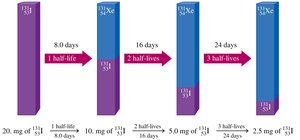
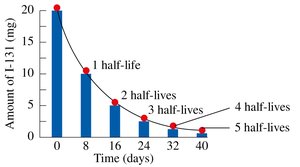
The half-life of a radioisotope is the time required for half of the radioactive atoms in a sample to decay. This property is used in radiometric dating and medical applications.
Radiological Dating
Carbon-14 dating is used to determine the age of ancient objects by measuring the remaining carbon-14 in organic material.


5.5 Medical Applications Using Radioactivity
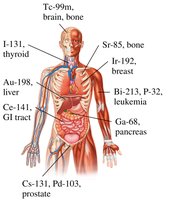
Radioisotopes are used in medicine for diagnosis and treatment, including imaging and cancer therapy. Examples include I-131 for thyroid, Tc-99m for bone scans, and Sr-85 for bone imaging.
5.6 Nuclear Fission and Fusion
Nuclear Fission
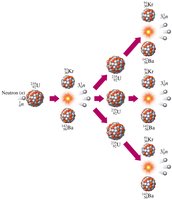
In nuclear fission, a large nucleus (e.g., uranium-235) splits into smaller nuclei when bombarded with a neutron, releasing energy and more neutrons, which can sustain a chain reaction.
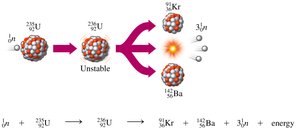
General equation:
Nuclear Fusion
Nuclear fusion combines small nuclei (e.g., hydrogen isotopes) into larger nuclei (e.g., helium), releasing even more energy than fission. Fusion occurs in stars and has potential for clean energy production.
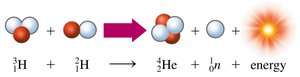
General equation:
Additional info: Nuclear chemistry is foundational for understanding radioactivity, nuclear energy, and their applications in medicine, industry, and environmental science. Mastery of nuclear equations, types of radiation, and safety protocols is essential for further study in chemistry and related fields.
