 Back
BackNucleophilic Substitution and β-Elimination: Mechanisms, Factors, and Applications
Study Guide - Smart Notes
 Tailored notes based on your materials, expanded with key definitions, examples, and context.
Chapter 9: Nucleophilic Substitution and β-Elimination
Introduction to Nucleophilic Substitution and β-Elimination
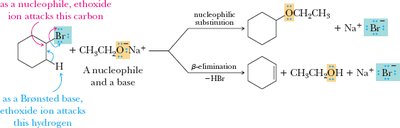
Nucleophilic substitution and β-elimination are two fundamental reaction types in organic chemistry, particularly for haloalkanes. In nucleophilic substitution, a nucleophile replaces a leaving group, while in β-elimination, a base removes a proton from the β-carbon, resulting in the formation of an alkene. These reactions often compete under similar conditions, and understanding their mechanisms is crucial for predicting reaction outcomes.
Nucleophilic Substitution: Concepts and Mechanisms
Key Definitions and Concepts
Nucleophile: An electron-rich species (Lewis base) that donates a pair of electrons to form a new covalent bond.
Electrophile: An electron-deficient species (Lewis acid) that accepts a pair of electrons.
Leaving Group: The atom or group that is displaced in a substitution reaction, typically forming a stable anion.
In nucleophilic substitution, new bonds are formed between the nucleophile and the electrophile, while bonds to the leaving group are broken. The nature of the nucleophile, electrophile, and leaving group all influence the reaction pathway.

Competing Reactions: Substitution vs. Elimination
When a haloalkane contains both a halide and a β-hydrogen, both nucleophilic substitution and β-elimination are possible. The outcome depends on the reaction conditions and the nature of the nucleophile/base.
Examples of Nucleophilic Substitution
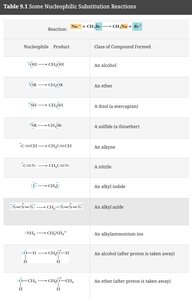
Common nucleophilic substitution reactions produce a variety of organic compounds, depending on the nucleophile used.
Nucleophile | Product | Class of Compound Formed |
|---|---|---|
HO- | R–OH | An alcohol |
RO- | R–OR' | An ether |
HS- | R–SH | A thiol (a mercaptan) |
RS- | R–SR' | A sulfide (a thioether) |
CN- | R–CN | A nitrile |
I- | R–I | An alkyl iodide |
N3- | R–N3 | An alkyl azide |
CH≡C- | R–C≡C–R' | An alkynyl compound |
NH3 | R–NH3+ | An alkylammonium ion |
Mechanisms of Nucleophilic Aliphatic Substitution
SN2 Mechanism (Bimolecular Nucleophilic Substitution)
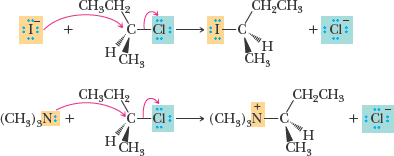
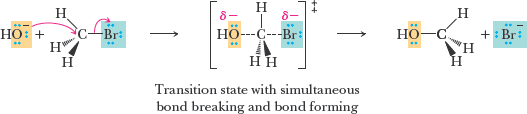
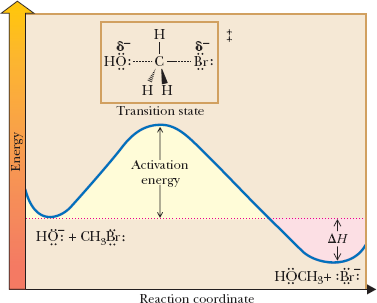
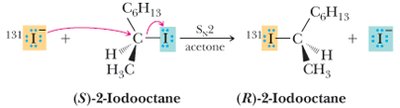
The SN2 mechanism occurs in a single concerted step, where the nucleophile attacks the electrophilic carbon from the side opposite the leaving group (backside attack), leading to simultaneous bond formation and bond breaking. The reaction is second order overall, depending on both the nucleophile and the substrate.
Transition state involves both nucleophile and leaving group.
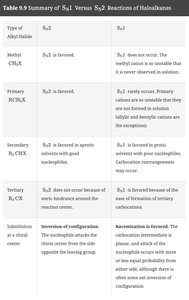
Results in inversion of configuration at the reaction center.
SN1 Mechanism (Unimolecular Nucleophilic Substitution)
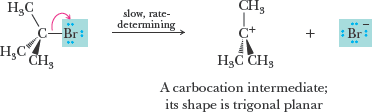
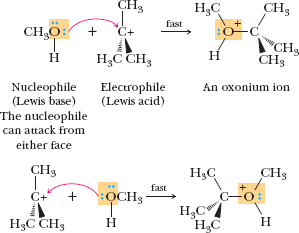
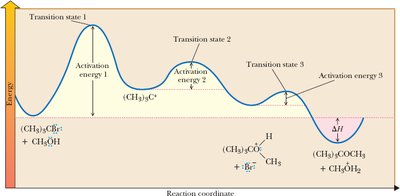
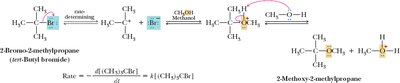
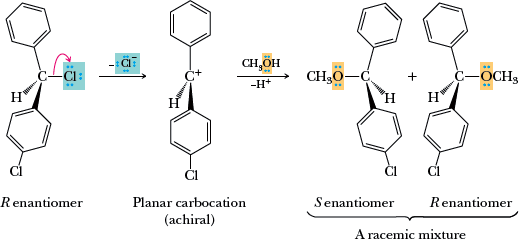
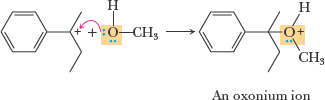
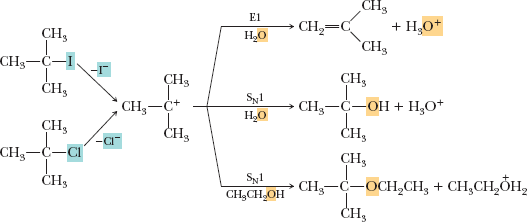
The SN1 mechanism proceeds in two or more steps. First, the leaving group departs, forming a carbocation intermediate. The nucleophile then attacks the planar carbocation, which can occur from either face, leading to racemization if the carbon is chiral. The rate-determining step is the formation of the carbocation and is first order with respect to the substrate.
Carbocation intermediate is planar and can be attacked from either side.
Often leads to racemization at a chiral center.
Key Mechanistic Differences: SN1 vs. SN2
SN2: One-step, concerted, inversion of configuration, sensitive to steric hindrance.
SN1: Multi-step, carbocation intermediate, racemization, sensitive to carbocation stability.
Kinetics of SN1 and SN2 Reactions
SN1: Rate = (first order, unimolecular)
SN2: Rate = (second order, bimolecular)
Doubling the nucleophile concentration affects only SN2 reactions, not SN1.
Stereochemistry of SN1 and SN2 Reactions
SN1: Leads to racemization due to planar carbocation intermediate, but often partial racemization due to ion-pair effects.
SN2: Always results in inversion of configuration at the reaction center (Walden inversion).
Factors Affecting Nucleophilic Substitution
Structure of the Alkyl Halide
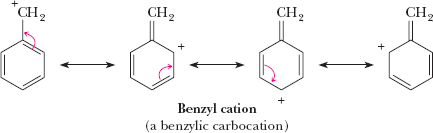
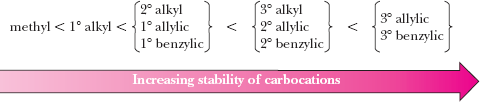
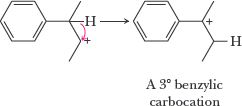
SN1: Favored by tertiary, allylic, and benzylic carbocations due to their stability.
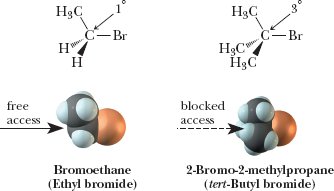
SN2: Favored by methyl and primary halides due to minimal steric hindrance.
Leaving Group Ability
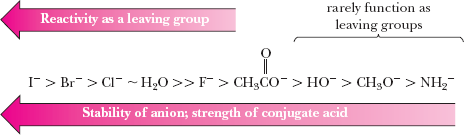
The best leaving groups are those that form the most stable anions. Weak bases (strong conjugate acids) are good leaving groups.
Solvent Effects
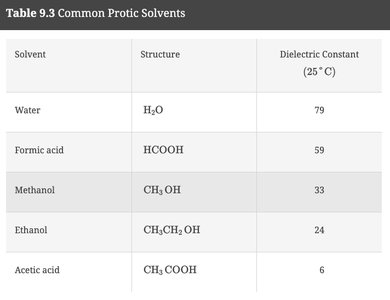
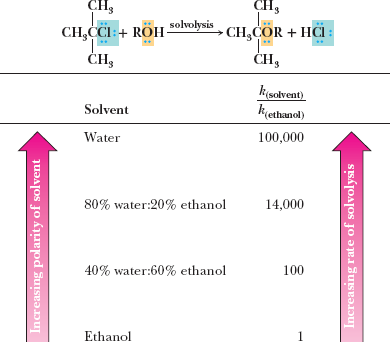
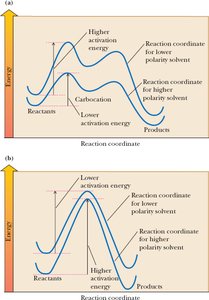
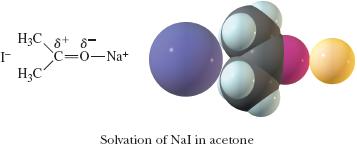
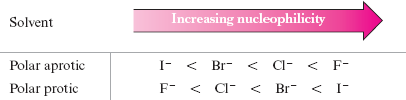
Protic solvents: Stabilize ions via hydrogen bonding; favor SN1 by stabilizing carbocations and anions.
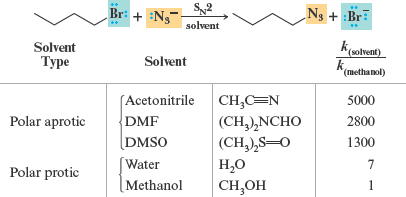
Aprotic solvents: Do not hydrogen bond to anions; favor SN2 by keeping nucleophiles less solvated and more reactive.
Solvent | Structure | Dielectric Constant (25°C) |
|---|---|---|
Water | H2O | 79 |
Formic acid | HCOOH | 59 |
Methanol | CH3OH | 33 |
Ethanol | CH3CH2OH | 24 |
Acetic acid | CH3COOH | 6 |
Nucleophile Structure and Strength
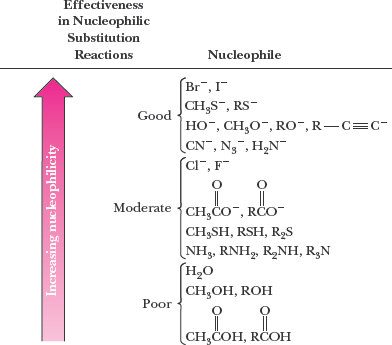
Nucleophilicity: A kinetic property; strong bases are usually strong nucleophiles, but steric hindrance and solvation can affect reactivity.
Basicity: An equilibrium property; not always correlated with nucleophilicity.
Skeletal Rearrangement in SN1 Reactions
Skeletal rearrangements are common in SN1 reactions due to the formation of carbocation intermediates, which can rearrange to more stable carbocations via hydride or alkyl shifts. SN2 reactions do not involve rearrangements.

Analysis and Prediction of Nucleophilic Substitution Reactions
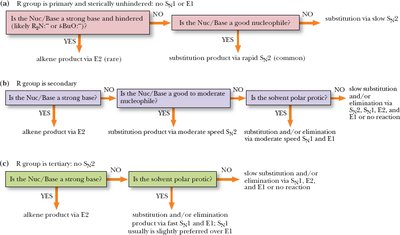
To predict the outcome of a nucleophilic substitution, consider the structure of the haloalkane, the nucleophile, the leaving group, and the solvent. Use flowcharts and tables to guide mechanism selection.
β-Elimination: Mechanisms and Products
β-Elimination (E1 and E2 Mechanisms)
β-Elimination: Removal of a proton from the β-carbon and a leaving group from the α-carbon, forming an alkene.
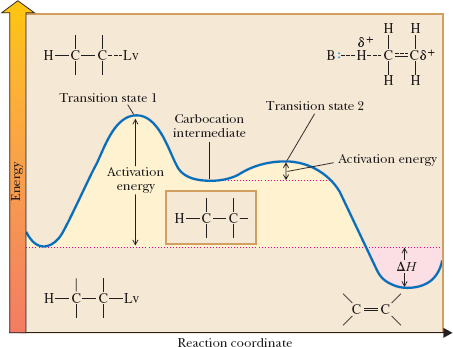
E1 Mechanism: Two-step, carbocation intermediate, similar to SN1.
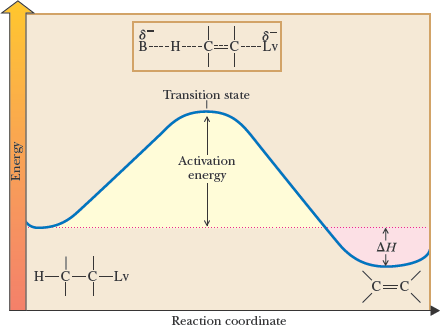
E2 Mechanism: One-step, concerted, similar to SN2; requires a strong base.
Zaitsev's Rule
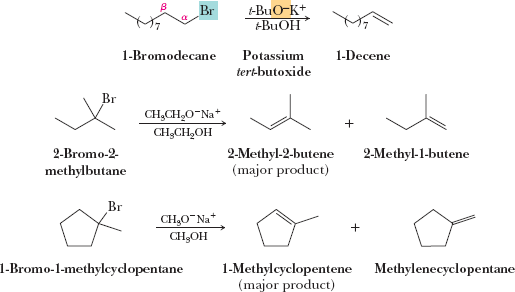
The major product of a β-elimination is the most substituted (and thus most stable) alkene, according to Zaitsev's rule.

Energy Diagrams for Elimination Mechanisms
Substitution vs. Elimination: Competition and Prediction
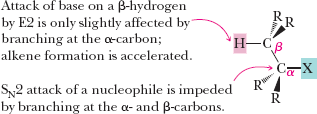
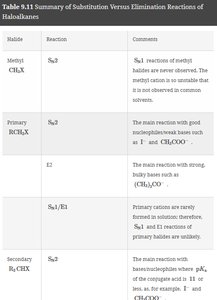
Whether substitution or elimination predominates depends on the structure of the substrate, the strength and steric bulk of the nucleophile/base, the solvent, and the temperature. Use decision trees and tables to predict outcomes.
Summary Table: Key Features of SN1, SN2, E1, and E2 Mechanisms
Mechanism | Steps | Order | Intermediate | Stereochemistry | Favored by |
|---|---|---|---|---|---|
SN1 | 2+ | First | Carbocation | Racemization | Tertiary, allylic, benzylic, polar protic |
SN2 | 1 | Second | None | Inversion | Methyl, primary, strong nucleophile, polar aprotic |
E1 | 2 | First | Carbocation | Mixture | Tertiary, weak base, polar protic |
E2 | 1 | Second | None | Anti-coplanar | Strong base, high temperature |
Additional info: The above summary table is inferred from standard organic chemistry textbooks to provide a concise comparison of the four main mechanisms discussed in this chapter.
