 Back
BackOrganic Chemistry Drawing and Structure Practice
Study Guide - Smart Notes
 Tailored notes based on your materials, expanded with key definitions, examples, and context.
Q1. How many π-bonds are in the following molecule?
Background
Topic: Bond Types in Organic Molecules
This question tests your ability to identify and count π-bonds (pi bonds) in a molecule, which are found in double and triple bonds.
Key Terms and Formulas:
π-bond: A type of covalent bond formed by sideways overlap of p orbitals, present in double and triple bonds.
Single bond: Contains only a σ-bond (sigma bond).
Double bond: Contains one σ-bond and one π-bond.
Triple bond: Contains one σ-bond and two π-bonds.
Step-by-Step Guidance
Examine the molecule and identify all double and triple bonds present.
Recall that each double bond contains one π-bond, and each triple bond contains two π-bonds.
Count the total number of double and triple bonds in the molecule.
Calculate the total number of π-bonds by summing the contributions from each bond type.
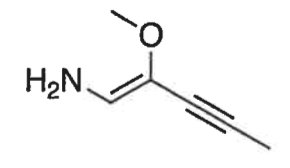
Try solving on your own before revealing the answer!
Final Answer: 3 π-bonds
There is one double bond (1 π-bond) and one triple bond (2 π-bonds), totaling 3 π-bonds.
Q2. How many hydrogens are there on the indicated carbons?
Background
Topic: Hydrogen Counting in Organic Structures
This question tests your ability to determine the number of hydrogen atoms attached to specific carbon atoms in a molecule, based on their bonding and structure.
Key Terms and Formulas:
Valency of carbon: Carbon forms four bonds.
Hydrogen atoms: Fill the remaining bonds on carbon after accounting for bonds to other atoms.
Step-by-Step Guidance
Identify the indicated carbon atoms in the structure.
Count the number of bonds each carbon makes to other atoms (including carbon, oxygen, nitrogen, etc.).
Subtract the number of bonds to other atoms from four to determine how many hydrogens are attached to each carbon.
Repeat for each indicated carbon.
Try solving on your own before revealing the answer!
Final Answer: The number of hydrogens depends on the specific carbons indicated in the structure.
For each carbon, use the formula: Hydrogens = 4 - (number of bonds to other atoms).
Q3. Draw CH3CH2C(CH3)2CH2OH as a skeletal structure.
Background
Topic: Skeletal (Line-Angle) Structures
This question tests your ability to convert a condensed chemical formula into a skeletal (line-angle) structure, which is a common shorthand in organic chemistry.
Key Terms and Formulas:
Skeletal structure: A simplified drawing where carbon atoms are implied at the ends and intersections of lines, and hydrogens attached to carbons are not shown.
Condensed formula: Shows groups of atoms in a compact form.
Step-by-Step Guidance
Break down the condensed formula into its individual groups: CH3, CH2, C(CH3)2, CH2, OH.
Arrange the groups in the correct order, noting that C(CH3)2 is a central carbon with two methyl groups attached.
Draw the main carbon chain, then add branches for the methyl groups and the OH group.
Ensure all carbons are implied at line ends/intersections, and hydrogens are omitted unless attached to heteroatoms.
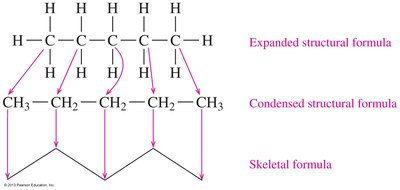
Try solving on your own before revealing the answer!
Final Answer: The skeletal structure is a five-carbon chain with a tertiary carbon at position 3, two methyl branches, and an OH group at the end.
Refer to the image for how to convert between expanded, condensed, and skeletal formulas.
Q4. Draw 1-sec-butyl-2-isopropylcyclopentane as a line structure.
Background
Topic: Nomenclature and Drawing Substituted Cycloalkanes
This question tests your ability to interpret IUPAC names and draw the corresponding line structure for a substituted cyclopentane.
Key Terms and Formulas:
Sec-butyl group: A four-carbon group attached via its second carbon.
Isopropyl group: A three-carbon group attached via its central carbon.
Cyclopentane: A five-membered ring.
Step-by-Step Guidance
Draw a five-membered ring to represent cyclopentane.
Identify position 1 for the sec-butyl group and position 2 for the isopropyl group.
Attach the sec-butyl group to carbon 1 and the isopropyl group to carbon 2 of the ring.
Ensure the correct orientation and branching for each substituent.
Try solving on your own before revealing the answer!
Final Answer: The line structure shows a cyclopentane ring with sec-butyl at position 1 and isopropyl at position 2.
Carefully place each substituent according to the IUPAC name.
