Back
BackOrganic Chemistry Exam II Study Guidance
Study Guide - Smart Notes
 Tailored notes based on your materials, expanded with key definitions, examples, and context.
Q1. Provide the missing starting material, major organic product, conditions, or reagent(s) for the following transformations. Please indicate stereochemistry where necessary.
Background
Topic: Organic Reaction Mechanisms and Stereochemistry
This question tests your ability to identify reagents, products, and starting materials for various organic transformations, including stereochemical outcomes. It requires knowledge of reaction types (e.g., substitution, elimination, addition), functional group interconversions, and stereochemistry.
Key Terms and Formulas:
Functional group: A specific group of atoms within molecules responsible for characteristic reactions.
Stereochemistry: The study of the spatial arrangement of atoms in molecules and its effect on chemical reactions.
Common reaction types: SN1, SN2, E1, E2, addition, elimination, oxidation, reduction.
Reagent notation: '/' for simultaneous reagents, ';' or '#' for stepwise reagents.
Step-by-Step Guidance
Examine each transformation and identify the functional groups present in the starting material and product.
Determine the type of reaction (e.g., substitution, addition, elimination) based on the change in functional groups.
Recall common reagents and conditions for the identified reaction type. For example, for bromination, with a catalyst for hydrogenation, or for elimination.
Consider stereochemistry: If the product or starting material shows wedge/dash bonds, think about whether the reaction is stereospecific or stereoselective.
Write the missing component (reagent, product, or starting material) in the box, using proper notation and indicating stereochemistry where necessary.
Try solving on your own before revealing the answer!
Q2A. Please provide the major product from the following reaction.
Background
Topic: Predicting Major Organic Products
This question tests your ability to predict the outcome of a specific organic reaction, considering regioselectivity and stereochemistry.
Key Terms and Formulas:
Major product: The most abundant product formed in a reaction, often determined by stability or reaction mechanism.
Regioselectivity: Preference for formation of one constitutional isomer over another.
Stereoselectivity: Preference for formation of one stereoisomer over another.
Step-by-Step Guidance
Identify the reactants and the type of reaction (e.g., addition, substitution).
Determine the mechanism (e.g., Markovnikov or anti-Markovnikov addition).
Predict the regioselectivity and stereochemistry of the product based on the mechanism.
Draw the major product, indicating any relevant stereochemistry.
Try solving on your own before revealing the answer!
Q2B. Which of the following energy diagrams best depicts the reaction above?
Background
Topic: Reaction Energy Diagrams
This question tests your understanding of reaction coordinate diagrams, including activation energy and transition states.
Key Terms and Formulas:
Reaction coordinate: A graphical representation of the energy changes during a reaction.
Activation energy (): The energy barrier that must be overcome for a reaction to proceed.
Transition state: The highest energy point along the reaction pathway.
Step-by-Step Guidance
Review the mechanism of the reaction to determine if it is a one-step or multi-step process.
Identify the number of transition states and intermediates expected.
Match the reaction mechanism to the appropriate energy diagram based on the number of peaks and valleys.
Try solving on your own before revealing the answer!
Q2C. Does this reaction obey Markovnikov’s rule?
Background
Topic: Markovnikov’s Rule in Organic Chemistry
This question tests your understanding of Markovnikov’s rule, which predicts the regioselectivity of certain addition reactions.
Key Terms and Formulas:
Markovnikov’s rule: In the addition of HX to an alkene, the hydrogen attaches to the carbon with more hydrogens, and the halide attaches to the carbon with fewer hydrogens.
Regioselectivity: Preference for one direction of addition over another.
Step-by-Step Guidance
Identify the alkene and the reagent being added.
Determine which carbon of the double bond will receive the hydrogen and which will receive the other group (e.g., halide).
Apply Markovnikov’s rule to predict the major product.
Try solving on your own before revealing the answer!
Q3. Please provide a mechanism to account for the following transformation.
Background
Topic: Reaction Mechanisms
This question tests your ability to draw and explain the stepwise mechanism for an organic transformation, including electron movement and intermediates.
Key Terms and Formulas:
Mechanism: A stepwise description of how reactants are converted to products, including intermediates and electron flow.
Curved arrow notation: Shows movement of electrons during each step.
Step-by-Step Guidance
Identify the starting material and product, noting any changes in functional groups.
Determine the likely mechanism (e.g., SN1, SN2, E1, E2, addition, elimination).
Draw the first step, showing electron movement with curved arrows.
Identify any intermediates formed and continue the mechanism stepwise.
Try solving on your own before revealing the answer!
Q4A. Rank the following from Most (1) to least (4) acidic:
Background
Topic: Acidity in Organic Molecules
This question tests your understanding of factors affecting acidity, such as resonance, inductive effects, and hybridization.
Key Terms and Formulas:
Acidity: The tendency of a molecule to donate a proton ().
pKa: A measure of acid strength; lower pKa means stronger acid.
Resonance stabilization, inductive effects, and hybridization all affect acidity.
Step-by-Step Guidance
Examine each molecule and identify the acidic hydrogen.
Consider resonance stabilization of the conjugate base.
Evaluate inductive effects from electronegative atoms or groups.
Assess hybridization of the atom bearing the acidic hydrogen.
Try solving on your own before revealing the answer!
Q4B. Rank the following from most (1) to least (5) stable:
Background
Topic: Stability of Organic Molecules
This question tests your understanding of molecular stability, including resonance, hyperconjugation, and inductive effects.
Key Terms and Formulas:
Stability: The tendency of a molecule or ion to resist change or decomposition.
Resonance: Delocalization of electrons increases stability.
Hyperconjugation: Stabilization through interaction of sigma bonds with empty or filled orbitals.
Step-by-Step Guidance
Identify structural features that contribute to stability (e.g., resonance, substitution).
Compare the degree of resonance stabilization among the molecules.
Consider inductive effects and hyperconjugation.
Rank the molecules based on these factors.
Try solving on your own before revealing the answer!
Q5A. One of the molecules depicted below will not undergo an SN2, regardless of the nucleophile; while the other does so readily, with a variety of nucleophiles. Which of the two will not undergo an SN2, and why?
Background
Topic: SN2 Reaction Mechanism and Steric Effects
This question tests your understanding of the SN2 mechanism and how steric hindrance affects reactivity.
Key Terms and Formulas:
SN2: Bimolecular nucleophilic substitution, a one-step mechanism.
Steric hindrance: Bulky groups near the reactive center hinder nucleophilic attack.
Step-by-Step Guidance
Identify the structure of each molecule and the position of the leaving group.
Assess the degree of substitution at the carbon bearing the leaving group (primary, secondary, tertiary).
Recall that SN2 reactions are hindered by bulky groups; tertiary carbons rarely undergo SN2.
Determine which molecule is too hindered for SN2 and explain why.
Try solving on your own before revealing the answer!
Q5B. The following molecule can not undergo an E2, why?
Background
Topic: E2 Reaction Mechanism and Geometric Requirements
This question tests your understanding of the E2 mechanism and the requirement for anti-periplanar geometry.
Key Terms and Formulas:
E2: Bimolecular elimination, a one-step mechanism.
Anti-periplanar: The leaving group and hydrogen must be on opposite sides for E2 to occur.
Step-by-Step Guidance
Examine the molecule and identify the leaving group and adjacent hydrogens.
Determine if the leaving group and hydrogen are anti-periplanar.
If not, explain why E2 cannot occur.
Try solving on your own before revealing the answer!
Q5C. The more substituted the carbocation (all other factors being equal), the more stable. Why?
Background
Topic: Carbocation Stability
This question tests your understanding of carbocation stability and the effects of substitution.
Key Terms and Formulas:
Carbocation: A positively charged carbon atom.
Substitution: The number of alkyl groups attached to the carbocation center.
Hyperconjugation and inductive effects stabilize carbocations.
Step-by-Step Guidance
Recall that alkyl groups donate electron density via hyperconjugation and inductive effects.
Explain how increased substitution leads to greater stabilization of the positive charge.
Try solving on your own before revealing the answer!
Q5D. True or False, an alkane is a better nucleophile than an alkene.
Background
Topic: Nucleophilicity in Organic Molecules
This question tests your understanding of nucleophilicity and the electronic structure of alkanes and alkenes.
Key Terms and Formulas:
Nucleophile: A species that donates an electron pair to form a bond.
Alkane: Saturated hydrocarbon.
Alkene: Unsaturated hydrocarbon with a double bond.
Step-by-Step Guidance
Compare the electron density and availability in alkanes versus alkenes.
Recall that pi bonds in alkenes are more reactive toward electrophiles.
Try solving on your own before revealing the answer!
Q6. Provide a reasonable mechanism to account for the following transformation.
Background
Topic: Organic Reaction Mechanisms
This question tests your ability to draw and explain the stepwise mechanism for a specific organic transformation.
Key Terms and Formulas:
Mechanism: Stepwise description of electron movement and intermediates.
Curved arrow notation: Shows electron flow.
Step-by-Step Guidance
Identify the starting material and product.
Determine the likely mechanism (e.g., addition, elimination, substitution).
Draw the first step, showing electron movement.
Continue the mechanism stepwise, identifying intermediates.
Try solving on your own before revealing the answer!
Q7. Provide a reasonable mechanism to account for the following transformation:
Background
Topic: Organic Reaction Mechanisms
This question tests your ability to draw and explain the stepwise mechanism for a specific organic transformation.
Key Terms and Formulas:
Mechanism: Stepwise description of electron movement and intermediates.
Curved arrow notation: Shows electron flow.
Step-by-Step Guidance
Identify the starting material and product.
Determine the likely mechanism (e.g., addition, elimination, substitution).
Draw the first step, showing electron movement.
Continue the mechanism stepwise, identifying intermediates.
Try solving on your own before revealing the answer!
Q7 Extra Credit. In the previous reaction, though only one product is shown, multiple are possible. Is a product where both bromines are pointing in the same direction (cis) one of those, why or why not?
Background
Topic: Stereochemistry of Addition Reactions
This question tests your understanding of stereochemical outcomes in addition reactions, specifically whether cis or trans products are possible.
Key Terms and Formulas:
Cis/trans isomerism: Arrangement of substituents on the same or opposite sides of a double bond or ring.
Stereospecificity: Whether a reaction produces only one stereoisomer.
Step-by-Step Guidance
Recall the mechanism of bromine addition to alkenes (anti addition).
Determine if both bromines can end up on the same side (cis) based on the mechanism.
Try solving on your own before revealing the answer!
Q8. Please provide the missing reagent(s), starting material or product(s) to complete the following transformations:
Background
Topic: Organic Reaction Pathways
This question tests your ability to identify reagents, products, or starting materials for a series of organic transformations.
Key Terms and Formulas:
Functional group interconversion: Changing one functional group to another using specific reagents.
Reaction sequence: Multiple steps, each requiring specific reagents or conditions.
Step-by-Step Guidance
Examine each transformation and identify the functional groups involved.
Determine the type of reaction for each step (e.g., oxidation, reduction, substitution).
Recall common reagents for each transformation.
Write the missing component (reagent, product, or starting material) in the box.
Try solving on your own before revealing the answer!
Q8 Extra Credit. Freon, now banned, was used for decades in many types of refrigeration processes. It was banned because it’s a gas that has depleted the ozone layer. Please depict the first mechanistic step and resulting intermediate you would expect between these two compounds.
Background
Topic: Environmental Chemistry and Reaction Mechanisms
This question tests your understanding of the mechanism by which Freon interacts with ozone, including the formation of reactive intermediates.
Key Terms and Formulas:
Freon: Chlorofluorocarbon (CFC) compound.
Ozone depletion: Mechanism by which CFCs break down ozone in the atmosphere.
Radical formation: Initiation step often involves homolytic bond cleavage.
Step-by-Step Guidance
Identify the structure of Freon and the ozone molecule.
Recall the initiation step: UV light causes homolytic cleavage of a C-Cl bond in Freon, forming a chlorine radical.
Draw the resulting intermediate (chlorine radical).
Try solving on your own before revealing the answer!
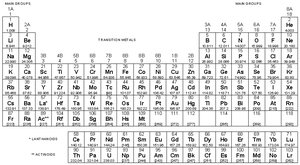
Reference: Periodic Table
The periodic table is a useful reference for atomic numbers, element symbols, and periodic trends relevant to organic chemistry, such as electronegativity and atomic size.