 Back
BackOrganic Chemistry Exam Practice: Reactions, Mechanisms, and Concepts
Study Guide - Smart Notes
 Tailored notes based on your materials, expanded with key definitions, examples, and context.
Q1. How many terminal alkynes have a molecular formula of C5H8?
Background
Topic: Alkynes and Isomerism
This question tests your understanding of structural isomerism in alkynes, specifically terminal alkynes (those with a triple bond at the end of the carbon chain).
Key Terms:
Terminal alkyne: An alkyne where the triple bond is at the end of the carbon chain.
Molecular formula: C5H8 (indicates degree of unsaturation).
Step-by-Step Guidance
Recall that a terminal alkyne has the structure R–C≡CH, where the triple bond is at the end.
Draw all possible carbon skeletons with five carbons and a terminal triple bond.
Check for structural isomers by moving the triple bond and branching the carbon chain, but keeping the triple bond terminal.
Count the unique structures that fit the criteria.
Try solving on your own before revealing the answer!
Final Answer: 2
There are two terminal alkynes with the formula C5H8: 1-pentyne and 3-methyl-1-butyne.
Both have the triple bond at the end of the chain, but differ in their carbon skeleton.
Q2. What is the hybridization of the carbons numbered 1 and 2 in the following compound?
Background
Topic: Hybridization in Organic Molecules
This question tests your ability to identify the hybridization of carbon atoms in a molecule, especially those involved in multiple bonds.
Key Terms:
Hybridization: The mixing of atomic orbitals to form new hybrid orbitals.
sp, sp2, sp3: Types of hybridization based on the number of regions of electron density.
Step-by-Step Guidance
Identify the type of bonds each carbon forms (single, double, triple).
Recall that a carbon in a triple bond is sp hybridized, while a carbon in a double bond is sp2 hybridized.
Assign hybridization to each numbered carbon based on its bonding.
Compare the hybridization types for carbons 1 and 2.
Try solving on your own before revealing the answer!
Final Answer: sp2, sp
Carbon 1 is sp2 hybridized (double bond), and carbon 2 is sp hybridized (triple bond).
Q3. The carbon-carbon triple bond of an alkyne is composed of:
Background
Topic: Bonding in Alkynes
This question tests your understanding of the types of bonds present in a carbon-carbon triple bond.
Key Terms and Formula:
σ (sigma) bond: Formed by head-on overlap of orbitals.
π (pi) bond: Formed by side-on overlap of p orbitals.
Step-by-Step Guidance
Recall that a triple bond consists of one sigma bond and two pi bonds.
Visualize the orbital overlap: one direct (sigma), two sideways (pi).
Count the number of each bond type in the triple bond.
Try solving on your own before revealing the answer!
Final Answer: One σ bond and two π bonds
The triple bond consists of one sigma bond and two pi bonds.
Q4. How many bonds in the following compound are formed by sp-s overlap?
Background
Topic: Bonding and Hybridization
This question tests your understanding of how different hybrid orbitals overlap to form bonds, specifically sp-s overlap.
Key Terms:
sp hybridization: Found in carbons of triple bonds.
s orbital: Found in hydrogen atoms.
sp-s overlap: Occurs when an sp hybridized carbon bonds to a hydrogen atom.
Step-by-Step Guidance
Identify which carbons are sp hybridized in the compound.
Determine which bonds are between an sp hybridized carbon and a hydrogen atom.
Count the number of such bonds in the compound.
Try solving on your own before revealing the answer!
Final Answer: 1
There is one bond formed by sp-s overlap in the compound.
Q5. Draw the major product of the following reaction:
Background
Topic: Reaction Mechanisms and Product Prediction
This question tests your ability to predict the major product of a given organic reaction, based on the reactants and conditions.
Key Terms:
Major product: The most abundant product formed in a reaction.
Reaction mechanism: The stepwise process by which reactants are converted to products.
Step-by-Step Guidance
Identify the type of reaction (e.g., addition, elimination, substitution).
Analyze the reactants and reagents to determine the expected transformation.
Draw the possible products and determine which is the major product based on stability and reaction conditions.
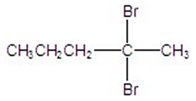
Try solving on your own before revealing the answer!
Final Answer: Structure D
The major product is the one shown in option D, based on the reaction mechanism and stability.
Q6. What is the major product of the following reaction?
Background
Topic: Organic Reaction Mechanisms
This question tests your ability to predict the outcome of a reaction based on the reactants and reagents.
Key Terms:
Major product: The most favored product under the given conditions.
Reaction mechanism: The pathway by which reactants are converted to products.
Step-by-Step Guidance
Identify the reactants and reagents used in the reaction.
Determine the type of reaction (e.g., elimination, substitution, addition).
Draw the possible products and evaluate which is the major product based on the mechanism and stability.
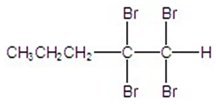
Try solving on your own before revealing the answer!
Final Answer: Structure E
The major product is the one shown in option E, based on the reaction mechanism and product stability.
