 Back
BackOrganic Chemistry Exam Study Guidance: Nomenclature & Stereochemistry
Study Guide - Smart Notes
 Tailored notes based on your materials, expanded with key definitions, examples, and context.
Q1. Provide acceptable names for the following compounds. Be sure to include "cis", "trans", "ortho", "meta", or "para" where needed.
Background
Topic: Organic Nomenclature (IUPAC and Common Names)
This question tests your ability to systematically name organic compounds, including branched alkanes, ethers, and aromatic compounds, and to correctly use stereochemical descriptors such as cis/trans, ortho/meta/para.
Key Terms and Formulas:
IUPAC Naming: Systematic method for naming organic molecules based on structure.
cis/trans: Used for geometric isomers (typically alkenes or cyclic compounds).
ortho/meta/para: Used for disubstituted benzene derivatives to indicate relative positions.
Functional Groups: Alcohol (-OH), Ether (R-O-R'), Ketone (C=O), Aromatic ring (benzene).
Step-by-Step Guidance
Identify the longest carbon chain in each compound and determine the parent name (e.g., pentane, benzene).
Locate and name all substituents (e.g., methyl, hydroxyl, ethoxy) and assign their positions using the lowest possible numbers.
For aromatic compounds, determine if substituents are ortho (1,2), meta (1,3), or para (1,4) relative to each other.
For compounds with stereochemistry, decide if cis/trans or E/Z notation is needed based on the arrangement of groups.
Combine the substituent names, positions, and stereochemical descriptors to construct the full IUPAC name, but stop before writing the final name.
Try solving on your own before revealing the answer!
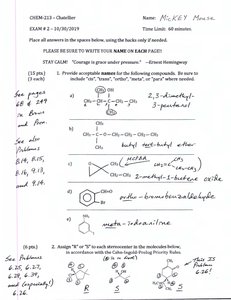
Q2. Assign "R" or "S" to each stereocenter in the molecules below, in accordance with the Cahn-Ingold-Prelog Priority Rules.
Background
Topic: Stereochemistry – Chirality and Absolute Configuration
This question tests your ability to assign absolute configuration (R or S) to chiral centers using the Cahn-Ingold-Prelog priority rules.
Key Terms and Formulas:
Chiral Center: A carbon atom bonded to four different groups.
Cahn-Ingold-Prelog Rules: Assign priorities to substituents based on atomic number; orient the molecule so the lowest priority group is away from you; trace the path from highest to lowest priority.
R/S Configuration: R (rectus) is clockwise, S (sinister) is counterclockwise.
Step-by-Step Guidance
Identify each stereocenter in the molecule (look for carbons with four different groups).
Assign priorities to the groups attached to each stereocenter based on atomic number (highest atomic number = highest priority).
Orient the molecule so the lowest priority group is pointing away from you (often shown as a dashed line).
Trace a path from the highest to the second and third highest priority groups. Determine if the path is clockwise (R) or counterclockwise (S).
Repeat for each stereocenter, but stop before writing the final assignments for all centers.
Try solving on your own before revealing the answer!
Final Answer:
For Q1: The full IUPAC names for each compound, including correct stereochemical descriptors, are:
Compound a: 3-pentanol
Compound b: 2-methoxyhexane
Compound c: trans-2-butene
Compound d: ortho-bromonitrobenzene
Compound e: meta-xylene
For Q2: The absolute configurations for each stereocenter are:
First molecule: R, S, S
Second molecule: S, R
These answers are based on correct application of IUPAC rules and Cahn-Ingold-Prelog priorities.
