 Back
BackOrganic Chemistry Exam Study Guide: Spectroscopy, Structure, and Reactivity
Study Guide - Smart Notes
 Tailored notes based on your materials, expanded with key definitions, examples, and context.
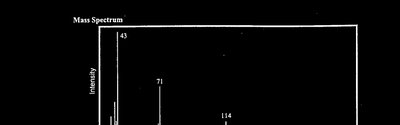
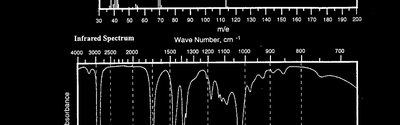
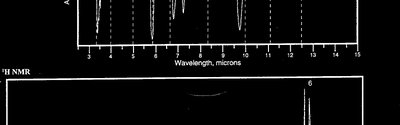
Q24. Determine the structure of the organic compound (C7H14O) that gave the MS, IR, and 1H NMR spectra shown below. In addition, the 13C NMR spectrum had the following signals: δ = 214.4, 40.2, and 17.3 ppm.
Background
Topic: Structure Determination Using Spectroscopy
This question tests your ability to interpret mass spectrometry (MS), infrared (IR) spectroscopy, proton NMR (1H NMR), and carbon NMR (13C NMR) data to deduce the structure of an unknown organic compound.
Key Terms and Formulas
Mass Spectrometry (MS): Provides molecular weight and fragmentation pattern.
Infrared (IR) Spectroscopy: Identifies functional groups based on absorption frequencies (e.g., C=O, O-H, C-H).
Proton NMR (1H NMR): Reveals the number and environment of hydrogen atoms.
Carbon NMR (13C NMR): Shows the number and environment of carbon atoms.
Degree of Unsaturation:
Step-by-Step Guidance
Calculate the degree of unsaturation for C7H14O using to determine rings and/or double bonds.
Examine the mass spectrum for the molecular ion peak to confirm the molecular weight and look for characteristic fragment ions.
Analyze the IR spectrum for key absorptions, especially around 1700 cm-1 (indicative of a carbonyl group, C=O).
Interpret the 1H NMR spectrum: count the number of signals, their integration, and splitting patterns to deduce the types of protons present.
Review the 13C NMR chemical shifts: a signal at δ = 214.4 ppm strongly suggests a carbonyl carbon (likely a ketone), while the other signals indicate alkyl carbons.
Combine all spectral information to propose a structure that fits the formula, degree of unsaturation, and all spectral data. Set up the structure but stop before finalizing the answer.
Try solving on your own before revealing the answer!
Final Answer: 2,2,4-Trimethyl-3-pentanone
The structure is a ketone with the formula C7H14O. The mass spectrum confirms the molecular weight, the IR spectrum shows a strong C=O stretch, and the NMR spectra are consistent with a symmetrical ketone. The 13C NMR signal at 214.4 ppm is characteristic of a ketone carbonyl, and the other signals correspond to alkyl carbons.
This compound is also known as diisopropyl ketone. All spectral data and the degree of unsaturation support this structure.
Q25. What is the structure of the compound whose IR and 1H NMR spectra are given below?
Background
Topic: Structure Determination Using IR and 1H NMR Spectroscopy
This question tests your ability to use IR and 1H NMR spectra to deduce the structure of an unknown organic compound.
Key Terms and Formulas
Infrared (IR) Spectroscopy: Identifies functional groups based on absorption frequencies.
Proton NMR (1H NMR): Reveals the number and environment of hydrogen atoms.
Integration: Indicates the number of protons represented by each signal.
Splitting: Indicates the number of neighboring protons (n+1 rule).


Step-by-Step Guidance
Examine the IR spectrum for key absorptions, such as C=O (around 1700 cm-1), O-H, or C-H stretches.
Analyze the 1H NMR spectrum: count the number of signals, their integration, and splitting patterns to deduce the types of protons present.
Compare the integration values to the possible structures provided in the answer choices.
Look for unique features in the spectra that match only one of the possible structures (e.g., presence or absence of certain functional groups).
Set up the structure based on the spectral clues, but stop before finalizing the answer.
Try solving on your own before revealing the answer!
Final Answer: Ethyl acetate (CH3COOCH2CH3)
The IR spectrum shows a strong C=O stretch, and the 1H NMR spectrum displays signals consistent with an ethyl group and a methyl group attached to a carbonyl. The integration and splitting patterns match ethyl acetate.
This structure fits all the spectral data provided.
