 Back
BackOrganic Chemistry I Final Exam Study Guidance
Study Guide - Smart Notes
 Tailored notes based on your materials, expanded with key definitions, examples, and context.
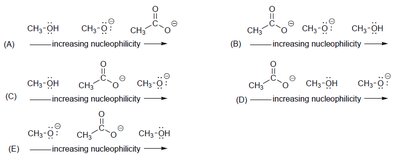
Q1. Choose the answer that has the following nucleophiles correctly arranged with respect to increasing reactivity:
Background
Topic: Nucleophilicity in Organic Chemistry
This question tests your understanding of how nucleophiles are ranked based on their reactivity, which is influenced by charge, electronegativity, and solvent effects.
Key Terms and Concepts:
Nucleophile: A species that donates an electron pair to form a new covalent bond.
Nucleophilicity: The relative reactivity of a nucleophile in a substitution reaction.
Factors affecting nucleophilicity: Charge (anions are more nucleophilic than neutrals), electronegativity (less electronegative atoms are more nucleophilic), and solvent effects.
Step-by-Step Guidance
Examine the structures in each answer choice and identify the charge and atom type for each nucleophile.
Recall that negatively charged species (anions) are generally more nucleophilic than their neutral counterparts.
Consider the effect of electronegativity: less electronegative atoms (like oxygen in alkoxides) are more nucleophilic than more electronegative atoms (like oxygen in water).
Arrange the nucleophiles from least to most nucleophilic based on these principles.
Try solving on your own before revealing the answer!
Final Answer: (C) CH3OH < CH3CO2- < CH3O-
The order is based on increasing nucleophilicity: neutral alcohol < carboxylate anion < alkoxide anion.
Alkoxide is the most nucleophilic due to its negative charge and lower resonance stabilization compared to carboxylate.
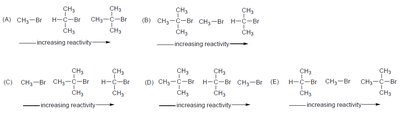
Q2. Choose the order that has the following alkyl bromides correctly arranged with respect to increased reactivity in an SN2 reaction:
Background
Topic: SN2 Reaction Mechanism
This question tests your ability to rank alkyl bromides based on their reactivity in SN2 reactions, which are sensitive to steric hindrance.
Key Terms and Concepts:
SN2 Reaction: A bimolecular nucleophilic substitution reaction.
Steric hindrance: The presence of bulky groups near the reactive center slows down SN2 reactions.
Primary, secondary, tertiary alkyl halides: Reactivity decreases as the carbon bearing the leaving group becomes more substituted.
Step-by-Step Guidance
Identify the degree of substitution (primary, secondary, tertiary) for each alkyl bromide.
Recall that SN2 reactions are fastest with primary alkyl halides and slowest with tertiary alkyl halides.
Arrange the compounds from least to most reactive based on steric hindrance.
Check the answer choices for the correct order.
Try solving on your own before revealing the answer!
Final Answer: (C) (CH3)3CBr < CH3CH2CH(CH3)Br < CH3CH2Br < CH3Br
Primary bromides are most reactive in SN2, tertiary are least due to steric hindrance.
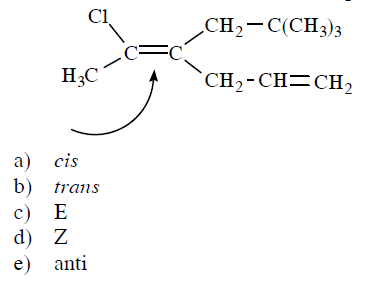
Q3. What is the best way to describe the stereochemistry of the double bond indicated in the compound below?
Background
Topic: Alkene Stereochemistry (E/Z, cis/trans)
This question tests your ability to assign the correct stereochemical descriptor to a double bond based on the priority of substituents.
Key Terms and Concepts:
E/Z notation: Used for alkenes with different substituents; E (entgegen) means highest priority groups are on opposite sides, Z (zusammen) means they are on the same side.
Cis/trans notation: Used for simple alkenes; cis means same side, trans means opposite sides.
Assigning priority: Use Cahn-Ingold-Prelog rules to determine which substituents have higher priority.
Step-by-Step Guidance
Identify the substituents attached to each carbon of the double bond.
Assign priorities to the substituents on each carbon using atomic number.
Determine whether the highest priority groups are on the same side (Z) or opposite sides (E).
Match your result to the answer choices provided.
Try solving on your own before revealing the answer!
Final Answer: (c) E
The highest priority groups are on opposite sides of the double bond, so the correct descriptor is E.
